Bicycle Light Buying Guide: Front Light Lumen Requirements and Safety Considerations for Rear Light Flashing Modes
Choosing Bike Lights: Front Light Lumen Requirements and Rear Light Flashing Mode Safety Considerations
Bike lights are often the most overlooked item on the gear list—until one night after dark on a descent, when you realize that “bike light” from the convenience store is nowhere near enough to illuminate the downhill road ahead. This article starts from practical needs to help you choose a front and rear light combo that truly protects you.
Taiwan Regulations: Lights Are Required by Law
According to Article 79 of the Road Traffic Safety Regulations, when riding at night or in poor visibility, bicycles must be equipped with:
- White light at the front: visible from 100 meters ahead
- Red light at the rear: visible from 100 meters behind
Although daytime riding is not explicitly regulated, many cyclists in Taiwan have developed the habit of running flashing lights during the day, effectively improving visibility.
Front Light Lumen Buying Guide
| Riding Scenario | Recommended Minimum Lumens | Notes |
|---|---|---|
| Urban night riding (ample streetlights) | 200–400 lm | Main purpose is to be seen by oncoming traffic |
| Suburban night riding (sparse streetlights) | 600–900 lm | Self-illumination is the priority |
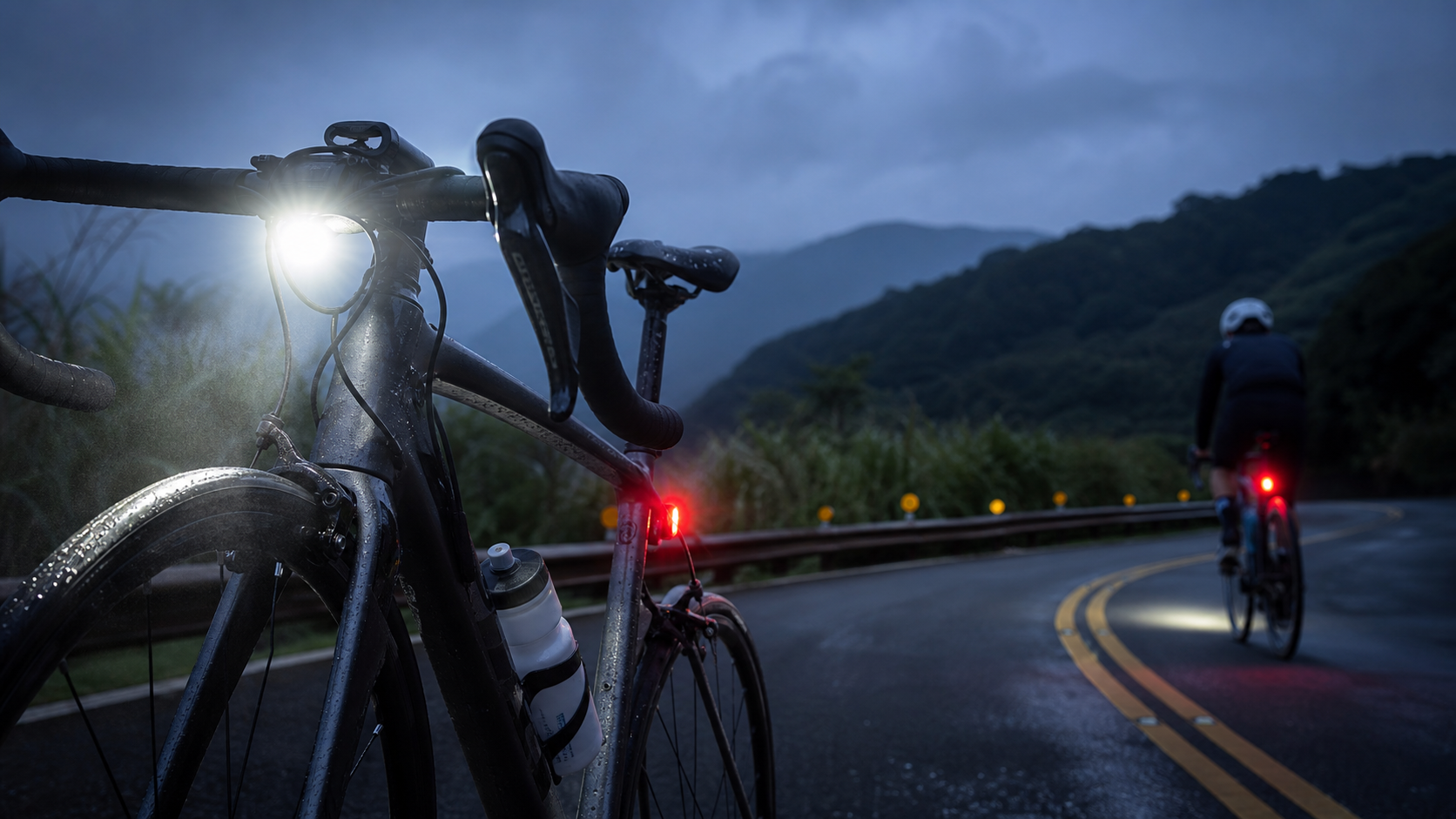
| Mountain descent night riding | 1,000–1,500 lm | Wide beam needed for cornering visibility |
| Daytime flashing | 100–300 lm (flashing mode) | Be proactively seen |
| Night riding in bad weather (fog, rain) | 800–1,200 lm | Fog scatters light, requiring higher lumens |
Lumens aren’t the only metric: Beam shape matters just as much. A “spot beam” is suited for seeing far ahead on straight roads; a “flood beam” is better for mountain descents to read the road surface. Many high-end front lights offer a hybrid beam (such as the Lezyne Mega Drive), covering both needs.
Rear Light Buying Guide: The Science of Flashing Modes
The rear light’s core mission is to “make drivers behind you see you,” not to illuminate the road. Therefore, the logic behind choosing a rear light is completely different from a front light.
Visual effect of flashing modes: The human eye responds more acutely to “dynamic” stimuli than “static” ones. Flashing lights—especially irregular flashing patterns—are visually more likely to catch the attention of drivers behind you, particularly in bright daytime conditions. Studies show that a daytime flashing rear light can increase the distance at which drivers notice a cyclist by approximately 30%.
Comparison of rear light flashing modes:
- Steady mode: Low battery consumption, meets basic regulatory requirements
- Regular flashing: Standard 1–2Hz flashing, the most common, suitable for primary nighttime use
- Pulse flashing: A cycle of gradually brightening then dimming, considered the most attention-grabbing mode
- Random flashing: Irregular flash frequency; studies show it works best for daytime use
Lumen recommendations: Rear lights don’t need high lumen output, but “visibility angle” matters. Choose a rear light with a side visibility angle exceeding 220° so you can be seen at intersections or by vehicles approaching from the side.
Major Brand Comparison
Cateye (Japan):
The most common brand in Taiwanese bike shops, with a wide service network and easy maintenance. The Volt 800 front light (800lm) paired with the Rapid X3 rear light is one of the best-selling combos in Taiwan.
Lezyne (USA):
Known for metal housings and excellent build quality. The Mega Drive 1400 XL delivers 1,400lm and is a mainstream choice for mountain night riding.
Knog (Australia):
Design-driven, especially the Blinder rear light series, known for stylish looks—ideal for urban riding.
Magicshine (China):
Extremely high lumen output at a relatively accessible price. Front lights above 1,000lm are widely popular in the mountain bike (MTB) community, and road cyclists are gradually switching over as well.
Battery Type: Rechargeable vs. Disposable
- Rechargeable (USB charging): Lower long-term cost, eco-friendly, suitable for daily use. Just make sure it’s fully charged before every ride.
- Replaceable battery (AA/AAA): A safety net for long-distance rides—you can top up at any convenience store. Ideal for island tours or multi-day trips.
- External battery packs: Suitable for extremely high-lumen (2,000lm+) MTB night-riding lights; less common for everyday road cycling.
Mounting Options and Handlebar Compatibility
Road handlebars in Taiwan range from 23mm (traditional aluminum) to 31.8mm (modern standard). Confirm the clamp diameter your light mount supports before purchasing. Lights compatible with computer out-front mounts (GoPro standard) can be mounted on the stem mount to save handlebar space.
Practical Buying Recommendations
Basic safety combo (NT$1,500–3,000):
- Front light: Cateye Volt 400 or equivalent 400lm+ rechargeable
- Rear light: Cateye Rapid X2 or similar 70lm+ rear light
Mountain / night-riding enhanced combo (NT$3,000–6,000):
- Front light: Lezyne Mega Drive 1400 or Magicshine Allty 1000
- Rear light: Cateye Rapid X3 or Knog Blinder Road 170
Conclusion
Lights are among the most life-protecting pieces of cycling gear, yet they’re often the last thing people buy. The visibility demands of night riding on Taiwan’s mountain roads far exceed those of urban commuting. Choose a front light with sufficient lumens based on your most common riding scenario, and build the habit of running your rear light in flashing mode even during the day. That small habit might just save you from a serious accident at a busy intersection.
Related Reading
- Choosing Bike Lights: Front Light Lumens and Rear Light Visibility Standards
- Bike Light Buying Guide: Lumens, Beam Angle, and Regulatory Requirements
- The Complete Bike Light Buying Guide: Lumens, Taiwan Regulations, and Night Riding Safety Needs
- Bicycle Light Buying Guide: Illumination Solutions for Safe Riding in the Dark
再快都跟的上!? 單車跟隨攝影機之王 HOVERAir X1 PROMAX 全面實測 / 唯一!8K畫質&自行車專用模式和跟蹤信標&前後避障 / DJI Neo 可參考/ 公路車 / CT Yeh
1 年前
趣味單車配件:多功能智慧尾燈 / 有方向燈 可app編輯圖案!? / GRC x Lumii 聯名款 / 公路車 CT Yeh
9 個月前
雷達尾燈 雷不雷? 邁金L508 智慧雷達尾燈 情境考驗實測 | 同場加映 2千元等級的專業車錶 C406 Pro | 公路車 | CT Yeh
3 年前
單車 一日北高 ( 雙城 ) 肥宅雙人瘋狂行 紀錄片 REACTO
10 年前
2025 自行車錶排行榜 兩萬車友大數據 / Garmin Bryton 排名會大洗牌嗎? / 全新的碼表前身分析 /公路車 / CT Yeh
1 年前
多到選擇障礙... 換個單車把帶想一個小時 / BTP / 編織&軟木特有材質超吸睛! / 公路車 / CT Yeh
1 年前
4K單車實境) 舊陽金P字道 第1P 仰德大道至小油坑 誤跟武嶺神人們 被拉爆爽飛天 Taiwan Cycling Climb Route Recommend
7 年前
#公路車 #Fitting 靠人工智慧APP 幫你調整單車
6 年前