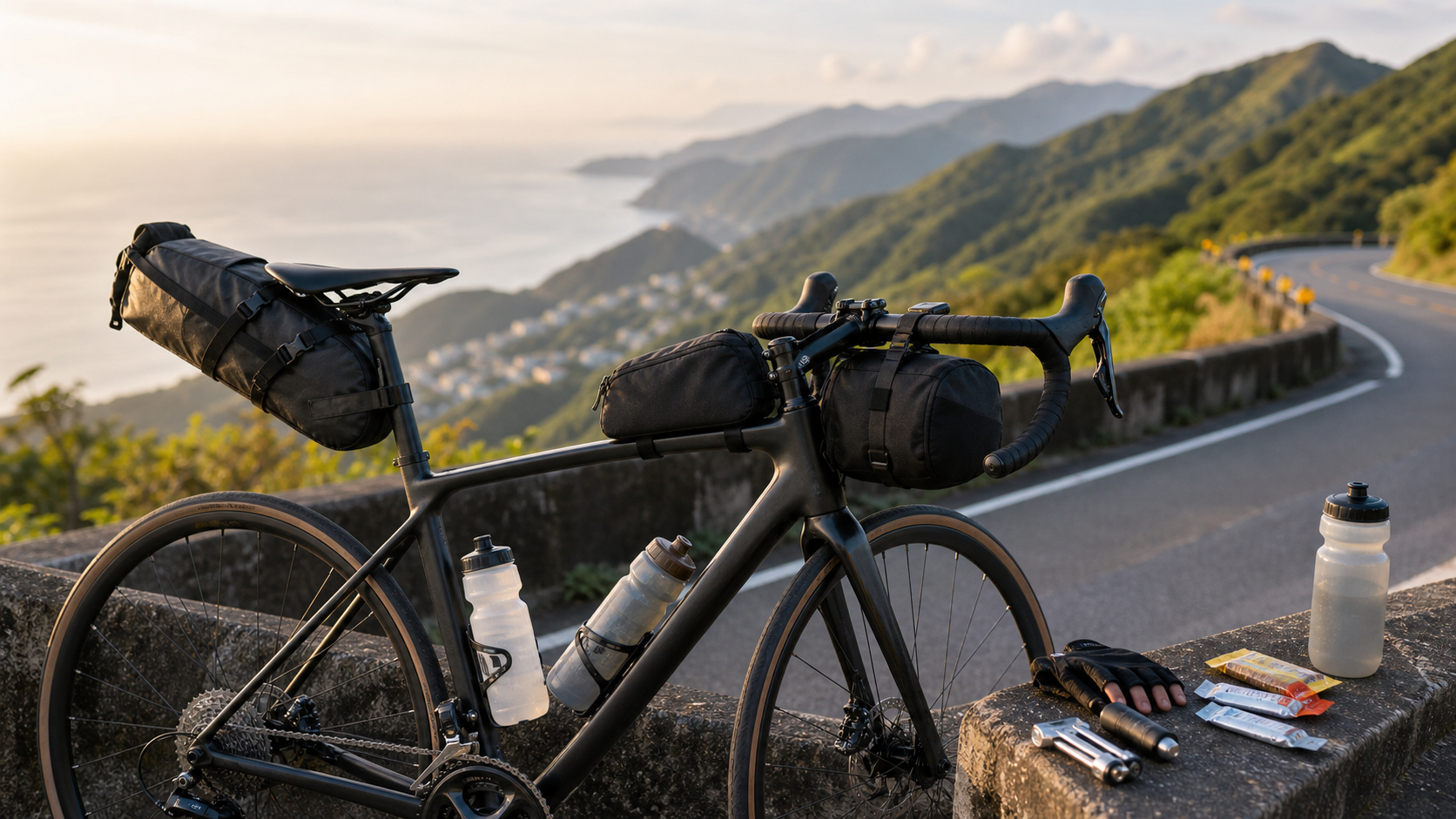
Cycling Storage Bag Buying Guide: Top Tube Bag vs Handlebar Bag vs Saddle Bag Capacity and Weight
Anyone who has done long-distance riding knows one thing: the accessibility of your nutrition determines whether you can maintain a steady energy intake. When items are stored in the hardest-to-reach place, riders tend to delay eating, resulting in insufficient energy. This article starts from real-world usage scenarios to help you find the storage bag setup that best suits your riding style.
Overview of Three Storage Bag Types
| Type | Capacity Range | Ease of Access | Weight Impact | Aerodynamic Impact | Suitable Riding Types |
|---|---|---|---|---|---|
| Top Tube Bag | 0.3–1.5L | Best | Low | Low | Day rides, racing, quick refueling |
| Handlebar Bag | 0.5–6L | Good | Low–Medium | Medium | Long-distance touring, ultra-distance |
| Saddle Bag | 0.5–16L | Poor | Low–High | Low | Ultra-distance, touring, repair tools |
Top Tube Bag: The Fastest-Access Storage Position While Riding
The Top Tube Bag is mounted between the top tube and the stem, and is the only position where you can access items without lifting your head or reaching behind your back while riding. Common energy gels, energy bars, and folded paper maps in Taiwan can be stored in the top tube bag and accessed at any time.
Best use cases for top tube bags:
- Riders who follow a rhythm of refueling every 30–45 minutes
- Challenging long climbs like Wuling or Taipingshan, where you need to refuel without stopping
- Dual-purpose bags for holding a phone (for navigation) or snacks
Buying considerations:
- Attachment method: Velcro-secured models fit most bike frames; frame bags are designed specifically for certain bike models’ top tubes, offering more stability but lower compatibility.
- Waterproof rating: Taiwan’s summer afternoon thunderstorms are frequent, so choose a model with at least IPX4 water resistance, or prepare a waterproof liner bag.
- Width limit: An overly wide top tube bag may interfere with knee pedaling motion; it’s recommended that the maximum width not exceed 100mm.
Handlebar Bag: The Capacity Workhorse for Long-Distance Touring
The Handlebar Bag is mounted on the handlebars or a handlebar extension rack at the front of the bike, and is the favorite storage choice for long-distance touring riders. Capacity ranges from 0.5L (small tool bag) to 6L (half-day nutrition plus light luggage).
Weight distribution advantage of handlebar bags: Front-end weight is concentrated in a low-center-of-gravity position, which has less impact on bike handling than a rear saddle bag, making descending more responsive. For round-island tours or multi-day rides, a handlebar bag can carry the day’s nutrition and a change of clothes.
Buying notes:
- Handlebar/extension rack compatibility: Confirm that the handlebar diameter (31.8mm is the mainstream standard) matches the clamping mechanism of the handlebar bag
- Front wheel wobble when loaded: When carrying over 2kg, the front-end weight becomes noticeable when cornering; first-time users need time to adapt
- Waterproof design: The biggest fear on long tours is rain soaking your change of clothes or electronic devices; a waterproof handlebar bag is a necessary investment
Recommended setup for Taiwan round-island tours: The Apidura Racing Handlebar Pack 5L is currently a highly regarded model—compact in design without compromising front-end weight feel, and offers good waterproofing.
Saddle Bag: The Storage Room for Repair Tools and Spare Gear
The Saddle Bag hangs between the seatpost and saddle rails beneath the saddle, and is the most common choice for storing repair tools. From mini models that hold a single inner tube to oversized versions (16L+) that can fit an entire change of clothes, the use cases vary enormously.
Saddle bag attachment methods:
- Traditional strap-clamp type: Secured with Velcro straps around the seatpost and saddle rails; easiest to install but may have slight wobble on long distances
- Strap System: Dedicated mounting straps with better stability, such as mid-to-high-end models from Ortlieb and Topeak
- Quick-release system (QR): Such as Specialized SWAT, requires a compatible saddle, but offers the fastest removal—convenient for both racing and day rides
Essential repair tool checklist (standard saddle bag contents):
- Spare inner tube × 1–2
- Patch kit + sandpaper
- Hex wrench set (3/4/5/6mm)
- Mini pump (or CO2 cartridges × 2)
- Quick link × 2
- Emergency phone power bank (optional)
Combination Strategies
Day rides of 50–100 km:
- Top tube bag (for nutrition) + Small saddle bag (tools and spare tube)
- Hydration via bottle cages; no handlebar bag needed
Long one-day rides of 150–200 km:
- Top tube bag (for high-frequency refueling access) + Medium saddle bag (tools + an extra spare tube + a jacket)
Round-island or multi-day tours:
- Handlebar bag 4–6L (daily clothing + nutrition) + Large saddle bag (tools + spare gear)
- If not using luggage transfer services, consider adding a rear rack or pannier bags
Weight vs. Aerodynamics Trade-offs
The added weight of storage bags does affect climbing, but for most non-racing riders, the energy saved by having nutrition available outweighs the cost. The aerodynamic impact mainly comes from the increased frontal and side area of handlebar bags and saddle bags, and is only noticeable at sustained speeds above 40km/h. Racing riders can consider using the rear pockets of a tight-fitting jersey instead of storage bags, but for rides exceeding 3 hours, the capacity advantage of storage bags remains irreplaceable.
Conclusion
There is no one-size-fits-all solution when it comes to storage bags—it depends on your riding distance, refueling strategy, and gear needs. We recommend starting with the most basic saddle bag (for repair tools), then gradually adding a top tube bag or handlebar bag based on your actual refueling access experience during rides. Once you find the right storage bag combination, your long-distance riding experience will improve dramatically.
Related Reading
- Complete Review of Cycling Storage Bag Types: Triangle Bag, Saddle Bag, and Top Tube Bag Capacity and Accessibility Comparison
- Cycling Storage Bags and Bike Packs Buying Guide: Triangle Bag, Saddle Bag, and Top Tube Bag Capacity and Use Cases
- Bike Storage Bags and Backpacks Buying Guide: Triangle Bag, Saddle Bag, and Hydration Backpack Full Analysis
- In-Depth Review of Bike Saddle Bags: Capacity, Waterproofing, and Mounting Stability Comparison
多到選擇障礙... 換個單車把帶想一個小時 / BTP / 編織&軟木特有材質超吸睛! / 公路車 / CT Yeh
1 年前
單車 一日北高 ( 雙城 ) 肥宅雙人瘋狂行 紀錄片 REACTO
10 年前
大家都在開箱的...單車用藍芽對講耳機真的有幫助嗎? SENA BiKom 20 長距離旅遊 & 海鷗繞圈賽 實際體驗心得 / 公路車 / CT Yeh
9 個月前
靠單車減肥35公斤 心得分享與整理
7 年前
一日北高前的高裝檢 | 北高 360 | 挑戰11小時的裝備 | 一日雙塔 | 補給
6 年前
詳測) 小米 電動打氣筒 公路車胎要充多久? 值得買嗎? 米家充氣寶 小心燙手!
7 年前
風櫃嘴! 現實與虛擬騎乘 會有誤差嗎? 背著iPad邊騎一趟風櫃嘴實際測試一次 | 公路車 | CT Yeh
3 年前
再一組! 全碳幅條 碟煞/無內胎輪組 開箱! 到底好騎嗎? UNAAS X40 | 公路車 | CT Yeh
4 年前