Cycling Glove Buying Guide: Short-Finger vs Long-Finger, and How Gel Pad Thickness Affects Long-Distance Rides
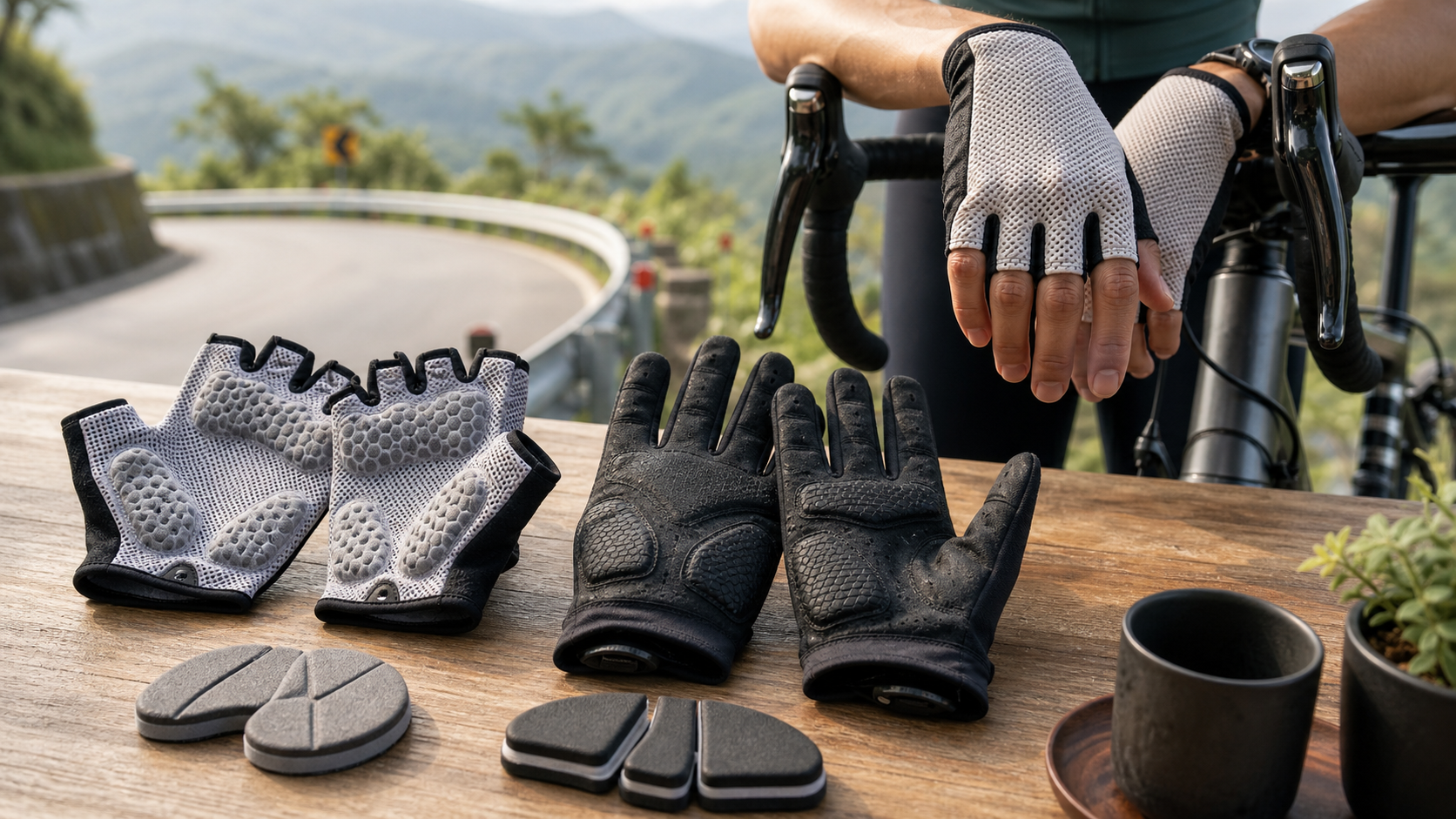
Choosing Cycling Gloves: Short-Finger vs Long-Finger, and the Impact of Gel Padding Thickness on Long Distances
Many riders don’t give gloves a second thought when putting together their gear list—until they finish a 120 km ride with numb hands and sore wrists, only to realize that a thin pair of cotton gloves simply can’t handle the road vibration over long distances. This article covers materials, design, and the science of vibration damping to help you choose gloves suited to Taiwan’s four seasons and various riding intensities.
Glove Type Selection Matrix
| Type | Suitable Temperature | Gel Padding Thickness | Breathability | Best Use Cases |
|---|---|---|---|---|
| Short-finger, thin | 18–35°C | 2–4mm | Excellent | Summer training, racing |
| Short-finger, thick (reinforced gel) | 18–30°C | 6–10mm | Good | Long day rides, ultra-distance |
| Long-finger, thin | 10–20°C | 2–5mm | Good | Autumn/spring, early morning departures |
| Long-finger, thick (insulated) | 0–15°C | 3–6mm | Poor | Winter, mountainous areas in northern Taiwan |
| Full-finger, waterproof | 0–15°C (rainy) | 2–4mm | Poor | Rain riding, winter Wuling rides |
Short-Finger Gloves: The Mainstream Choice for Taiwan’s Summer
From April to November, temperatures in most parts of Taiwan are above 20°C, making short-finger gloves the everyday choice for the vast majority of riders. Their advantage lies in ventilation and heat dissipation, keeping palms from slipping due to sweat and maintaining a stable grip on the handlebar.
Material options for short-finger gloves:
- Mesh back of hand: Best breathability, ideal for high-intensity flatland training in summer
- Lycra stretch fabric: Excellent fit, commonly found in racing gloves
- Leather/synthetic leather palm: Best abrasion resistance, protects the palms in a crash; however, breathability is poor
The importance of crash protection: The abrasion-resistant palm material on short-finger gloves is an important safety feature. When crashing, the natural instinct is to reach out with your hands to break the fall. If the glove palm lacks abrasion-resistant material, the skin on your palms can be severely abraded. All riders are advised to use gloves with palm protection.
Gel Padding Thickness: Thicker Isn’t Always Better
The high-frequency vibration transmitted through the road surface (gravel roads, asphalt cracks) and low-frequency impacts (potholes, the road seams commonly found in Taiwan) are the main causes of numb palms and wrist fatigue. Gel padding protects the nerves in your hands by absorbing these vibrations.
Logic for choosing gel thickness:
-
2–4mm (thin gel): Suitable for racing or high-intensity training, providing basic protection without compromising feel, feedback, or handling sensitivity. Professional riders generally prefer thin gloves because they get more direct sensory feedback from the bike’s dynamics.
-
5–8mm (standard gel): Suitable for recreational long rides of 50–150 km, striking a balance between comfort and control. The standard daily distance of a Taiwan round-island tour (90–120 km per day) suits this thickness.
-
8mm and above (thick gel): Suitable for ultra-long distances exceeding 200 km, or areas with poor road quality (such as certain provincial highways in eastern Taiwan). However, overly thick gel can cause friction between the skin and the gel, potentially leading to blisters over long distances.
Design differences in gel placement: High-quality cycling gloves feature asymmetrical gel distribution targeting the “pressure points” of the palm—the ulnar nerve pressure zone (the area near the wrist on the little-finger side of the palm) is the most prone to numbness during long rides. Choosing a design with reinforced gel in this area can noticeably improve numbness issues.
Long-Finger Gloves: Essential for Taiwan’s Mountainous Areas in Autumn and Winter
Winter mornings in northern Taiwan’s mountainous regions (such as Yangmingshan and the Northern Cross-Island Highway) can drop to 5–8°C, and Wuling or Hehuan Mountain can even approach below 0°C in winter. Long-finger gloves are essential gear for these routes.
Insulation technologies for long-finger gloves:
- Fleece lining: The most common insulation method—lightweight but with limited warmth, suitable for temperatures above 10°C
- Windproof membrane: Blocks the cold wind generated at high speed on descents, a core requirement for riding in 0–10°C
- Waterproof membrane: Essential protection for riding in the rain, but with poor breathability, hands can become stuffy and sweaty during prolonged use
Standard gear for Wuling: Riders summiting Wuling (elevation 3,275 m) are advised to carry windproof long-finger gloves and switch to them near the summit. Winter Wuling challenges may even require snow gloves.
Brand Recommendations (Common in the Taiwan Market)
Castelli (Italy): Known for aerodynamic design; the Entrata V Glove is a well-regarded entry-level option.
Pearl Izumi (Japan/US): More consideration given to Asian head and hand shapes, offering excellent fit, with comprehensive service from Taiwan distributors.
Giro (US): The Strade Dure series is designed for long distances with sensible gel distribution, earning praise from many round-island riders.
Shimano gloves: An affordable choice that pairs well with Shimano groupsets, with consistent quality and wide availability at bike shops across Taiwan.
Sizing, Cleaning, and Maintenance
Glove sizing: Measure the widest point across the four fingers (index to little finger) of your dominant hand and compare against each brand’s size chart. Gloves that are too large create wrinkle pressure points when gripping the handlebar; gloves that are too small restrict blood circulation and accelerate hand numbness.
Cleaning recommendations: Gloves should be washed regularly (approximately every 3–5 rides), either by hand in cold water or in a washing machine inside a laundry bag, then air-dried naturally. Gel padding layers cannot withstand high temperatures—never use a dryer.
Conclusion
A good pair of gloves isn’t just about comfort—it’s an investment in fatigue management and safety protection. Riders in Taiwan are advised to have at least two pairs of gloves: a summer short-finger gel model (for daily training) and a winter long-finger windproof model (for cold mountain roads). When purchasing, prioritize gel placement design, and find a gel distribution that matches your pressure points—the comfort of long-distance riding will improve significantly.
Related Reading
- Road Cycling Glove Buying Guide: Long-Finger vs Short-Finger and the Myths of Vibration-Damping Gel
- Cycling Glove Buying Guide: Full Analysis of Seasonal Suitability and Functional Differences Between Short-Finger and Long-Finger Gloves
- Bike Glove Buying Guide: Full-Finger vs Half-Finger, Cushioning, and Summer/Winter Differences
- Complete Cycling Glove Comparison: Half-Finger vs Full-Finger, Materials, Padding, and Buying Guide
大家都在開箱的...單車用藍芽對講耳機真的有幫助嗎? SENA BiKom 20 長距離旅遊 & 海鷗繞圈賽 實際體驗心得 / 公路車 / CT Yeh
9 個月前
多到選擇障礙... 換個單車把帶想一個小時 / BTP / 編織&軟木特有材質超吸睛! / 公路車 / CT Yeh
1 年前
2025 自行車錶排行榜 兩萬車友大數據 / Garmin Bryton 排名會大洗牌嗎? / 全新的碼表前身分析 /公路車 / CT Yeh
1 年前
單車 一日北高 ( 雙城 ) 肥宅雙人瘋狂行 紀錄片 REACTO
10 年前
超開放的自行車錶!可以玩遊戲裝APP!?/ SRAM合併的 Hammerhead Karoo深入開箱!/ 即時爬坡偵測 / 全球導航地圖 / Garmin Bryton / CT Yeh
1 年前
鉅齒紋輪組!? ControlTech MEG-T50 EVO 碳纖維幅條輪組/ 功率對比實驗 / 公路車 / CT Yeh
2 年前
#公路車 #Fitting 靠人工智慧APP 幫你調整單車
6 年前
3D 列印車褲墊 / 舒適改善? / 無痕 x 分區壓縮 / ATK & Decider系列 / JE22黑科技 / #公路車 #CTYEH
11 個月前