Cycling Bib Shorts Buying Guide: The Logic of Choosing Between Chamois Thickness and Fabric Compression Level
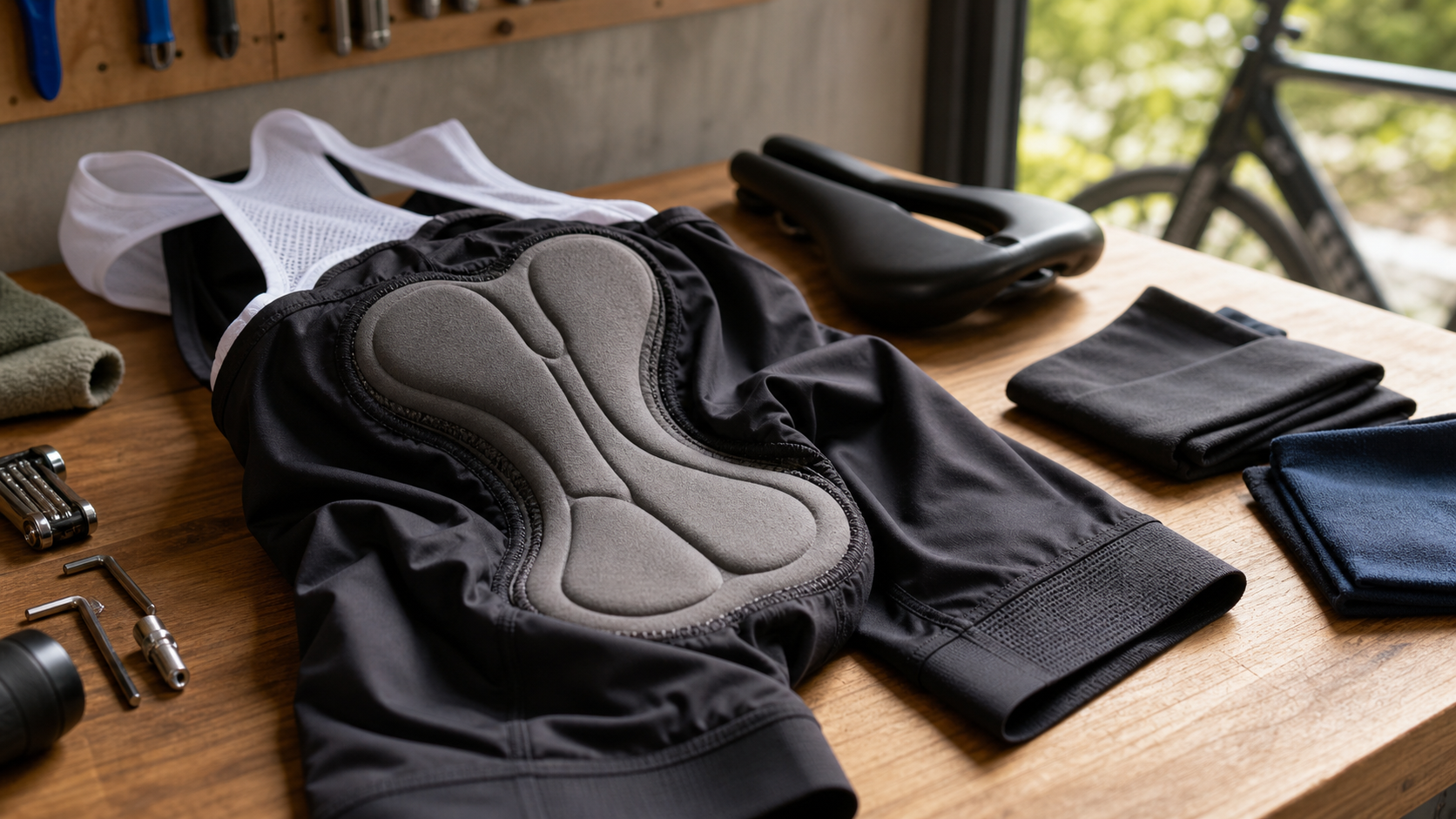
Cycling Bib Shorts Buying Guide: The Logic of Choosing Between Chamois Thickness and Fabric Compression Level
A good pair of cycling bib shorts is the only cushioning layer between the rider and the saddle. Choose wrong, and you’ll face discomfort at best, or at worst, wounds caused by sit-bone pressure and skin friction that turn every ride into a painful ordeal. This article systematically breaks down how to choose the cycling shorts that best suit you, from chamois design to fabric technology.
Types of Cycling Shorts and Suitable Scenarios
| Type | Compression Level | Chamois Position | Suitable Distance | How to Wear |
|---|---|---|---|---|
| Bib Short | High | Hip | 50–300km | Racing/Training |
| Bib Tight | Medium–High | Hip | 50–200km | Autumn/Winter |
| Casual Cycling Shorts | Low | Hip | 30–80km | Leisure/City |
| Liner Shorts with Pad | None (pad only) | Hip | Worn under outer shorts | Travel/Dual-purpose |
Chamois Material and Thickness Analysis
The chamois is the most critical technology in cycling shorts. Its function is to distribute the concentrated pressure on the sit bones and protect the skin during repeated friction against the saddle.
The two main chamois materials:
- Natural chamois leather: A traditional craft, now largely replaced by synthetic materials, though a few high-end products still use it
- Synthetic foam: The modern mainstream choice, allowing precise control of density distribution and offering greater design flexibility
Chamois Thickness vs. Recommended Riding Distance:
-
4–6mm (Thin): Suitable for 30–80 km training rides with high cadence. Thin pads allow the rider to feel the saddle’s dynamics more directly, which helps in technical riding. Race competitors prefer thin pads because there is less friction between the hips and the saddle.
-
6–10mm (Standard): The most mainstream choice in Taiwan, suitable for daily rides of 80–150 km. It strikes a balance between protection and sensory feedback, and most brands’ flagship models fall within this thickness range.
-
10–15mm (Thick): Suitable for long distances exceeding 150 km or multi-day tours. Thick pads delay the accumulation of sit-bone fatigue, but the sensation during pedaling is less precise.
Key Concept: A thicker pad is not necessarily better. An overly thick pad can create extra friction at the inner thigh, actually causing chafing wounds. A common mistake beginners make is choosing the “thickest pad” while overlooking whether the pad’s shape matches their own pelvic structure.
Gender Differences in Chamois Shape
Men and women have different pelvic structures and sit-bone spacing, so cycling shorts are clearly divided into men’s and women’s models:
- Women’s chamois: Wider sit-bone support area, different design for the perineal pressure zone, and a narrower front
- Men’s chamois: Designed and optimized for male anatomy, preventing numbness in specific areas during long rides
Be sure to choose the model corresponding to your gender when purchasing; otherwise, even the best chamois cannot provide effective protection.
Benefits of Fabric Compression Levels
Modern cycling shorts fabrics mostly use elastic fibers (such as Lycra) and offer varying degrees of compression.
The three main benefits of compression:
- Muscle stability: High-compression fabrics reduce excess vibration in the thigh muscles during pedaling, theoretically slowing the accumulation of lactate
- Venous return: Compression design promotes venous blood flow from the legs back to the heart, reducing leg swelling after long distances
- Fit: High-compression fabrics wrap the leg shape more tightly, reducing relative friction between the fabric and the skin
Recommendations for Choosing Compression Levels:
- Low compression (casual models): Comfortable to wear, no need for a fully tight fit, suitable for city riding
- Medium compression (training models): Provides muscle support without restricting blood flow, suitable for general training
- High compression (race models): Strongest muscle support and aerodynamic fit; wearing for more than 8 hours continuously may cause a feeling of pressure in the legs
Bib vs. Traditional Waistband Design
Bib (Bib Short): Secured by shoulder straps, eliminating the pressure of a waistband. The chamois position is more stable, and comfort on long rides is far superior to waistband designs. Most serious riders prefer bib design.
Disadvantages: When stopping to use the restroom, you must completely remove your jersey to take care of business—an inconvenience on long rides (some brands offer detachable straps to solve this problem).
Waistband style: Easy to take off, suitable for scenarios requiring frequent dismounts or urban commuting.
Budget Recommendations
- Under NT$1,500: Entry-level cycling shorts, suitable for one to two short rides per week; chamois and fabric quality are limited
- NT$1,500–4,000: Mid-range models, training shorts from mainstream brands; chamois design is already quite good and suitable for a Taiwan round-island tour
- NT$4,000–10,000: High-end models, race-grade chamois, high-compression fabrics; flagship products from Castelli, Rapha, and Assos
- Above NT$10,000: Top-tier race models, such as Assos T.cento, pursuing perfection in every detail; suitable for riders training at a professional intensity
Conclusion
The logic of choosing cycling shorts is to “first find a chamois shape that fits your hip anatomy, then consider compression level and fabric quality.” For your first purchase, we recommend visiting a physical bike shop that offers fitting services. Put on the shorts and simulate your pedaling position to confirm that your sit bones land correctly on the chamois’s support area. A good pair of cycling shorts is the most important comfort investment for long-distance riding.
Related Reading
- Cycling Bib Shorts Buying Guide: Saddle Material and Thickness Standards
- The Complete Guide to Choosing a Bicycle Saddle: Say Goodbye to the Pain and Nightmares of Long Rides
- The Science of Bicycle Saddle Selection: A Complete Guide to Pressure Distribution, Sit-Bone Width, and Materials
- The Science of Road Bike Saddle Selection: Analysis of Shape, Material, Sit-Bone Width, and Pressure Mapping
Nepest NOVA 碳條輪組:輕量、空力、舒適一次滿足!/ 公路車 / CT Yeh
7 個月前
靠單車減肥35公斤 心得分享與整理
7 年前
3D 列印車褲墊 / 舒適改善? / 無痕 x 分區壓縮 / ATK & Decider系列 / JE22黑科技 / #公路車 #CTYEH
11 個月前
多到選擇障礙... 換個單車把帶想一個小時 / BTP / 編織&軟木特有材質超吸睛! / 公路車 / CT Yeh
1 年前
#公路車 #Fitting 靠人工智慧APP 幫你調整單車
6 年前
訓練台體驗) 2019台北自行車展 三大家 訓練台體驗 Tacx Neo Flux 2 Xepdo Apx Wahoo Kickr
7 年前
再一組! 全碳幅條 碟煞/無內胎輪組 開箱! 到底好騎嗎? UNAAS X40 | 公路車 | CT Yeh
4 年前
單車 一日北高 ( 雙城 ) 肥宅雙人瘋狂行 紀錄片 REACTO
10 年前