Building an Aerobic Base in Swimming: Heart Rate Zones and Training Benefits of Long-Distance Slow Swimming
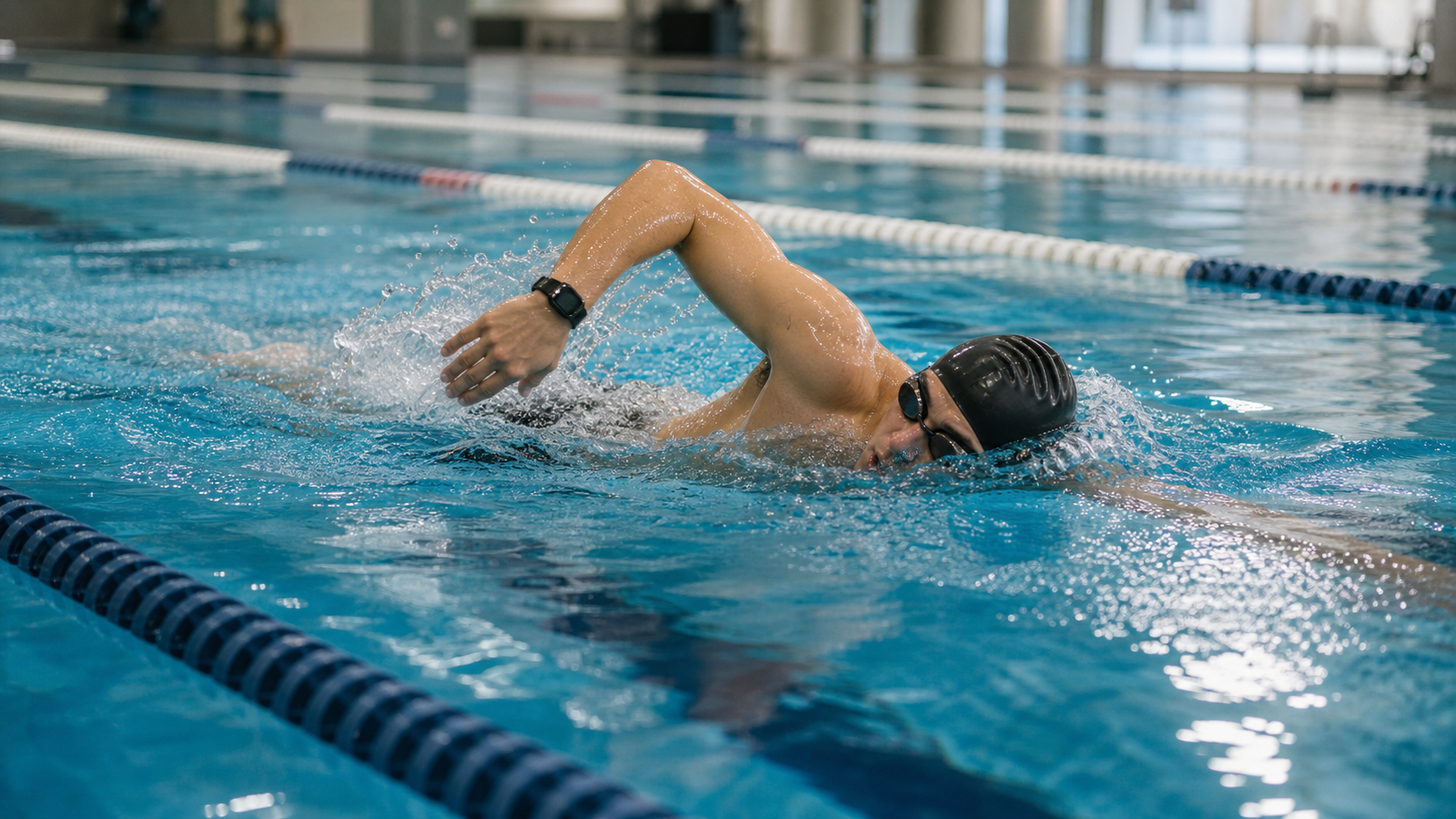
The Science of Slow Swimming: Why Deliberately Slow Down?
In any swimming pool, you can observe a phenomenon: the strongest swimmers often appear to swim “effortlessly,” while beginners and intermediates struggle and thrash in the water. The core of this gap is not strength, but the depth of the aerobic base.
Aerobic Base Training is the foundation of endurance sports. Training at this intensity increases capillary density, boosts mitochondrial count, and improves fat-burning efficiency. These adaptations allow you to use less oxygen at the same speed, enabling you to swim longer and faster.
Setting Swimming Heart Rate Zones
The heart rate response in swimming differs from land-based exercise. The hydrostatic pressure of water assists venous return, and combined with the cooling effect of water temperature, the maximum heart rate in swimming is typically 10–13bpm lower than in running. Therefore, land-based heart rate formulas cannot be directly applied to swimming.
Swimming Heart Rate Zone Reference Table (Example for a 35-year-old, with a maximum heart rate set at 170bpm):
| Zone | Name | Heart Rate Range | Perceived Effort |
|---|---|---|---|
| Z1 | Recovery Swim | <110bpm | Completely easy, can converse normally |
| Z2 | Aerobic Base | 110–130bpm | Slightly breathless, can speak in full sentences |
| Z3 | Aerobic Development | 130–145bpm | Noticeably breathless, can only speak in short phrases |
| Z4 | Lactate Threshold | 145–160bpm | Very breathless, can only speak single words |
| Z5 | Maximum Intensity | >160bpm | All-out sprint, unable to speak |
Aerobic base training is primarily conducted in Z2. Feeling that this intensity is “a bit boring” is normal.
How to Monitor Heart Rate While Swimming?
Unlike running, you cannot easily check your watch while swimming. Here are a few practical methods:
- Carotid Artery Palpation Method: Stop at the pool edge and immediately count your heartbeat for 10 seconds, then multiply by 6 to get your per-minute heart rate. The Z2 target is 18–22 beats per 10 seconds
- Waterproof Heart Rate Watch: Brands like Garmin/Polar offer optical heart rate watches that support swimming, allowing you to analyze data after the session
- Rating of Perceived Exertion (RPE): Without equipment, Z2 corresponds to an RPE of 4–5 (on a 0–10 scale), feeling “moderately easy, sustainable for a long time”
Designing a Z2 Aerobic Base Training Plan
Building an aerobic base requires accumulating sufficient time (volume) in Z2, rather than pursuing intensity. Below are weekly plans suitable for different levels:
Beginners (Weekly swimming volume 800–1500m):
- Each session is primarily conducted in Z2, with distance based on “stop when you feel 60% fatigued”
- Example: 400m Z2 → rest 2 minutes → another 300m Z2 → 100m cool-down
Intermediate (Weekly swimming volume 2000–4000m):
- 2–3 Z2 long-distance swim sessions per week, plus 1 higher-intensity session
- Example: 1×1500m continuous Z2 (goal: maintain the same pace throughout)
Advanced (Weekly swimming volume 5000m and above):
- Z2 accounts for 70–80% of total training volume
- Aerobic sessions can reach 3000–4000m continuous, at a pace 30–40 seconds/100m slower than race pace
Common Myths About Long-Distance Slow Swimming
Myth 1: Slow swimming has no training effect
False. Z2 training directly enhances mitochondrial density, which is the physiological foundation of all endurance improvements and cannot be replaced by high-intensity training.
Myth 2: Every session must be swum to exhaustion
This actually hinders progress. Overtraining suppresses immune function and leads to technical regression. The correct approach is to “still have something left at the end.”
Myth 3: A low heart rate means insufficient training volume
As aerobic capacity improves, heart rate at the same speed decreases. This is precisely a sign of progress, and you should not speed up just to raise your heart rate.
Practical Advice
- Once a month, perform a timed test over a fixed distance (e.g., 1000m) and observe whether completion time shortens under the same perceived effort
- At the start of Z2 training, you may feel the pace is so slow that it “doesn’t feel like training.” This is normal; stick with it for 6–8 weeks and you will see significant changes
- During long-distance slow swimming, focus on stroke technique details (such as hand entry angle), turning monotonous distance into technical practice time
- Do 15 minutes of land-based core training before and after swimming to accelerate aerobic capacity gains
Conclusion
The aerobic base is the underlying structure of all swimming improvement. Just as building a house requires laying a solid foundation first, accumulating sufficient long-distance slow swimming in the Z2 heart rate zone is necessary for subsequent high-intensity training to yield maximum benefits. Slow down—you are making the most valuable training investment.
Related Reading
- Swimming Aerobic Base Building: Weekly Scheduling and Monitoring for Low-Intensity Swimming
- Swimming Aerobic Base Building: Setting Weekly Training Volume for Low-Intensity Long-Distance
- The Importance of Swimming Aerobic Base: The Scientific Basis for Z2 Training Comprising 80%
- Swimming Aerobic Base Building: Three Low-Intensity Long-Distance Sessions Per Week
西進武嶺 免費訓練分析服務 Intervals | 練不夠還是練過頭?你哪一種類型選手?AI模型告訴你! | 備戰神器 | 公路車 訓練 | CT Yeh
4 年前
一起升級!海鷗盃LSD團練...JJSC Zone2招待 騎到手抖 / 公路車 / CT Yeh
1 天前
#公路車 #Vo2Max #最大攝氧量 測驗 體驗 | 心肺測試
6 年前
[教學] Premiere 影片 手震 修正 教學 防抖 單眼 影像 GoPro 穩定 Video Stabilization
8 年前
教學) 如何做出專業 慢動作 影片 Slow Motion 120fps GoPro 7 ActionCam AX700 A99II
7 年前
西進武嶺 自製新版AI配速表產生器 x 賽前攻略 抱佛腳! 沒有功率計也可以產生配速表嗎?有什麼其他眉角賽前要注意的呢? | 西進武嶺 / 東進武嶺 KOM 攻略 | 公路車 | CT Yeh
4 年前
[教學] Dashware 教學 如何製作有 速度 功率 心律的 騎車影片 Guages Video
8 年前
JE22 百里任務體驗,心跳不能過150,三小時內有可能...? 沒有天時地利難度有多高? / 公路車 / CT Yeh
1 年前