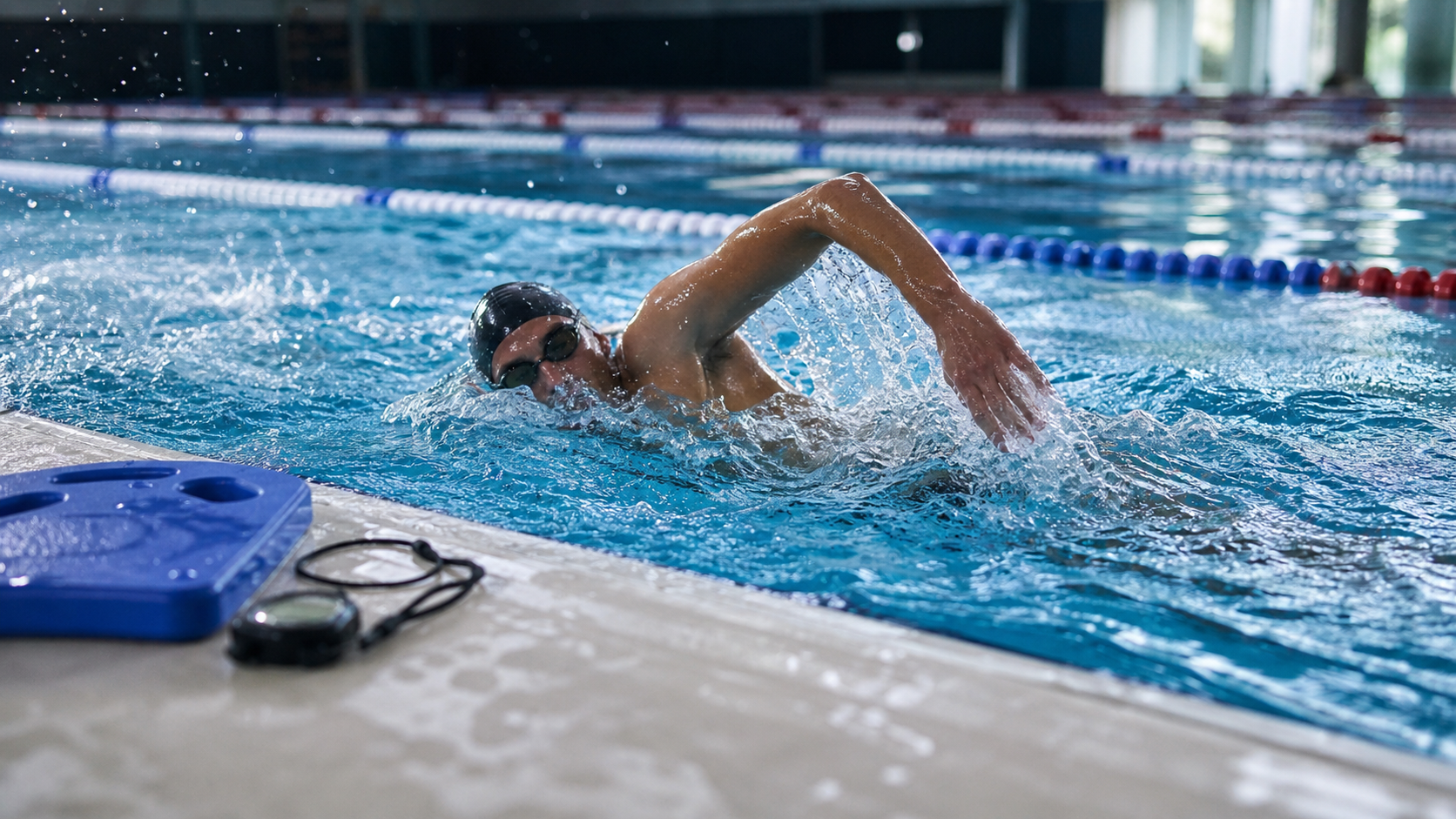
What is Base Pace?
In running, people often say, “My marathon pace is 6 minutes per kilometer.” Swimming has the same concept, except the unit is “seconds per 100 meters.” Base Pace is the moderate-intensity speed you can sustain steadily under your current fitness level, usually expressed as T-pace (Threshold Pace).
Knowing your base pace is the key tool to making every workout “effective without overdoing it.”
How to Measure Your Base Pace
Method 1: 1000m Timed Test
After a full warm-up, swim 1000m at your fastest steady speed (not a sprint, but a pace you can maintain throughout), and record the time.
Base Pace (T-pace) = 1000m time ÷ 10
Example: 1000m = 20 minutes → T-pace = 120 seconds/100m = 2:00/100m
Method 2: 400m + 200m (CSS Calculation Method)
As described in the CSS article, you can use T400 and T200 to calculate CSS, and this CSS is your T-pace.
Method 3: Practical Quick Method (for when you have no equipment)
Swim 8 × 100m, with each set feeling “hard but not so breathless that you can’t speak.” Take the average time of the last 4 sets as an estimate of your T-pace.
Designing Training Intensity Targets Based on T-pace
Once your T-pace is determined, you can calculate target paces for all training intensities. Using T-pace = 2:00/100m as an example:
| Training Intensity | Relative to T-pace | Target Pace | Perceived Effort |
|---|---|---|---|
| Recovery Swim | T + 30+ seconds | 2:30+/100m | Very easy |
| Aerobic Base | T + 15–25 seconds | 2:15–2:25/100m | Comfortable, can talk |
| Aerobic Development | T + 5–15 seconds | 2:05–2:15/100m | Slightly breathless, short phrases |
| T-pace Training | T (Base) | 2:00/100m | Hard but steady |
| Anaerobic Development | T − 5–10 seconds | 1:50–1:55/100m | Very breathless |
| Sprint | T − 15+ seconds | <1:45/100m | All-out sprint |
Sample Pace-Based Workouts
Workout A: T-pace Threshold Session
Target pace: T-pace (per 100m = base seconds)

Warm-up: 400m @ T+20 seconds
Main set:
  10 × 100m @ T-pace
  Rest between reps: 15 seconds (fixed, no adjustment)
Cool-down: 200m @ T+30 seconds

Evaluation: If the last 4 reps start to slow by more than 5 seconds, reduce to 8 × 100m next time
Workout B: Pace Awareness Training
Goal: Build the ability to control pace without looking at the clock

Warm-up: 300m
Main set:
  6 × 200m "blind swim":
    Estimate the time before swimming, check the watch after finishing, target error <5 seconds
  Rest between reps: 45 seconds
Cool-down: 200m

Record: "Estimated time" vs. "actual time" for each rep to track pace awareness accuracy
Workout C: Descending Pace
Speed up by 5 seconds/100m every 500m:
500m @ T+10 seconds
500m @ T+5 seconds
500m @ T (T-pace)
500m @ T−5 seconds (if energy allows)

This workout trains the ability to accelerate while fatigued, simulating a negative-split strategy in the latter half of a race
Pace and Distance Conversion Tips
In the pool, learning to quickly convert “split time → per 100m pace” is very practical:
- 50m rep: Multiply the time by 2 = per 100m pace (if you swim 50m in 55 seconds, your pace is 1:50/100m)
- 200m rep: Divide the time by 2 = per 100m pace (if you swim 200m in 4:20 = 260 seconds, your pace is 130 seconds = 2:10/100m)
- 400m rep: Divide the time by 4 = per 100m pace
How Often to Update T-pace
- Re-test T-pace every 4–6 weeks, because your fitness changes after training, and the old pace will feel too easy
- If a workout feels much easier than usual, your T-pace may have underestimated your actual ability
- Seasonal factors (e.g., warmer water in summer, better physical condition) can also affect T-pace, so calibrate regularly
Practical Tips
- Before each pool session, jot down “today’s target pace range” in your phone’s notes app to avoid “swimming aimlessly” once you’re in the water
- Investing in a waterproof sports watch that displays split times is the best investment for pace training
- If you don’t have a watch, using the pool’s wall clock or asking a friend to time you can still achieve 70% of the effectiveness of pace training
- The mindset of pace training is “precisely executing the target pace,” not “the faster, the better.” Controlling the first half is where the real skill lies
Conclusion
Pace training based on T-pace elevates swimming from “training by feel” to “training by data.” When you can precisely control your time per 100m, your understanding of your own fitness reaches a new depth. Start designing every swim with pace targets, and you’ll find a significant boost in both the sense of direction and accomplishment in your training.
Related Reading
- Swim Pace Awareness Training: How to Judge Your Pace Without Looking at the Clock
- 8-Week Swim CSS Pace Training: Core Workouts for Mastering Critical Speed
- Long-Distance Swim Pace Training: Speed Management for 1500m to 5000m
- Swim Lactate Threshold Testing: Complete Guide to T-pace Testing and CSS Calculation
西進武嶺 免費訓練分析服務 Intervals | 練不夠還是練過頭?你哪一種類型選手?AI模型告訴你! | 備戰神器 | 公路車 訓練 | CT Yeh
4 年前
西進武嶺 自製新版AI配速表產生器 x 賽前攻略 抱佛腳! 沒有功率計也可以產生配速表嗎?有什麼其他眉角賽前要注意的呢? | 西進武嶺 / 東進武嶺 KOM 攻略 | 公路車 | CT Yeh
4 年前
武嶺配速表最佳使用方式 #bike
1 年前
#公路車 #西進武嶺 配速配瓦實驗 坡度分析 四小時內攻略 建大盃 NeverStop #西進武嶺攻略
6 年前
Live) 備戰2019彰化經典百K 賽前攻略 (已完賽請看新影片
7 年前
實景訓練台) 彰化經典百K 高強度喵團 90分鐘 跟著一起練功 2019 Indoor workout Changhua Classic 100 Taiwan
7 年前
西進武嶺各路段 前8000名 大數據分析 配速攻略/功率/心律/推力比/維持率/踏頻/踏瓦比/牽車率 大公開 | 建大盃 NeverStop 可參考 | 公路車 | CT Yeh
5 年前
#公路車 #Vo2Max #最大攝氧量 測驗 體驗 | 心肺測試
6 年前