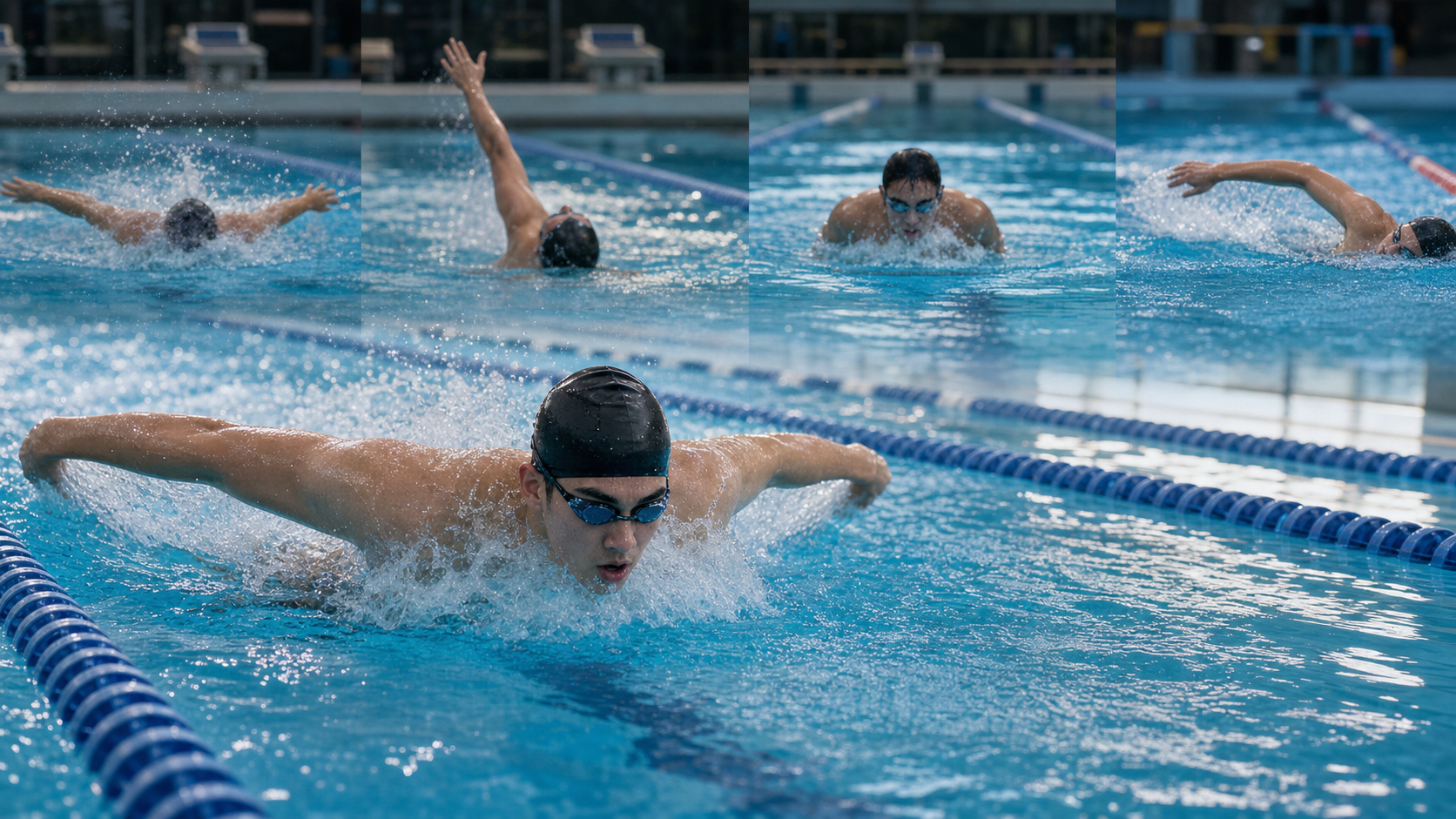
Why Train the Medley?
Most recreational swimmers only swim freestyle, occasionally switching to breaststroke to rest. This training approach overlooks the most complete form of swimming. The Individual Medley (IM) requires you to complete butterfly → backstroke → breaststroke → freestyle in sequence during continuous swimming. Each stroke uses different muscle groups and techniques, making it the most balanced full-body swimming training.
Even if you don’t plan to compete, practicing the medley regularly improves full-body muscular balance, prevents muscle imbalances caused by swimming only freestyle long-term, and makes training more varied and enjoyable.
Energy Demands of the Four Strokes
| Stroke | Relative Energy Expenditure | Primary Muscle Groups | Technical Difficulty | Suitable Distance |
|---|---|---|---|---|
| Butterfly | Highest (100%) | Upper back, shoulders, core | Hardest | 25–50m |
| Breaststroke | Second highest (75%) | Inner thighs, frog kick | Moderate | 100–200m |
| Backstroke | Moderate (65%) | Rear shoulders, back muscles | Easy | 100–200m |
| Freestyle | Lowest (60%) | Full-body balance | Easiest | Unlimited |
The official medley order is butterfly → backstroke → breaststroke → freestyle. This sequence goes from the most energy-intensive to the most economical, allowing swimmers to finish with a sprint using their most practiced stroke as fatigue accumulates.
Technical Points for Each Stroke Over 25m
Butterfly 25m
- Undulation: The whole body should maintain a continuous wave motion, not just legs kicking up and down
- Entry angle: Hands enter the water at approximately 45 degrees, driven by the shoulders, avoiding “slapping” the water with the palms
- Breathing timing: Breathe every 2 arm strokes (every 3–4 for advanced swimmers), keeping the chin close to the water surface
- 25m technique: Butterfly is physically demanding; over 25m you can complete it without breathing (16–20 dolphin kicks) for better rhythm
Backstroke 25m
- Body balance: Ears at the waterline, head tilted back but not lifted, eyes looking straight up
- Turn preparation: At 5m from the wall (at the 15m flag), start counting strokes to prepare for the touch-and-flip turn
- Coordination rhythm: One arm stroke cycle for every 6 kicks, maintaining an even tempo
- Common mistake: Hips sinking—engage the core and actively lift the hips
Breaststroke 25m
- Leg recovery angle: Heels draw toward the buttocks, not knees pulling toward the chest (the latter creates significant drag)
- Kick timing: Hands push through to the thighs → head drops into the water → kick simultaneously; the motion must be fluid
- Glide phase: Maintain a streamlined glide for 2–3 seconds after each kick—this is the key to breaststroke speed
- Breathing: Exhale fully before lifting the head; inhale as the hands sweep outward
Freestyle 25m
- The final freestyle is often the “release segment,” letting accumulated fatigue dissipate through your most familiar stroke
- Focus on high-elbow catch and a steady kicking rhythm
- You can sprint with a slightly faster stroke rate than usual, since the distance is only 25m
4-Stroke × 25m Medley Workout Design
Beginner Medley Workout
Warm-up: 400m freestyle

Familiarization segment:
  4×25m butterfly (focus on undulation, not speed)
  4×25m backstroke (focus on body balance)
  4×25m breaststroke (focus on the glide phase)
  Rest between sets: 30 seconds

Medley integration:
  4×100m IM (25 fly + 25 back + 25 breast + 25 free)
  Rest between sets: 60 seconds

Cool-down: 200m easy freestyle

Total: 1600m
Intermediate Medley Workout
Warm-up: 600m (including one 25m of each stroke)

Main set:
  8×100m IM
  Rest between sets: 30 seconds

Supplement:
  4×50m (rotate through each stroke, one of each)

Cool-down: 400m

Total: 2400m
Pacing Strategy
The most common mistake in the medley is swimming butterfly too fast, causing a collapse in the remaining three strokes. Proper pacing should be:
- Butterfly (25m): 80–85% effort, holding back some reserve
- Backstroke (25m): 70–75% effort, actively recovering your heart rate
- Breaststroke (25m): 75–80% effort, feeling the power of the kick
- Freestyle (25m): 85–90% effort, final sprint
Practical Tips
- Butterfly places significant stress on the shoulders; limit medley sessions to no more than 2 per week, and only increase butterfly volume once you’re sure your shoulders are pain-free
- Backstroke turns require practice; dedicate several sessions specifically to practicing the back-to-free flip turn
- If you experience knee discomfort in breaststroke, temporarily substitute dolphin kicks for the breaststroke kick to avoid lateral knee stress
- Record underwater video with your phone (using a waterproof case)—it’s the most direct way to compare technical issues across the four strokes
Conclusion
The medley is the “comprehensive exam” of swim training. It challenges your technical breadth, pacing intelligence, and mental endurance. A weekly medley session not only makes you a more complete swimmer but also gives every pool visit a fresh sense of challenge. Four strokes, four different sensations in the water—this is what makes swimming most captivating.
Related Reading
- Swimming Medley Training: Weekly Workout Schedule for Training All Four Strokes
- Swimming Medley Training: Benefits of Balanced Four-Stroke Training for Individual Events
- Swimming Medley Workouts: Full-Body Training with Freestyle as the Base, Complemented by Breaststroke and Butterfly
- Swimming Medley Race Strategy: Stroke Order and Pacing Allocation
靠單車減肥35公斤 心得分享與整理
7 年前
一日北高/長距離團騎 常見問題補充篇 / 組團或跟團的眉角 / 壯車友容易被瘦車友慢性拉爆 / 原來屁股痛可能是這個原因...? / 風場配速法 / 公路車 / CT Yeh
2 年前
西進武嶺 免費訓練分析服務 Intervals | 練不夠還是練過頭?你哪一種類型選手?AI模型告訴你! | 備戰神器 | 公路車 訓練 | CT Yeh
4 年前
訓練台體驗) 2019台北自行車展 三大家 訓練台體驗 Tacx Neo Flux 2 Xepdo Apx Wahoo Kickr
7 年前
西進武嶺 自製新版AI配速表產生器 x 賽前攻略 抱佛腳! 沒有功率計也可以產生配速表嗎?有什麼其他眉角賽前要注意的呢? | 西進武嶺 / 東進武嶺 KOM 攻略 | 公路車 | CT Yeh
4 年前
2019 夏季KOM 5小 完賽心得 準備攻略 東進武嶺 夏季登山王之路 Taiwan KOM Challenge
7 年前
抖肩舞 台灣x日本交流版 (台灣 vs 前橋) 赤城山登山賽 coincidance
8 年前
CT 喇低賽) 武嶺牽車 才是王道 西進牽車四小時內秘訣 攝手位置 如何判斷 防抽筋小秘訣
7 年前