Why Do You Need a Swim Training Log?
Human memory is highly unreliable, especially when it comes to recalling fatigue and pace. Vague impressions like “Was I faster last month?” or “Have I really not swum properly in weeks?” can only be turned into precise numbers with a log.
The core value of a training log comes down to three things:
- Objectively tracking progress: Replace feelings with numbers to confirm whether your training is actually working
- Spotting patterns: Identify correlations between fatigue, progress, plateaus, and your daily routine
- Providing motivation: Looking back at records from three months ago and seeing your improvement is one of the most powerful training motivators
Key Metrics Worth Recording
Must-Record Metrics (fill in within 5 minutes after each session)
| Metric | What to Record | Purpose |
|---|---|---|
| Date & Time | 2025-06-01, 07:30 | Track training frequency |
| Total Distance | 2400m | Calculate weekly/monthly volume |
| Main Workout | CSS 8×100m | Confirm execution |
| Key Set Times | 100m: 1:58, 2:01, 2:03… | Track pace improvement |
| Rate of Perceived Exertion (RPE) | 7/10 | Monitor accumulated fatigue |
Recommended to Record (once a week)
- Weekly total distance: Sum up all training for the week and compare with the previous week
- Best 100m time: Your fastest 100m of the week, serving as a pace improvement indicator
- Recovery heart rate: Heart rate 3 minutes after an intensity session; the lower the number, the better your fitness
- Sleep quality (1–5 scale): Observe the correlation between sleep and training performance
Periodic Test Records (every 4–6 weeks)
- Updated T-pace/CSS values
- 1000m or 500m time trial results
- Average time for a fixed set (e.g., 8×100m CSS)
Designing Your Log Format
Paper Version (lowest technical barrier)
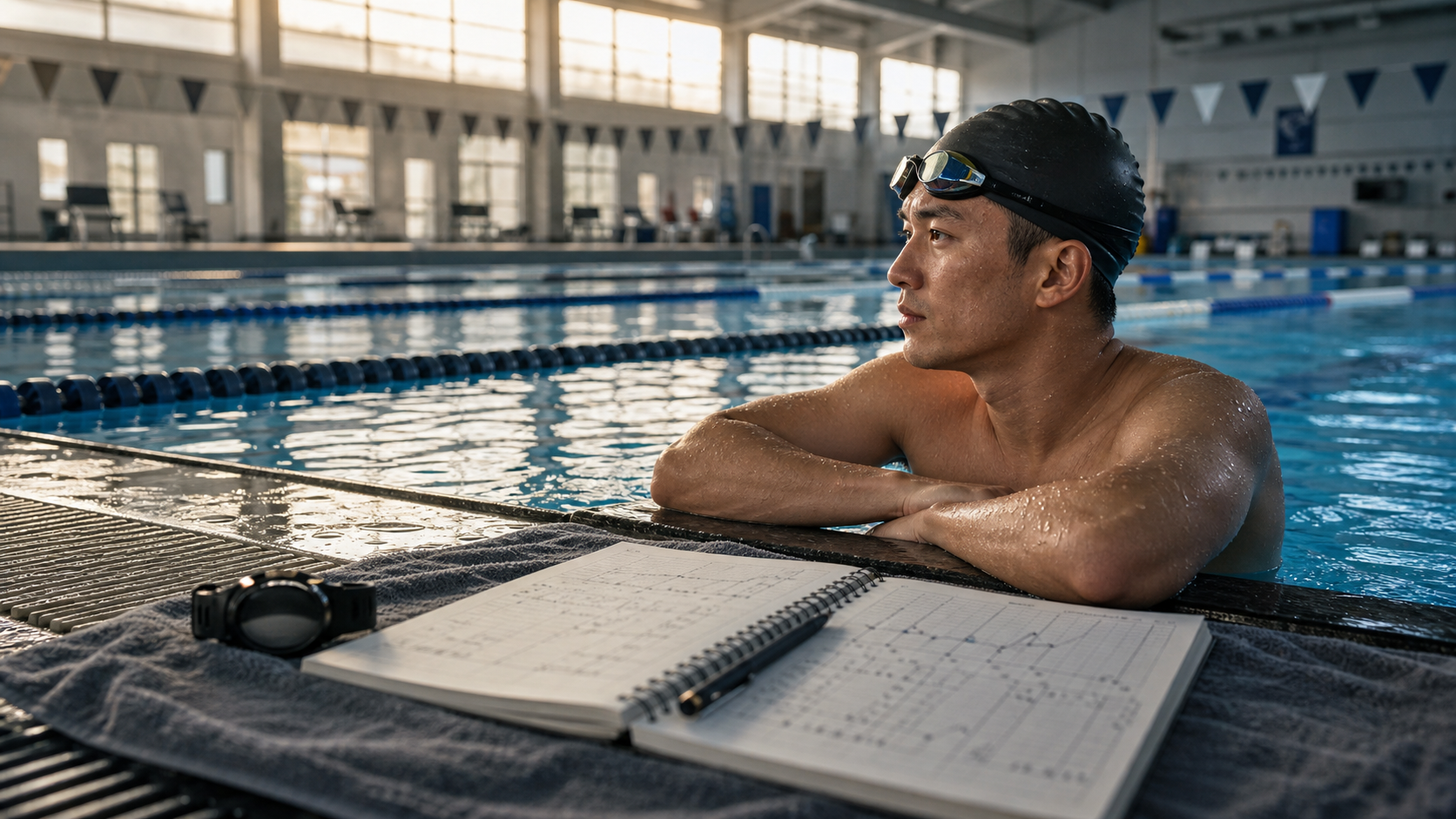
Use a grid notebook, with each page formatted as follows:
Date: ________ Location: __________
Weather/Conditions: _________________
Total Distance: ________m

Workout Content:
─────────────────────────

Key Time Records:
  Set 1: __  Set 2: __  Set 3: __
  Set 4: __  Set 5: __  Set 6: __

How I Felt Today: (RPE __ /10)
──────────────────────

Special Observations (technique/fatigue/mood):
Phone Version (most convenient)
Use “Apple Notes” or “Google Keep” to create a “Swim Log” note and quickly append an entry after each session. Example format:
05/01 2500m | CSS8×100m avg 2:01 | RPE 7 | Right shoulder slightly tight
05/03 1800m | Technique session | RPE 4 | Fist drill felt effective
05/05 Rest | Too tired from work
05/06 3000m | Distance swim | 2:15 pace throughout | RPE 6 | Very smooth
How to Analyze Your Log Data
Weekly Analysis (5 minutes):
- How many days did you swim this week? How does that compare with your goal?
- Did your key set times improve compared to last week?
- Is RPE generally high (>8) or low (<5)? Do you need to adjust training volume?
Monthly Analysis (15 minutes):
- How does this month’s total training volume compare with last month? Does it align with your periodization plan?
- Has your CSS or T-pace been updated? If not, should you retest?
- Any injury warning signs this month (shoulder, knee, neck)?
- What is the key training focus for next month?
Progress Tracking Example
Below is a six-month key data tracking record for an intermediate swimmer:
| Month | Monthly Volume | T-pace | 1000m Time | Avg Sessions/Week |
|---|---|---|---|---|
| Month 1 | 8,200m | 2:12 | 22:30 | 3.2 |
| Month 2 | 9,500m | 2:09 | 21:45 | 3.5 |
| Month 3 | 11,200m | 2:05 | 21:00 | 3.8 |
| Month 4 | 10,800m (recovery) | 2:05 | 20:55 | 3.0 |
| Month 5 | 12,500m | 2:02 | 20:10 | 4.0 |
| Month 6 | 13,000m | 1:59 | 19:30 | 4.2 |
This table clearly shows: although Month 4 was a recovery month, T-pace did not regress, and the 1000m time even improved slightly—this is the supercompensation effect of periodized training. The log makes this “invisible progress” visible.
Tips for Keeping Your Log Consistent
- Lower the barrier: Your log doesn’t need to be complete—even writing “05/01 2000m, felt okay” is better than not recording at all
- Keep a notebook in your swim bag: Fill in your log before you shower and change, don’t wait until you get home
- Review last month on the first day of each month: Looking back at your progress is the strongest motivation for maintaining the log habit
- Don’t judge yourself: If your training volume was low one week, just record it honestly. The log is not a tool for criticizing you
Conclusion
A swim training log is the best coach a swimmer can have—it doesn’t lie, it doesn’t cheer you on, it simply reflects your effort and results truthfully. Starting today, even if it’s just jotting down “how far I swam and how it felt” in your phone’s notes, you’ll already understand your training better than yesterday’s you. Six months from now, when you open that first entry, you’ll thank yourself for starting to log today.
Related Reading
- Swim Training Recording Methods: How to Track Progress and Adjust Your Plan
- Designing Swim Test Sets: Standardized Workouts for Periodically Assessing Training Progress
- How to Keep a Running Log: Using Data Analysis to Improve Training Efficiency
- The Importance of a Cycling Training Log: How to Record and Analyze Your Progress
西進武嶺 免費訓練分析服務 Intervals | 練不夠還是練過頭?你哪一種類型選手?AI模型告訴你! | 備戰神器 | 公路車 訓練 | CT Yeh
4 年前
西進武嶺 自製新版AI配速表產生器 x 賽前攻略 抱佛腳! 沒有功率計也可以產生配速表嗎?有什麼其他眉角賽前要注意的呢? | 西進武嶺 / 東進武嶺 KOM 攻略 | 公路車 | CT Yeh
4 年前
Live) 備戰2019彰化經典百K 賽前攻略 (已完賽請看新影片
7 年前
2025 自行車錶排行榜 兩萬車友大數據 / Garmin Bryton 排名會大洗牌嗎? / 全新的碼表前身分析 /公路車 / CT Yeh
1 年前
崇越盃武嶺冠軍高手 賽前JJSC 群峰會精華!對應大數據分析,會有落差嗎?/ feat. JJSC中部公路車約騎 /公路車 / CT Yeh
2 年前
滑雪新手們慘摔學習全紀錄(請開字幕),滑雪好好玩 | Snowboard + Ski | 岩原 スキー場 | 滑雪APP使用 | GoPro Max
6 年前
2019 柯P 超越北高 第一集團實錄 (11小時實錄請參考另一部影片) 一日雙城 一日北高 NeverStop Taiwan Long Distance Cycling Challenge
7 年前
一日北高 11小時 賽後心得分享篇 | TWB北高360 | 一日雙城 | 單車 | 公路車
6 年前