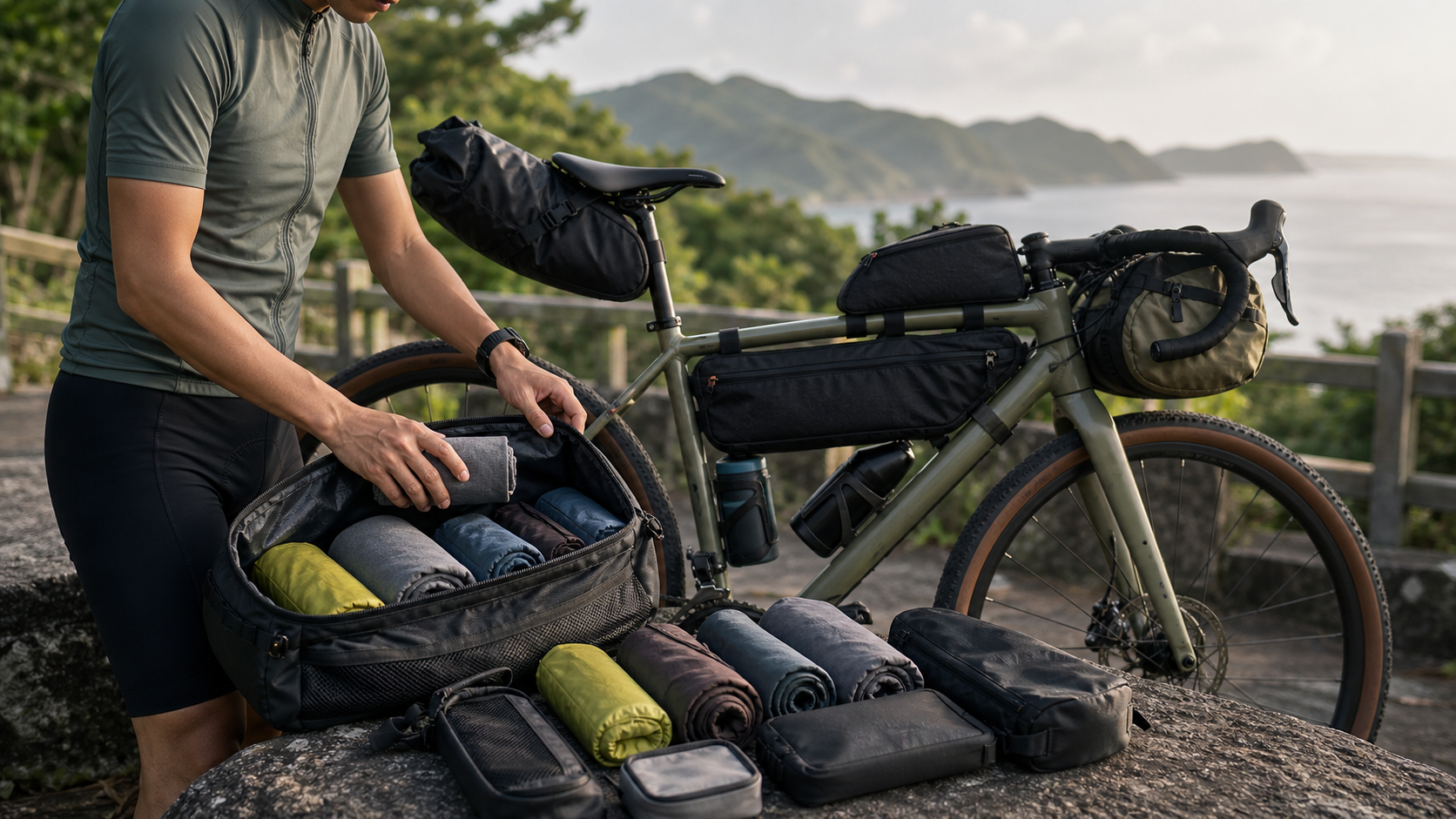
The Art of Packing for Bicycle Travel: How to Fit a Week’s Worth of Clothing into Your Bike Bags
“I brought too much—I can barely pedal.” This is a common regret shared by many first-time bicycle travelers. Before departure, you optimistically stuff in all sorts of “just in case” clothing, only to realize on the road that every gram is a burden when climbing hills. Packing is the first lesson of bicycle travel, and one of the clearest indicators that separates veterans from newcomers.
First, Understand Your Bag System
Before discussing “what to bring,” you first need to understand “where it goes.” Common bag setups for bicycle travel are as follows:
| Bag Type | Mounting Position | Best For | Capacity Reference |
|---|---|---|---|
| Saddle Bag | Under the saddle | Spare inner tubes, tools, first-aid kit | 0.5–20L |
| Top Tube Bag | On top of the top tube | Phone, snacks, nutrition | 0.5–2L |
| Handlebar Bag | Front handlebars | Clothing, sleeping bag, lightweight items | 5–20L |
| Pannier | Both sides of the rear rack | Clothing, food, heavy items | 10–20L each |
| Frame Bag | Inside the bike frame triangle | Tools, food, tablet | 2–8L |
For a week-long Taiwan round-island tour or long-distance trip, the most common setup is a “handlebar bag + rear panniers” combination, with a total capacity of about 30–50 liters—enough to hold a week’s worth of daily necessities.
Clothing Choices: The Core of Lightweight Packing
The biggest enemy of packing is “ordinary cotton clothing.” Cotton is heavy, gets even heavier when wet, and dries slowly—it is the nemesis of bicycle travel. It is recommended to switch entirely to the following materials:
- Merino Wool: Naturally antibacterial, resistant to odor, and can be worn for multiple days in a row—the ace material for long-distance travel
- Polyester moisture-wicking shirts: Quick-drying and lightweight; wash them at night and they are usually dry by the next morning
- Tencel blends: Comfort sits between cotton and synthetics, offering both the look and function of everyday wear
Using a seven-day week as an example, here is a proven minimalist clothing list:
- 2–3 cycling jerseys (worn in rotation)
- 2 moisture-wicking base layers (can be worn for 2 days straight)
- 2 lightweight casual tops (for after arriving at your destination)
- 1 lightweight jacket (for nighttime warmth and rain protection)
- 1–2 pairs of shorts or lightweight trousers
- 3 pairs of compression underwear (quick-dry material)
- 3–4 pairs of thin wool or performance socks
If you choose lightweight performance materials, the total weight of this list can usually be kept within 2 kilograms.
Folding Techniques: How to Maximize Space
The way you fold your clothing directly affects packing efficiency:
- Roll Packing: Roll clothing tightly—it saves more space than flat folding and also resists wrinkles better
- Organize with Stuff Sacks: Use lightweight mesh stuff sacks to categorize clothing, keeping the inside of your bags orderly so you don’t have to rummage through everything when looking for something
- Make Good Use of Compression Sacks: For lightweight down jackets or sleeping bags, compression sacks can reduce volume by more than half
- Handling Shoes: If you need to bring casual shoes, stuff small items inside them (such as charging cables or electrolyte packets) to make full use of the space
The Indispensable Non-Clothing Checklist
Beyond clothing, there are some essential items for bicycle travel:
- Tool Kit: 2 spare inner tubes, tire patch kit, chain lube, multi-tool, pump (a CO₂ inflator is also worth considering)
- Electronics: Phone, power bank (a lightweight 10000mAh model is recommended), bike light charging cables
- Toiletries: Solid shampoo bar (replaces liquid shampoo, saving space and being eco-friendly), solid soap, toothbrush and toothpaste, small towel
- First-Aid Kit: Band-aids, anti-inflammatory ointment, sunscreen (Taiwan’s intense summer UV should not be underestimated)
- Document Protection: A waterproof ziplock bag for your ID card, credit cards, and cash
The Golden Rules of Packing
- Keep heavy items close to the bike’s center of gravity: Heavy items in rear panniers should be placed as close to the frame as possible to avoid swaying while riding
- Balance both sides: Keep the weight of the left and right panniers as even as possible to avoid riding lopsided
- Put frequently used items in the outermost layer: Items you need to grab on the go—lip balm, phone, snacks—should be placed in the easiest-to-access position
- Take a test ride before departure: After packing, ride for 10–15 minutes around your neighborhood to confirm the weight distribution and riding feel
Conclusion
Packing for bicycle travel is an “art of subtraction.” After every trip, you will always find that some things were never used; the next time you set out, leave them at home. True freedom often comes from carrying less. When you are climbing a steep hill, every gram you shed is a gift to your future self. Travel light, and let the journey itself become the most abundant luggage.
Related Reading
- Bicycle Touring Gear Checklist: The Packing Philosophy for a Week of Bikepacking Luggage
- Packing Luggage for Bicycle Travel: Lightweight Techniques for a Cycling Expedition
- Packing Luggage for Bicycle Travel: A Gear List for Long-Distance Cycling
- The Minimalism of Bicycle Travel: The Philosophy of Traveling Light with Just One Bike and One Bag
單車 一日北高 ( 雙城 ) 肥宅雙人瘋狂行 紀錄片 REACTO
10 年前
靠單車減肥35公斤 心得分享與整理
7 年前
#公路車 #Fitting 靠人工智慧APP 幫你調整單車
6 年前
單車賞雪 裝備準備及注意事項分享 | 公路車
5 年前
多到選擇障礙... 換個單車把帶想一個小時 / BTP / 編織&軟木特有材質超吸睛! / 公路車 / CT Yeh
1 年前
太平山單車員工旅遊 | 這樣玩CP值最高!| 公路車
5 年前
DJI Osmo Action 6 / 單車運動拍攝實用技巧 公路車 CT Yeh
7 個月前
大家都在開箱的...單車用藍芽對講耳機真的有幫助嗎? SENA BiKom 20 長距離旅遊 & 海鷗繞圈賽 實際體驗心得 / 公路車 / CT Yeh
9 個月前