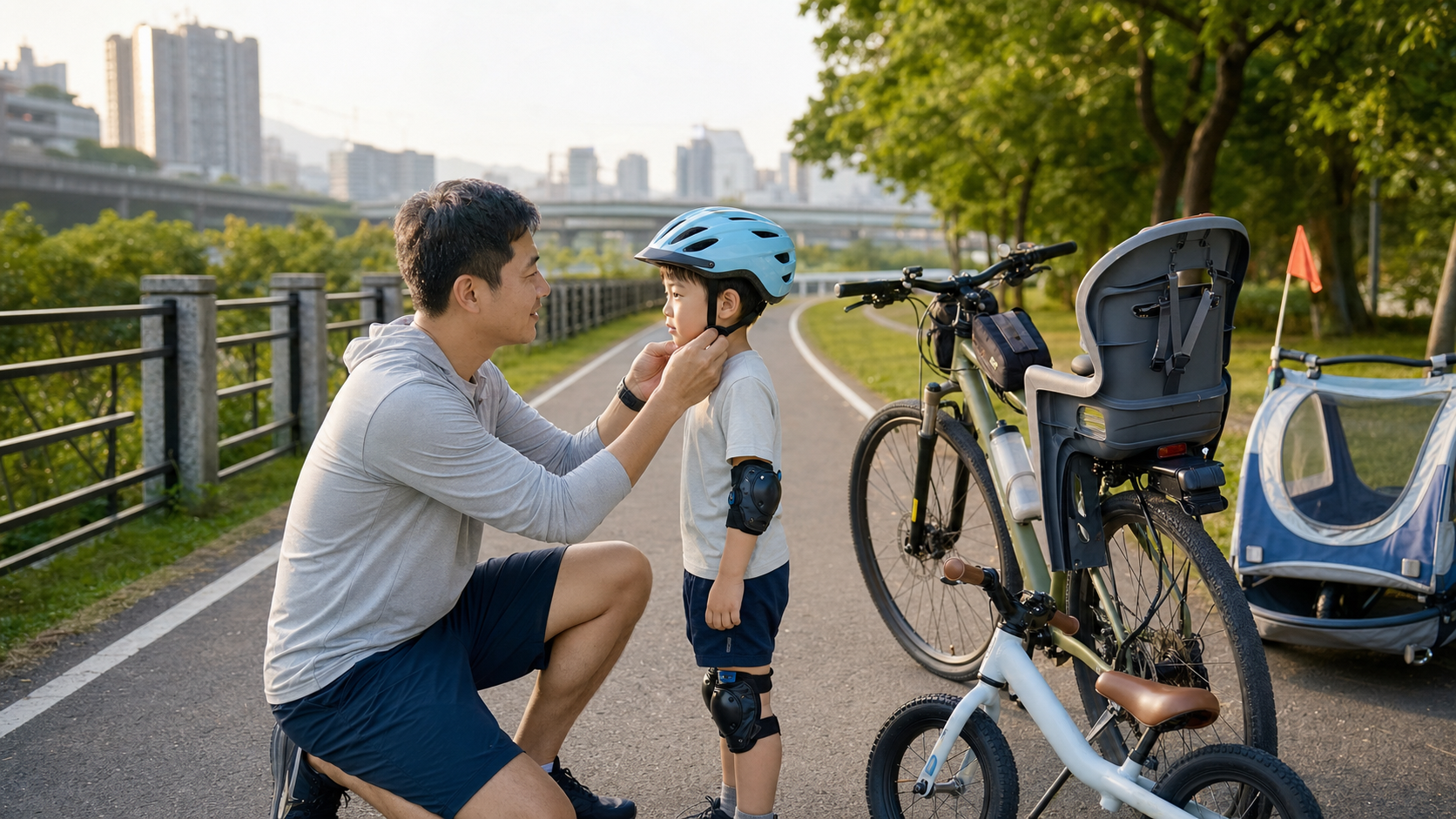
Family Cycling with Kids: A Guide to Safety Gear and Route Selection
“Dad, I want to ride a bike too!” Many parents in Taiwan have heard their children say this. Riding a bicycle together with your child is not just exercise—it’s a precious opportunity to build a parent-child bond. However, children’s safety must come first—the right gear and route planning are what ensure that family cycling memories are made without regret.
Main Forms of Family Cycling
Depending on the child’s age and ability, family cycling can take several different forms:
| Form | Suitable Age | Equipment Needed | Features |
|---|---|---|---|
| Child Seat (Front) | 9 months–3 years | Front child seat, helmet | Child stays within parent’s sight, high interactivity |
| Child Seat (Rear) | 9 months–6 years | Rear child seat, helmet | Higher weight capacity, more stable seating for child |
| Trailer | 1–6 years | Child bicycle trailer | Two-child space, rain and sun protection, safest option |
| Balance Bike Transition | 2–5 years | Balance bike, helmet, protective gear | Develops balance, prepares child for riding a real bike |
| Riding Side by Side | 5 years and up | Child’s bicycle, helmet, protective gear | Child rides their own bike, trains independent riding |
| Follow-me Tandem Adapter | 3–8 years | Connecting bar, child’s bicycle | Child’s bike connects to adult’s bike, child can pedal |
Helmets: The Gear You Can’t Afford to Overlook
Choosing a child’s helmet requires more care than choosing one for an adult:
- Certification Standards: Make sure it meets EN1078 (European) or CPSC (US) safety certification—these two are the most common certifications for products sold in Taiwan
- Proper Fit: The helmet should fit snugly against the head without shifting forward or backward. Test with your fingers: the brim should sit two finger-widths above the eyebrows, and the chin strap should be adjusted to fit one finger snugly underneath
- Lightweight: Children’s neck muscles are not fully developed; an overly heavy helmet can strain the cervical spine
- Good Ventilation: Taiwan summers are hot, so a design with plenty of vents will prevent children from refusing to wear the helmet due to stuffiness
Other Essential Safety Gear
In addition to helmets, the following protective equipment is also essential for family cycling:
- Knee and Elbow Pads: Children learning to ride fall frequently; knee and elbow pads reduce both the likelihood and severity of scrapes
- Reflective Gear: If riding near dusk, reflective vests or reflective stickers can greatly increase visibility
- Gloves: The instinctive reaction when falling is to brace with the hands; padded gloves protect the palms
- Proper Footwear: Avoid flip-flops or sandals when cycling—shoes can get caught in the wheel spokes and cause danger
Recommended Family-Friendly Routes in Taiwan
Principles for choosing family routes: flat terrain, fully separated from cars and scooters, restrooms and rest areas along the way, and moderate distance—not too long.
Northern Taiwan:
- The Tamsui River Left Bank Bikeway from Dadaocheng to Guandu (approximately 15 km in total, completely flat)
- Hsinchu’s Seventeen Kilometers Coastline Bikeway (beautiful ocean views, suitable for young children)
Central Taiwan:
- Taichung’s Houfeng Bikeway (converted from an abandoned railway; the tunnel section stays cool, ideal for summer family rides)
- Changhua’s Tianwei Highway Garden section (flower nurseries lining the route, visually rich, short distance suitable for toddlers)
Southern Taiwan:
- Kaohsiung’s Cijin Island Loop Bikeway (take the ferry to the island; the route is short and flat)
- Tainan’s Anping Canal Bikeway (ride amid historic scenery, moderate distance)
Eastern Taiwan:
- Hualien’s Liyu Lake Bikeway (lake and mountain scenery, loop route about 5 km, very suitable for young children)
- Taitung’s Zhiben Bikeway (riverside views, safe and flat)
Practical Tips for Family Cycling
- Start Early: In summer, try to finish riding before 9 a.m. to avoid the midday heat and to prevent children from becoming cranky from exhaustion
- Bring Plenty of Supplies: Children burn energy quickly and need water and snacks more frequently than adults
- Set Reasonable Distances: Young children have limited attention spans and stamina—better to ride a shorter distance and leave energy to spare than to push through an overly long route
- Let Children Join the Planning: Before heading out, let your child point out on the map where they “want to go”—involving them greatly boosts their enthusiasm for riding
- Praise and Encourage: Give specific compliments after each ride (e.g., “You rode 5 km today—amazing!”), helping your child build a sense of accomplishment
When Should You Start Teaching Your Child to Ride?
Parents in Taiwan typically start teaching children to ride bikes with training wheels between ages 4–7, but more and more research shows that starting with a “balance bike” first—letting children build their sense of balance before transitioning to a pedal bike—often leads to faster learning.
The most important thing in the learning process: don’t rush. Let your child progress at their own pace, and celebrate every small breakthrough.
Conclusion
Riding bikes with your child is a gift that will be remembered for a lifetime. Many Taiwanese adults still clearly remember the moment they first rode without training wheels, and the face of their mom or dad running behind them. Proper safety gear is the foundation, but it’s the devoted companionship that makes those memories so precious.
Related Reading
單車 一日北高 ( 雙城 ) 肥宅雙人瘋狂行 紀錄片 REACTO
10 年前
靠單車減肥35公斤 心得分享與整理
7 年前
單車賞雪 裝備準備及注意事項分享 | 公路車
5 年前
太平山單車員工旅遊 | 這樣玩CP值最高!| 公路車
5 年前
#公路車 #Fitting 靠人工智慧APP 幫你調整單車
6 年前
摔車後補裝備: 好市多新款單車安全帽& Specialized Romin 北高整路屁股都不痛的坐墊 | 一千元居然有MIPS | CT Yeh | 公路車
4 年前
高雄綠園道鐵路自行車道 / 外地人能輕鬆駕馭 還是整路崩潰? / 2025 全線開通 春節實地探索一次!(附GPS連結)/ 公路車 / CT Yeh
1 年前
#PUSHBIKE 原來這麼好玩! 小朋友 滑步車 初體驗 超可愛
6 年前