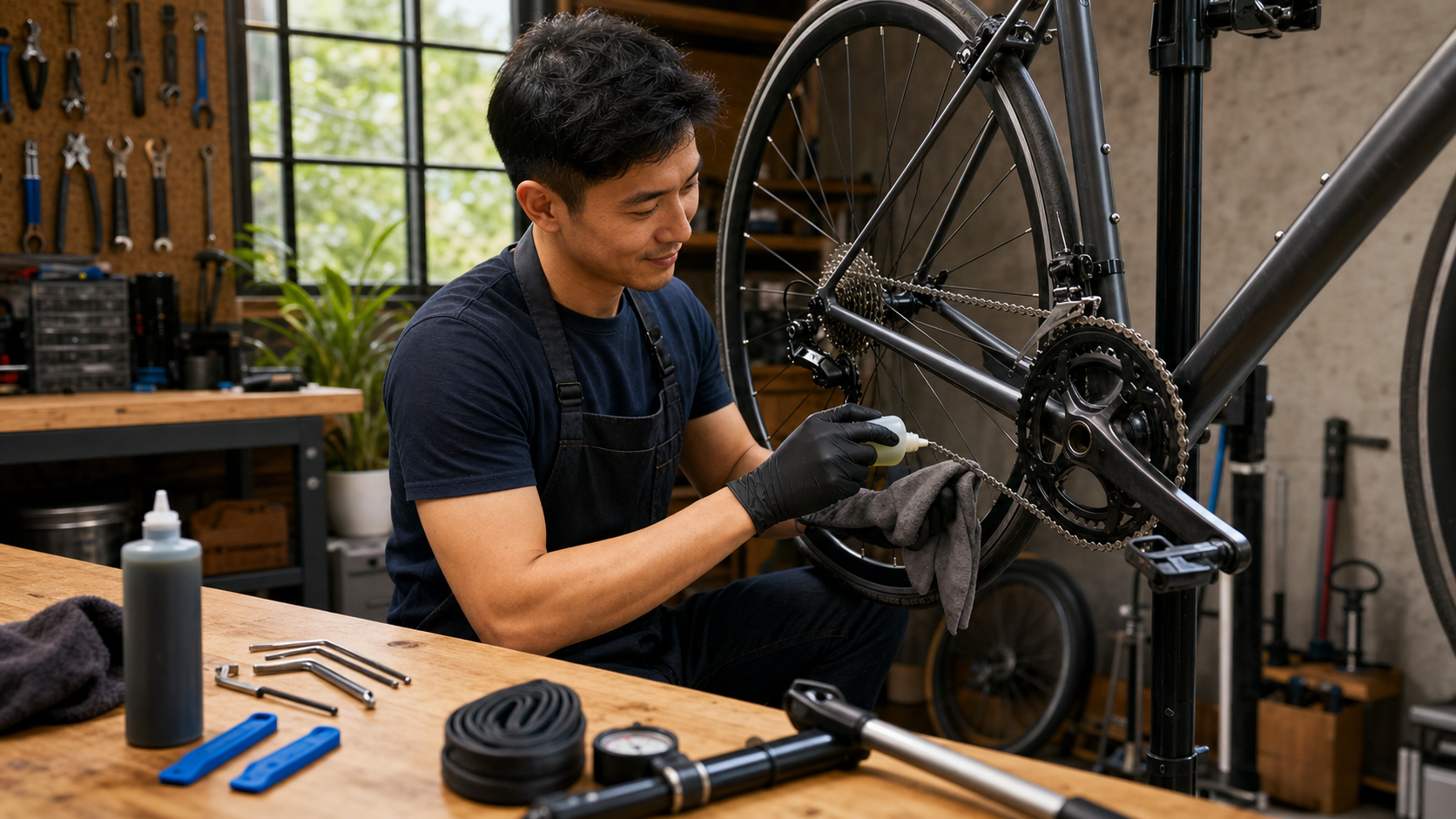
Bicycle Maintenance Culture: The Sense of Accomplishment and Skill Development of DIY Maintenance
“I just replaced my inner tube by myself!” The sense of pride after completing your first flat-tire fix on your own can be even stronger than finishing a half marathon. Bicycle maintenance, for many riders, is an important journey from “just riding” to “truly understanding the bike.” It’s not just about saving money—it’s a way to build a deep connection with your machine.
Why Learn to Maintain Your Own Bike?
Many riders are used to leaving all problems to the bike shop, which is certainly an option, but doing it yourself has several irreplaceable benefits:
- Emergency response on the road: When a flat happens in a remote mountain area, only you can solve the problem
- Better understanding of your bike: After personally disassembling and reassembling parts, you become more attuned to your bike, making minor abnormalities easier to detect
- Significant cost savings: Handling basic maintenance yourself can save a considerable amount in shop labor costs each year
- Pure sense of accomplishment: Some things can’t be bought—they can only be earned by completing them with your own hands
Essential Basic Tools
To start DIY maintenance, you don’t need to buy all the tools at once. Here’s a prioritized tool list:
Phase 1 (Basic Entry-Level):
| Tool | Purpose | Estimated Cost |
|---|---|---|
| Hex wrench set (3/4/5/6mm) | Adjusting seatpost, handlebars, bolts | NT$150–300 |
| Tire levers (2–3 pieces) | Removing and installing tires | NT$50–100 |
| Pump (with pressure gauge) | Checking and maintaining tire pressure | NT$400–800 |
| Patch kit and sandpaper | Repairing inner tube leaks | NT$100–200 |
| Chain lubricant | Chain maintenance, reducing wear | NT$150–300 |
Phase 2 (Advanced Tools):
- Chain cleaner (makes chain cleaning easier)
- Bicycle work stand (keeps the bike stable and elevated for easier work)
- Brake/shift cable cutters
- Cycling computer installation tool kit
Phase 3 (Deep Maintenance):
- Bottom bracket tool (for bracket removal and installation)
- Cassette removal tool
- Hub wrenches
- Wheel truing stand
The Five Skills You Should Learn First
1. Replacing Inner Tubes and Patching
This is the most important roadside emergency skill. Steps: remove the wheel → use tire levers to remove the tire → take out the old inner tube (or find the puncture to patch it) → install the new inner tube → remount the tire → inflate and confirm. Practice 2–3 times at home before your first real attempt, and you won’t panic when a flat happens on the road.
2. Cleaning and Lubricating the Chain
The chain is the component that accumulates the most dirt and requires the most regular maintenance. Clean and lubricate every 300–500 km (or after every long ride). A clean chain extends the life of the chainrings and cassette.
3. Adjusting the Brakes
Brake performance directly affects riding safety. Worn brake pads and slack cables all require timely adjustment. Learning to test brake power (when the front brake is fully locked, the rear wheel can be lifted off the ground) is a basic way to confirm the brakes are effective.
4. Adjusting Front and Rear Derailleurs
Skipping gears or rough shifting is often caused by cable tension issues or misaligned derailleur positioning. Learning to fine-tune the adjustment barrels on shifters or grip shifters can resolve most everyday shifting problems.
5. Tire Pressure Management
Different rider weights, tire specifications, and road surfaces all correspond to different optimal pressure ranges. Learning to read the pressure range printed on the tire sidewall (usually marked in PSI or Bar) and adjusting accordingly can simultaneously improve comfort, efficiency, and puncture protection.
Taiwan’s DIY Maintenance Ecosystem
Taiwan has several resources that support DIY culture:
- Taiwanese YouTube channels: Several Taiwanese rider YouTubers offer detailed maintenance tutorial videos in Chinese. Searching “單車保養” or “自行車換胎” will yield plenty of practical content
- Bicycle forums and communities:
- The Mobile01 bicycle section is Taiwan’s longest-standing cycling discussion community, with a rich archive of maintenance Q&As
- Facebook cycling communities in various cities also often have enthusiastic members answering maintenance questions
- DIY courses at some bike shops: Some specialty bike shops in Taipei and Taichung offer paid or free introductory maintenance courses—a quick way to get started
The Maintenance Philosophy: Knowing When to Leave It to the Pros
DIY doesn’t mean you have to do everything yourself. In the following situations, it’s recommended to leave it to a professional bike shop:
- Correcting severely bent rims (requires a truing stand and extensive experience)
- Assessing carbon fiber damage (requires professional judgment)
- Bottom bracket removal and installation (requires special tools and torque specifications)
- Diagnosing electronic shifting system faults (requires software tools)
Knowing the boundaries of your own abilities is a hallmark of a mature DIY rider.
Conclusion
Learning to maintain your own bike is a sign of respect for the machine and a validation of your own abilities. From the moment you successfully complete your first patch job, your relationship with the bike is no longer just that of a rider—you become a partner who understands it and takes care of it. Whatever happens on the road, you have the ability to handle it—this composure is one of the most worthwhile states to pursue in cycling.
Related Reading
- Bicycle Maintenance Culture: The Sense of Accomplishment and Skill Development of DIY Maintenance
- Bicycle Maintenance for Beginners: The First Step to Learning How to Replace Your Own Inner Tube
- Road Bike Maintenance Culture: The Trade-Off Between DIY Repair and Professional Bike Shops
- DIY Bicycle Repair: A Practical Skill That Saves You Tens of Thousands of Dollars Every Year
自助洗車場 洗單車 50元有找 清鍊條大法 居然還有小小兵
7 年前
單車 一日北高 ( 雙城 ) 肥宅雙人瘋狂行 紀錄片 REACTO
10 年前
碟煞公路車 銑面器 !? 原來銑完差這麼多! 降低蹭碟機率! | TIME 公路車 保養小記錄 | CT Yeh
3 年前
沉浸室內單車練功房開箱! 100吋大畫面,最便宜的花費? 居然還能K歌!? | 公路車 | CT Yeh
3 年前
洗單車神器 吹水機! 實際洗車用用看 暴力洗鍊條大法 | 公路車 | CT Yeh
4 年前
摔車後補裝備: 好市多新款單車安全帽& Specialized Romin 北高整路屁股都不痛的坐墊 | 一千元居然有MIPS | CT Yeh | 公路車
4 年前
#公路車 #Fitting 靠人工智慧APP 幫你調整單車
6 年前
單車胎壓觀察到的有趣現象,SRAM Quarq TyreWiz 2.0 無內胎胎壓計 / 裝了有哪些幫助? / Tubeless / 公路車 / CT Yeh
1 年前