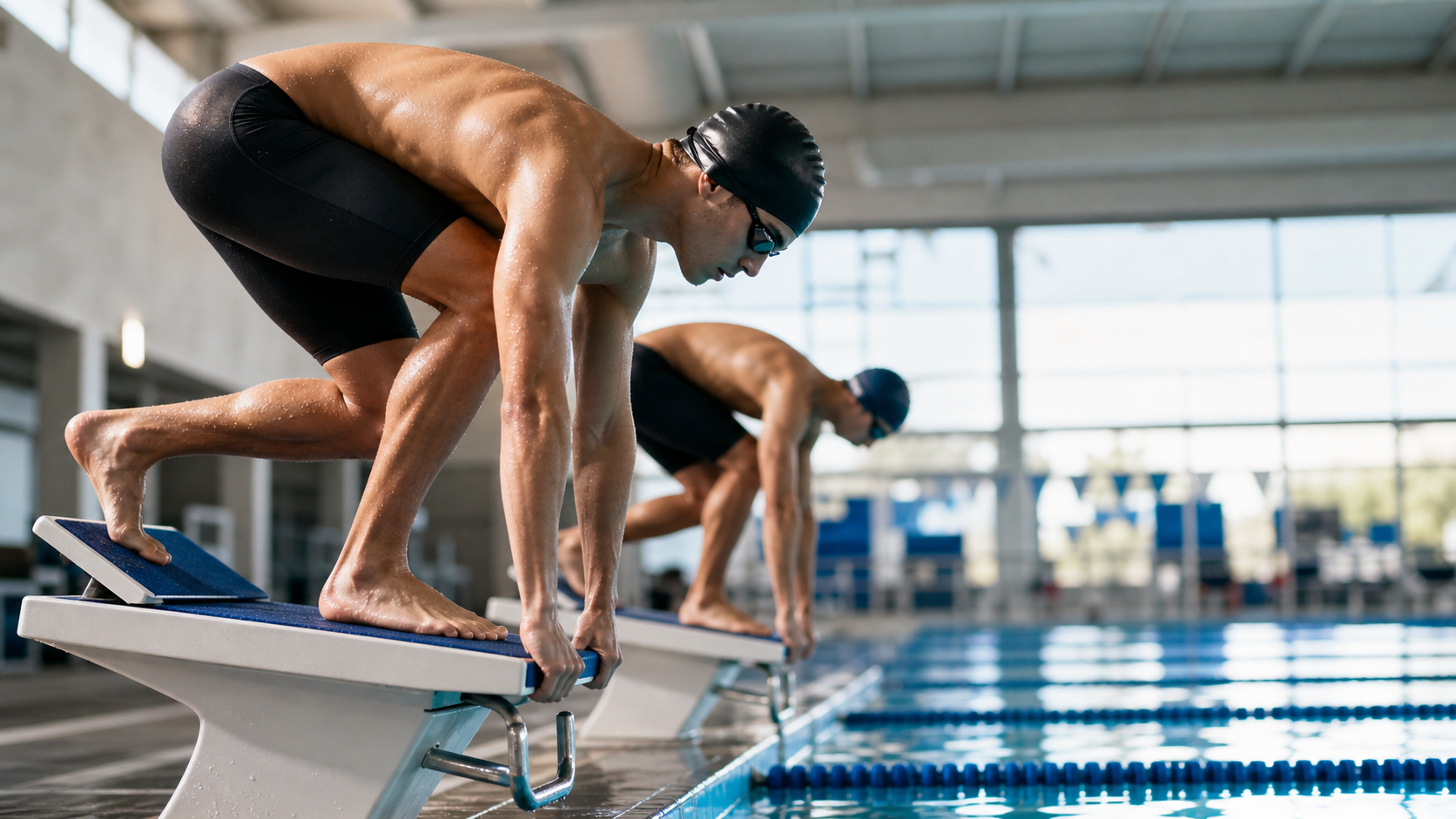
Starting Dive Technique Analysis: Track Start vs. Grab Start
The outcome of competitive swimming is often decided in the first 15 meters. From hearing the starting signal to both feet leaving the starting block—the “block time”—elite swimmers typically fall between 0.6 and 0.75 seconds, and the time from leaving the block to the end of the streamline after entry (usually at the 7-meter mark) accounts for nearly 25% of the critical phase in the 50-meter events.
1. Comparison of the Two Starting Positions
| Item | Grab Start (hands gripping front edge of block) | Track Start (staggered stance) |
|---|---|---|
| Center of gravity | Centered, feet parallel | Shifted forward, rear leg drives |
| Reaction time (block time) | 0.70–0.80 s | 0.62–0.72 s |
| Block exit velocity | 4.4–4.7 m/s | 4.6–5.0 m/s |
| Entry angle | 30–35 degrees | 32–40 degrees |
| Suitable distance | 100m and above | 50m sprint |
| Learning difficulty | Lower | Higher, requires balance |
2. The Force Chain of the Track Start
Modern competition has almost fully adopted the Track Start, and its advantage comes from “pre-tension”: the body leans forward in the ready position, hands grip the front edge of the block, weight is loaded onto the balls of the front foot, and the rear foot rests on the kick plate behind.
- Ready position: Hip angle approximately 60–70 degrees, knee angle approximately 90–100 degrees.
- At the starting signal: Both hands pull upward forcefully, propelling the body forward like a “launch.”
- Block exit sequence: Hands → hips → rear foot → front foot, forming a continuous whip-like motion.
- Airborne position: Keep the body elongated, both arms extended forward and together, chin tucked toward the chest.
3. The Key to Entry Angle
If the entry angle is too shallow (less than 30 degrees), it causes “slapping” on the water, generating significant drag; if the angle is too steep (more than 45 degrees), it dives too deep, wasting distance. The optimal range falls between 32 and 38 degrees, entering through a single “hole” (hands, head, hips, and feet passing through the same point in sequence).
4. Gliding and Timing of the Underwater Kick
After entry, the swimmer enters a glide phase at a depth of 1.0 to 1.5 meters. At this point, speed can reach 6.5 m/s, far higher than swimming speed through the water. The key points are:
- Maintain a strict streamline: hands stacked, arms squeezing the ears, core engaged and chest lifted
- Begin the first underwater dolphin kick before speed decays to approximately 2.2 m/s
- The first dolphin kick is directed “downward” for propulsion, not upward
5. Training Recommendations
- Reaction light training: Use OmegaLight or inexpensive LED reaction devices, 2 sessions per week, 15 reps per session.
- 5-meter float timing: Measure the time from entry to the 5-meter mark; target under 1.5 seconds for men and 1.7 seconds for women.
- Complementary strength training: Back squat 1RM of at least 1.5 times body weight, and box jump height of 80 cm or more.
Conclusion
The start may seem to occupy only a very brief moment of a race, but in the 50-meter events, a 0.1-second improvement is often the difference between gold and eighth place. Switching from Grab to Track Start improves time by an average of 0.15 to 0.25 seconds—a highly cost-effective technical investment.
Related Reading
- Starting Technique: Comparison of Grab Start, Track Start, and In-Water Start
- Competitive Starting Technique: Grab Start vs. Track Start
- Block Start vs. In-Water Start: Technical Choices and Competition Rules Explained
- Swimming Start Technique: Speed Differences Between Grab Start and Rearward Start
CT 喇低賽) 武嶺牽車 才是王道 西進牽車四小時內秘訣 攝手位置 如何判斷 防抽筋小秘訣
7 年前
Live) 備戰2019彰化經典百K 賽前攻略 (已完賽請看新影片
7 年前
戰略) Zwift Race 如何咬在第一集團 如何評估自己要開多少推力 (請開1.5倍速看)
7 年前
Zwift跨國線上追逐賽 第二站 台灣 TTR vs. 日本 JETT 第二場 (台灣追日本) | 數百位國內外公路車高手,同場較勁 | 多視角賽事直播
4 年前
半日 小台灣 極限單車路線挑戰實錄
7 年前
入門車錶王者 iGPSPORT BSC100S 一千元的售價! 超大螢幕、連續兩趟北高的續航、藝術般的APP! Bryton Garmin 兩王地位撼動? | 公路車 | CT Yeh
3 年前
西進武嶺 免費訓練分析服務 Intervals | 練不夠還是練過頭?你哪一種類型選手?AI模型告訴你! | 備戰神器 | 公路車 訓練 | CT Yeh
4 年前
滑雪新手們慘摔學習全紀錄(請開字幕),滑雪好好玩 | Snowboard + Ski | 岩原 スキー場 | 滑雪APP使用 | GoPro Max
6 年前