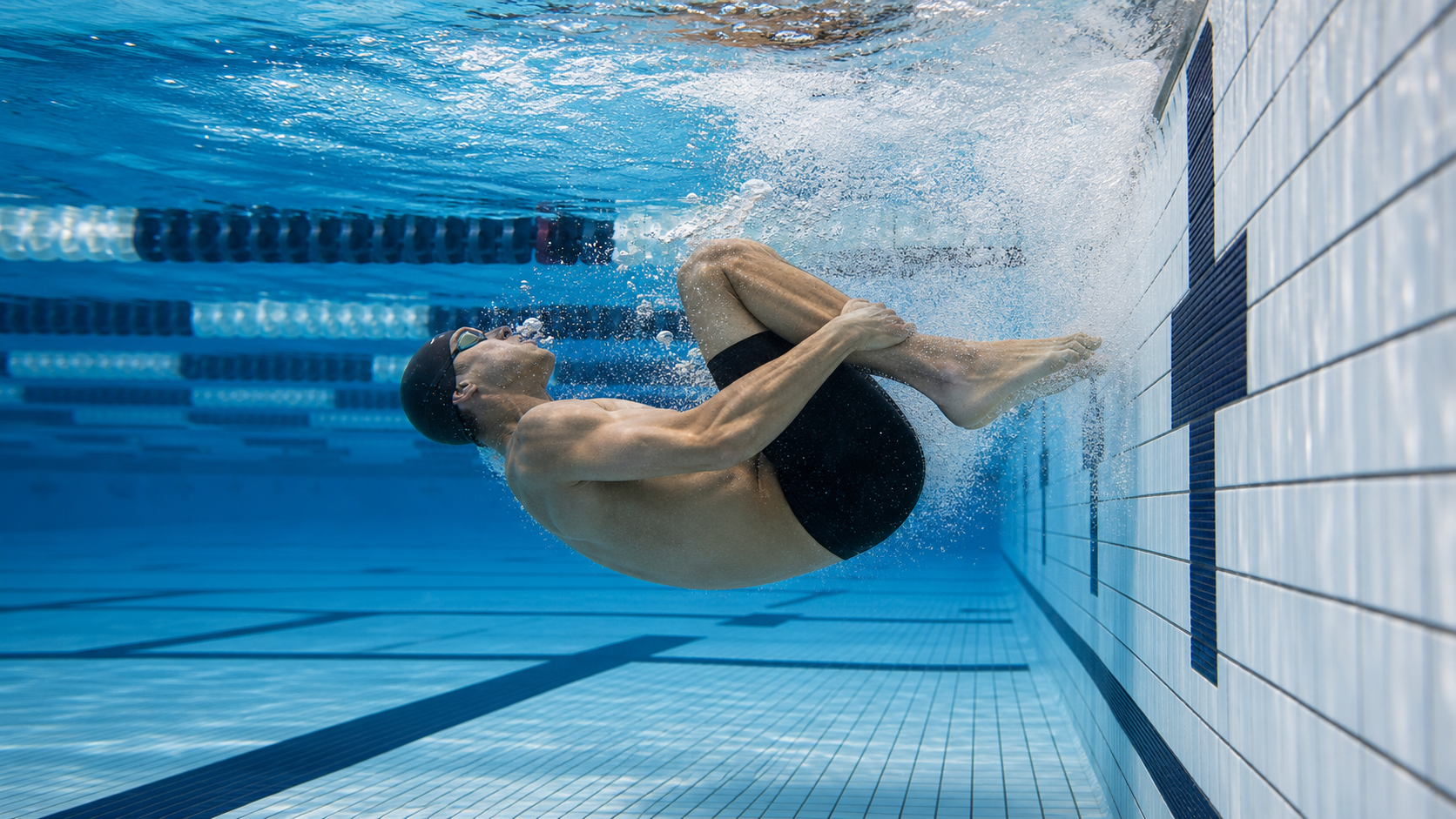
Flip Turn Frame-by-Frame Breakdown
The flip turn is the core technique for transitioning between lengths in freestyle and backstroke. A precise flip can complete the switch from swimming posture to wall-push posture within 0.9 seconds, and push off the wall at 2.4–2.8 m/s, faster than swimming speed.
1. Distance Judgment: Initiating from the T-Marker
The T-marker on the pool bottom is typically 2 meters from the wall. Swimmers should begin preparation when the top of their head (not their hands) passes the T-marker plus 0.3 meters (i.e., when the midsection of the body passes the T-marker):
| Phase | Distance from Wall | Action |
|---|---|---|
| Spotting the T | 2.0 m | Accelerate the final arm stroke |
| Initiating the flip | 0.8–1.0 m | The last hand does not pull, acting as a pivot point for the flip |
| Hip tuck moment | 0.5 m | Both legs tuck toward the chest |
| Feet plant on wall | 0 m | Knee joint angle at 90–100 degrees |
| Push off wall | -0.3 m | Arms extended forward into streamline |
2. Physics of the Flip: Reducing Drag in the Water
The key to flip speed is not “flipping fast,” but “flipping tight.” Tucking the body into a ball shape reduces the moment of inertia, which is physically analogous to the principle a figure skater uses to accelerate a spin by pulling their arms in.
- Head Position: Chin tucked toward the chest, eyes looking at the navel
- Hand Action: The final hand stays by the thigh, both hands then assist by pressing down on the water
- Hip Posture: Hip flexion angle approximately 120 degrees (close to a seated position)
3. Push-Off Angle and Depth
Push-off depth directly affects the efficiency of the subsequent underwater dolphin kicks:
- Too Shallow (< 0.4 m): The body is too close to the surface, prone to generating wave drag
- Too Deep (> 0.8 m): The distance to surface is too long, making the total time slower
- Optimal Depth: 0.5–0.7 meters
The push-off angle should keep the body at a slight downward trajectory of 0–5 degrees relative to the horizontal plane after leaving the wall, which provides a better gliding path than a perfectly horizontal direction.
4. Push-Off Mechanics Data
According to research by FINA (International Swimming Federation):
- Optimal knee flexion angle at push-off: 85–95 degrees
- Push-off duration: 0.25–0.35 seconds
- Peak instantaneous force at push-off: Can reach 1.5–2.2 times body weight
- Instantaneous speed leaving the wall: 2.4–2.8 m/s
5. Common Mistakes and Corrections
- Flipping Too Far Away: Flipping only when the hand touches the wall, causing deceleration. Correction: Practice T-marker judgment on dry land.
- Pushing Off with Toes Pointing Up: Energy dissipation. Correction: When feet plant on the wall, imagine “standing up from a squat to jump.”
- Lifting the Head to Look at the Wall: Increases drag. Correction: Close your eyes or look at the pool bottom during the flip.
- Kicking Immediately After Push-Off: Expending energy before the streamline is fully established. Correction: Glide for 1.5 seconds before starting underwater dolphin kicks.
6. Training Sets
- Slow Flips: Perform one flip every 25 meters, deliberately slowing down to observe body position.
- 3-5-7 Drill: After each push-off, perform 3, 5, and 7 underwater dolphin kicks respectively to find the optimal number.
- Timed Flips: Time from 5 meters before touching the wall to 5 meters after pushing off. Target times: under 4.5 seconds for men, under 4.9 seconds for women.
The flip turn is “free speed.” In a 1500-meter race, you flip 29 times. Saving 0.1 seconds each time totals 2.9 seconds, enough to change the rankings.
Related Reading
- Freestyle Flip Turn: A Step-by-Step Tutorial from Zero to Proficient
- Complete Flip Turn Technique Tutorial: Make Your Pool Training Smoother and More Efficient
- Swimming Turn Technique Refinement: Flip Turn Wall-Push Timing and Streamline Maintenance
- Turn Technique Full Analysis: Freestyle Flip Turn Wall-Strike Timing and Push-Off Angle
FTL 與 SYB 車隊專訪 西進武嶺 實用攻略分享! 2小時 如何練?!你不知道的眉角!新手準備武嶺必看 EP1 | 實力派女車友 | 精華版 | 公路車 | CTYeh
4 年前
西進武嶺 免費訓練分析服務 Intervals | 練不夠還是練過頭?你哪一種類型選手?AI模型告訴你! | 備戰神器 | 公路車 訓練 | CT Yeh
4 年前
風櫃嘴 衝刺慢動作回放!
8 年前
CT 喇低賽) 武嶺牽車 才是王道 西進牽車四小時內秘訣 攝手位置 如何判斷 防抽筋小秘訣
7 年前
大禹嶺 到 武嶺牌樓 全程前後實況錄影 | 北進武嶺 | 東進武嶺 | KOM | 訓練台 | 坡度分析 | Taiwan KOM Last 10 km HARD | 公路車
6 年前
戰略) Zwift Race 如何咬在第一集團 如何評估自己要開多少推力 (請開1.5倍速看)
7 年前
2023桃園團體繞圈賽 / 海鷗繞圈賽 | 全程空拍數據版 | 公路車 | CT Yeh
2 年前
實景訓練台) 彰化經典百K 高強度喵團 90分鐘 跟著一起練功 2019 Indoor workout Changhua Classic 100 Taiwan
7 年前