The Rhythm of Two-Hand Touch in the Open Turn: The Science of Turning in Breaststroke and Butterfly
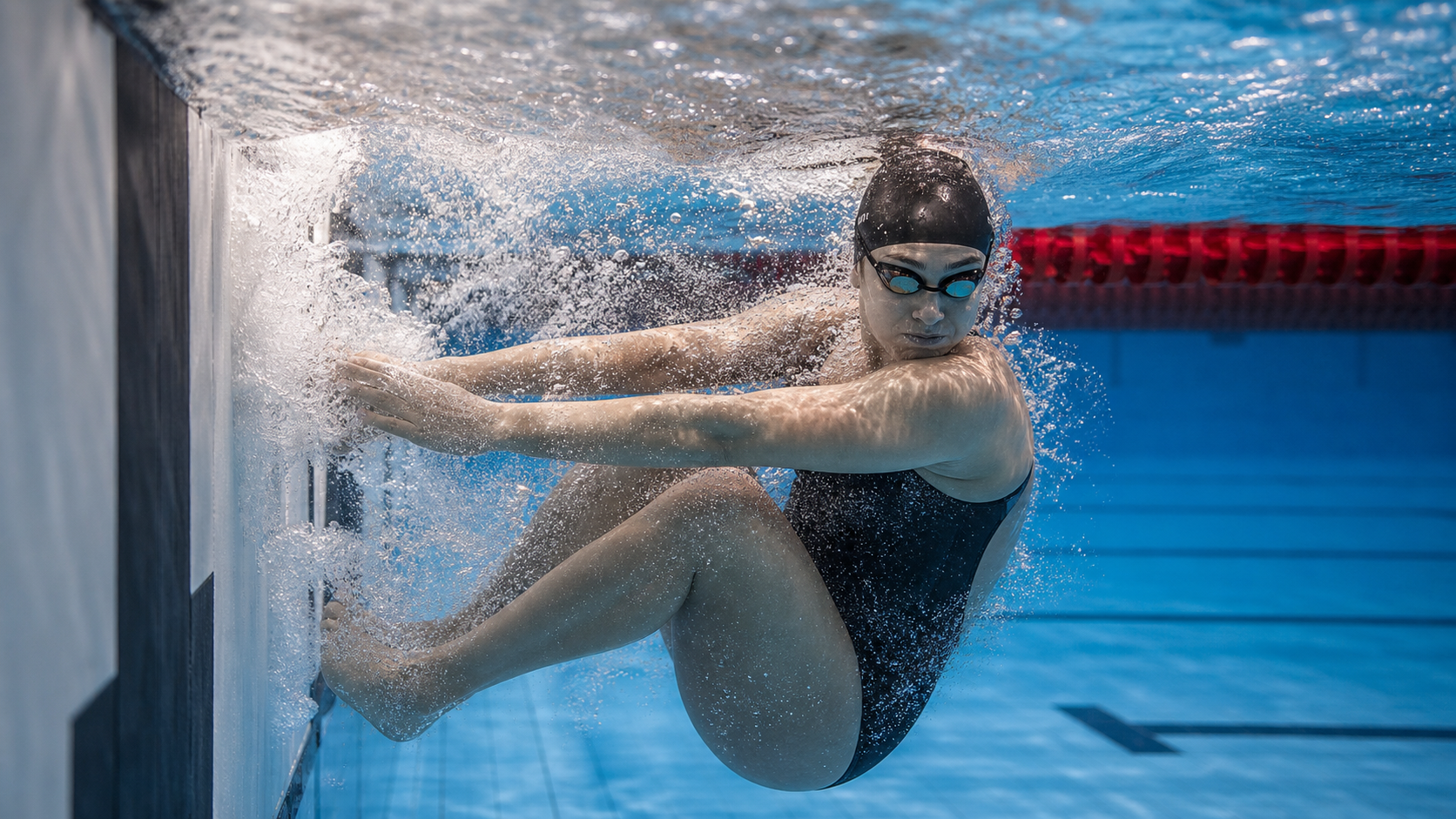
Open Turn Hand-Touch Rhythm
Breaststroke and butterfly must touch the wall with both hands simultaneously per FINA rules, so flip turns are not allowed. The so-called Open Turn uses the fulcrum provided by the moment both hands touch the wall to quickly complete a 180-degree turn and push off. Elite swimmers can complete the turn and begin pushing off within 0.7–0.9 seconds after touching the wall.
1. The “Hard” vs. “Soft” Hand Touch
There are two styles of touching the wall:
| Style | Description | Best Suited For |
|---|---|---|
| Hard Touch | Press firmly with both hands, using the reaction force | Power-oriented swimmers, 50/100m |
| Soft Touch | Light touch and release, relying on lower-body momentum | Technique-oriented swimmers, 200m |
2. The 5 Key Phases of the Turn (timeline based on a 50m breaststroke)
- Approach phase (1 meter before the wall): sprint after the final pull, no breathing
- Moment of touch (t=0): both hands touch the wall simultaneously, wrists slightly flexed as a buffer
- Tuck and curl (t=0.1–0.3s): pull knees toward the chest, hips sink
- Rotate to the side (t=0.3–0.6s): lift the head sideways to breathe, one hand leaves the wall and swings back
- Feet on the wall and push off (t=0.6–0.9s): soles planted firmly on the wall, hands meet in a streamline
3. Two Schools of Thought on Breathing Timing
- Elite school (Adam Peaty school): take only one breath during the turn, the entire motion is lightning-fast
- Conservative school: take a big, forceful breath at the highest point of the turn to ensure ample oxygen for the next lap
For the 100m breaststroke, one big breath is recommended; for the 200m breaststroke, consider taking two.
4. The Particularity of the Butterfly Open Turn
The final arm pull before touching the wall in butterfly is critical:
- If the pull is too early: the hands miss the wall, requiring an extra small pull, wasting 0.3 seconds
- If the pull is too late: the body hits the wall and cannot generate force
- Optimal timing: begin the final pull 0.5–0.7 meters from the wall so the hands touch at a near-horizontal angle
5. Underwater Actions After Pushing Off
Per FINA rules:
- Breaststroke: after pushing off, one full pull + one full kick + one dolphin kick is allowed (added in 2014)
- Butterfly: underwater dolphin kicks are permitted, but the swimmer must surface before 15 meters
The underwater “pull out” in breaststroke is crucial, propelling the swimmer 7–8 meters in 4–5 seconds:
| Action | Time Share | Speed Range |
|---|---|---|
| Push-off glide | 1.5s | 2.4 → 1.8 m/s |
| Pull to the thighs | 1.0s | 1.8 → 2.2 m/s |
| Dolphin kick | 0.4s | — |
| Hands recover and kick | 1.8s | 2.2 → 1.6 m/s |
| Glide before first pull | 0.6s | 1.6 → 1.4 m/s |
6. Training Focus Points
- Wall-touch feel training: attach a sponge to the wall, swim in with eyes closed and feel the reaction force of the touch
- Single-hand touch drills: practice one hand at a time (left and right), then combine into both hands
- Video analysis: use a GoPro to film the underwater angle and check whether the knee angle is consistent when the feet plant on the wall
Conclusion
Although the Open Turn has more rule restrictions, details determine success or failure. A 200m butterfly has 3 turns; saving 0.2 seconds each adds up to 0.6 seconds—often the difference between gold and silver.
Related Reading
- Breaststroke Turn Technique: Two-Hand Touch Rules and Quick Turnaround
- Refining Turn Technique: Hand-Foot Coordination in Flip Turns and Wall Push-Off Power Optimization
- Comprehensive Comparison of Turn Techniques Across Four Strokes: The Art of Touch, Flip, and Rhythm
- Flip Turn Frame-by-Frame Breakdown: Touch Distance, Hip Tuck Timing, and Push-Off Angle
CT 喇低賽) 武嶺牽車 才是王道 西進牽車四小時內秘訣 攝手位置 如何判斷 防抽筋小秘訣
7 年前
抖肩舞 台灣x日本交流版 (台灣 vs 前橋) 赤城山登山賽 coincidance
8 年前
Insta 360 One 超級防手震技術實測
7 年前
戰略) Zwift Race 如何咬在第一集團 如何評估自己要開多少推力 (請開1.5倍速看)
7 年前
FTL 與 SYB 車隊專訪 西進武嶺 實用攻略分享! 2小時 如何練?!你不知道的眉角!新手準備武嶺必看 EP1 | 實力派女車友 | 精華版 | 公路車 | CTYeh
4 年前
#公路車 #西進武嶺 配速配瓦實驗 坡度分析 四小時內攻略 建大盃 NeverStop #西進武嶺攻略
6 年前
[教學] Premiere 影片 手震 修正 教學 防抖 單眼 影像 GoPro 穩定 Video Stabilization
8 年前
Zwift跨國線上追逐賽 第二站 台灣 TTR vs. 日本 JETT 第二場 (台灣追日本) | 數百位國內外公路車高手,同場較勁 | 多視角賽事直播
4 年前