The Complete Guide to Freestyle Breathing Rhythm: The Scientific Choice Between 2-Stroke, 3-Stroke, and 5-Stroke
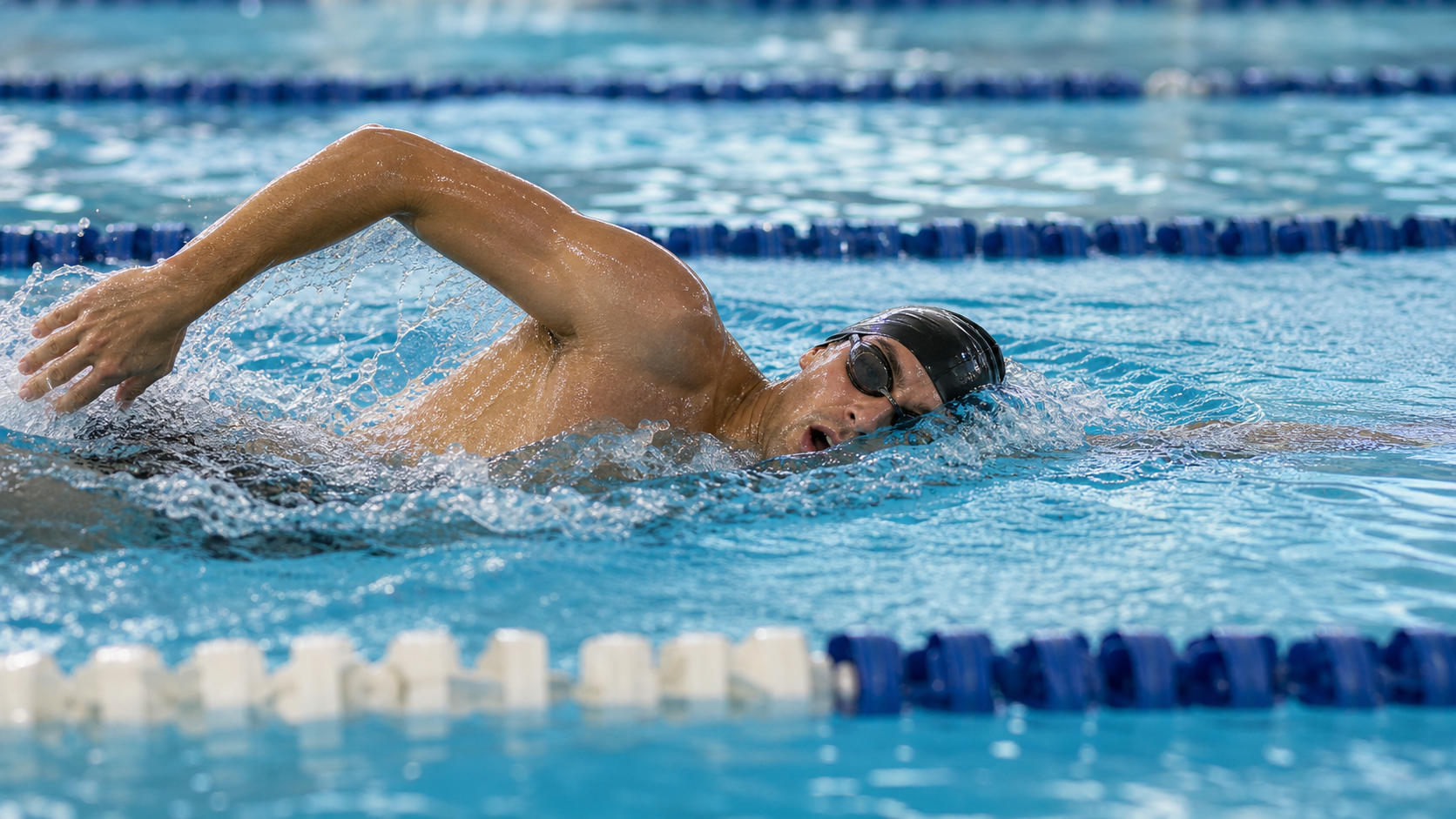
The Complete Guide to Freestyle Breathing Rhythm
Freestyle breathing rhythm has long been a topic of discussion. Beginners are often advised to use “3-stroke bilateral breathing,” yet top competitive swimmers predominantly use 2-stroke unilateral breathing. What is the science behind this?
1. Comparison of the Three Main Rhythms
| Rhythm | Breathing Frequency | Suitable Distance | Air Intake |
|---|---|---|---|
| 2-stroke | 1 breath every 2 strokes | 50–200m racing | High |
| 3-stroke | 1 breath every 3 strokes (bilateral) | Training, long distance | Medium |
| 5-stroke | 1 breath every 5 strokes | Final sprint segment | Low |
2. The Advantages of 2-Stroke
Unilateral 2-stroke is the golden rhythm for 50m and 100m freestyle:
- Maximized oxygen supply: Breathing every 1.2 seconds maintains blood oxygen saturation above 95%
- Stable head position: The body only needs to rotate to one side, making neuromuscular control more refined
- Pairs with stroke timing: Works well with “catch-up” or “front-quadrant” stroke techniques
Disadvantages: The body may drift toward the habitual breathing side (left shoulder dropping), which needs to be corrected through drills.
3. 3-Stroke Bilateral Breathing
3-stroke forces bilateral breathing and is mainly used for:
- Training balance: Prevents unilateral development of the body
- Long-distance swimming (400m and above): Reduces breathing interference with rhythm
- Open water: Allows observation of other swimmers and landmarks on both sides
Physiological impact: Breathing every 1.8 seconds reduces oxygen supply by approximately 33%. Athletes training for VO2max can tolerate this, but sprinters will feel insufficient oxygen.
4. 5-Stroke and Higher Frequencies
5-stroke (or even 7-stroke) typically appears in:
- 50m freestyle: The final 15 meters may involve complete breath-holding
- Hypoxic training sets: Deliberately reducing breathing to improve hemoglobin oxygen-carrying efficiency
However, 5-stroke does not mean “not breathing is faster.” Research shows that the speed loss from breathing itself is approximately 0.05–0.08 m/s, mainly from head lifting and body tilting; if insufficient oxygen causes a significant slowdown in the final 25m, it becomes counterproductive.
5. Recommended Rhythms by Event
| Event | First Segment | Middle Segment | Final Segment |
|---|---|---|---|
| 50m FR | 0–2 breaths | — | 0 breaths |
| 100m FR | 2-stroke | 2-stroke | 2 or 3-stroke |
| 200m FR | 3-stroke | 2-stroke | 2-stroke |
| 400m FR | 3-stroke | 3-stroke | 2-stroke |
| 800/1500m | Primarily 3-stroke | Adjust based on fatigue | 2-stroke sprint |
6. Technical Details of Breathing
Regardless of the rhythm, pay attention to the following when breathing:
- Eyes look down and to the side: Rotate the head only 70–80 degrees, not fully facing upward
- The lower goggle stays in the water: Avoid lifting the head too high, which causes the lower body to sink
- Exhale fully in the water: Don’t wait until the mouth clears the water to start exhaling
- Coordinate with body rotation: Breathing is a “result of body rotation,” not “independent head rotation”
7. Progressive Training
Suggested periodized training:
- Base phase: Focus on 3-stroke to establish bilateral symmetry
- Strength phase: Incorporate alternating 2-stroke and 3-stroke
- Race phase: Lock in the rhythm according to the target event, adding hypoxic sets
Conclusion
There is no “best solution” for breathing rhythm—only “what suits you best.” Through comprehensive analysis of heart rate, blood lactate, and split times, find your own breathing rhythm so you can maintain speed in the final 50 meters rather than fading.
Related Reading
- Freestyle Breathing: How to Choose Between 2-Stroke, 3-Stroke, and 5-Stroke? A Trade-off Chart of Rhythm and Endurance
- Freestyle Breathing Rhythm: Energy Cost Comparison of Two-Stroke, Three-Stroke, and Mixed Rhythms
- Learning Methods and Pros/Cons of Bilateral Breathing in Freestyle
- Freestyle Breathing Rhythm: Bilateral vs Unilateral Breathing—What Does Science Say?
CT 喇低賽) 武嶺牽車 才是王道 西進牽車四小時內秘訣 攝手位置 如何判斷 防抽筋小秘訣
7 年前
#公路車 #Vo2Max #最大攝氧量 測驗 體驗 | 心肺測試
6 年前
碟煞公路車 優缺點?換車一年半實際經驗分享 / 公路車 / CT Yeh
2 年前
Live) 備戰2019彰化經典百K 賽前攻略 (已完賽請看新影片
7 年前
西進武嶺 免費訓練分析服務 Intervals | 練不夠還是練過頭?你哪一種類型選手?AI模型告訴你! | 備戰神器 | 公路車 訓練 | CT Yeh
4 年前
多機位拍片神器 DJI Action 2 拍出速度張力感 | 類空拍機視角 4陣列麥克風超強降風噪 實測! | 公路車 | CT Yeh
3 年前
碟煞公路車 銑面器 !? 原來銑完差這麼多! 降低蹭碟機率! | TIME 公路車 保養小記錄 | CT Yeh
3 年前
2023桃園團體繞圈賽 / 海鷗繞圈賽 | 全程空拍數據版 | 公路車 | CT Yeh
2 年前