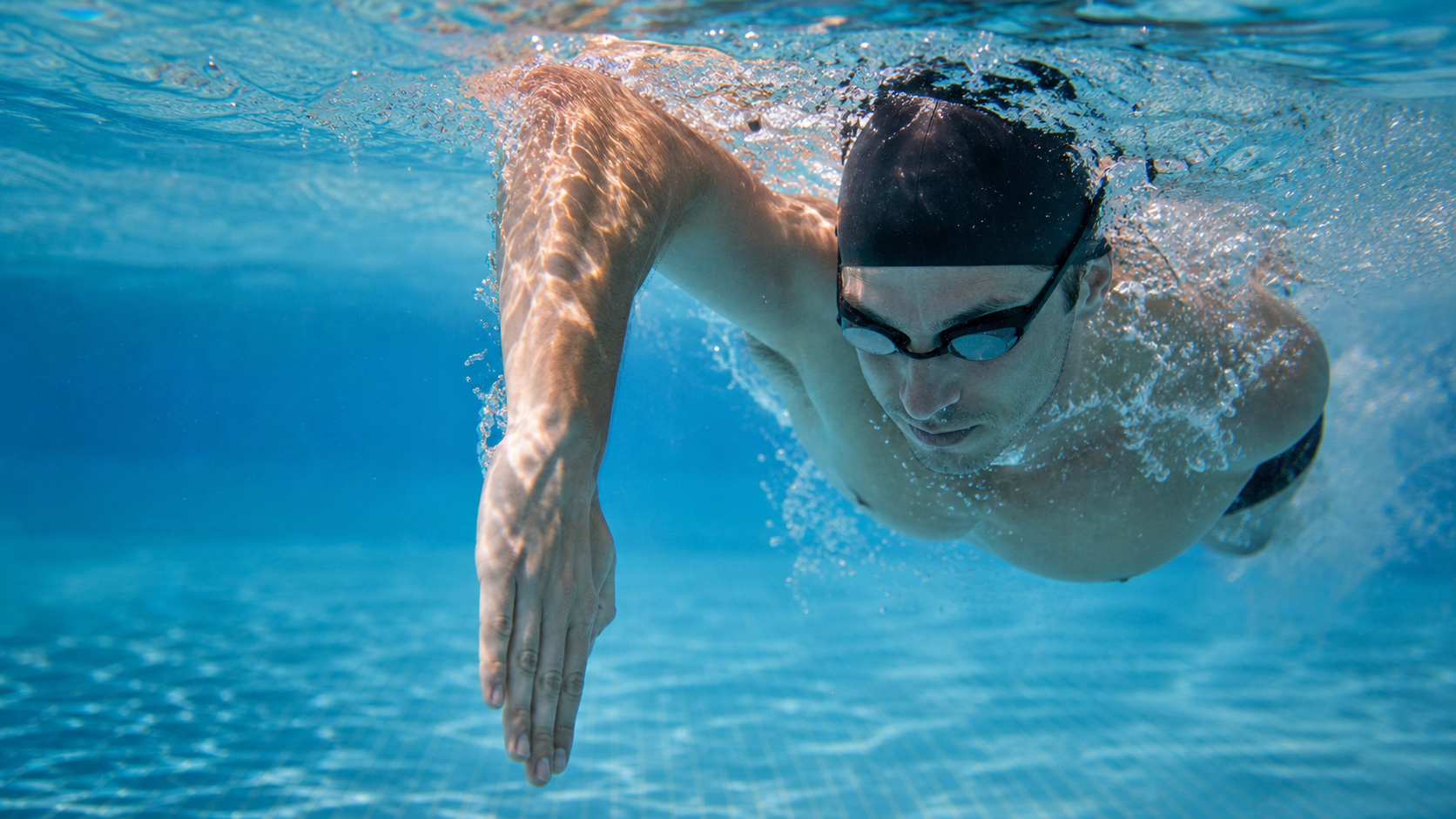
Early Vertical Forearm (EVF) Catch Technique
Early Vertical Forearm (EVF), often translated as “high-elbow catch” or “early vertical forearm” in Chinese, is one of the most important underwater techniques for modern elite freestyle swimmers. Its core principle is to get the forearm into a position “perpendicular to the direction of travel” as early and as quickly as possible during the pull cycle.
1. Why Is EVF Faster Than Straight-Arm Pulling?
With straight-arm pulling, the entire arm (from shoulder to fingertips) acts as a lever, but the actual surface area pushing water is limited. EVF, on the other hand, turns the forearm and palm into a “large paddle,” increasing the pushing surface area by more than 40%.
| Pulling Style | Pushing Surface Area | Shoulder Strain | Suitable For |
|---|---|---|---|
| Straight-arm pull | Approx. 250 cm² | High | Short-distance sprint |
| EVF high-elbow | Approx. 350 cm² | Medium | Middle-to-long distance |
2. The 4 Phases of EVF
Phase 1: Entry
- Fingertips enter the water first, at a downward angle of about 45 degrees
- Entry point is at the forward extension of the shoulder line; do not overreach across the midline
- Palm faces slightly outward (about 30 degrees) upon entry
Phase 2: Extension
- The hand extends forward and downward while the shoulder reaches forward
- This phase generates no propulsion; it merely prepares for the next phase
Phase 3: Catch
- This is the key to EVF!
- The elbow stays high (near the water surface) while the forearm rotates downward
- Viewed from the side, the forearm should be nearly perpendicular to the water surface (90 degrees)
- This movement is typically completed at a position 30–40 degrees in front of the body
Phase 4: Pull/Push
- The forearm stays vertical and pulls backward from beneath the shoulder
- The hand path resembles an “S-shape” or a “straight line,” depending on personal preference
- The pull finishes at the side of the thigh
3. Shoulder Mobility Required for EVF
EVF requires good internal rotation mobility of the shoulder joint. Testing method:
- Stand with the elbow bent at 90 degrees and tucked against the side of the body
- Forearm pointing forward
- Keeping the elbow in place, rotate the forearm downward (toward the navel)
- Healthy mobility should reach at least 70 degrees; those suited for EVF should have 80–90 degrees
4. Common Mistakes and Corrections
Mistake 1: Dropped Elbow
The elbow sinks below the forearm, preventing the forearm from becoming vertical and drastically reducing the pushing surface area.
Correction: Use sculling drills (sweeping the hand side-to-side underwater) and add assistive equipment such as the Finis paddle.
Mistake 2: Crossing the Midline
The hand crosses the body’s midline upon entry, causing an S-shaped deviation and lower-body sway.
Correction: Use a kickboard for assistance and keep both hands parallel like two railroad tracks.
Mistake 3: Catching Too Late
The hand has already extended fully forward before starting the catch, wasting the distance gained from the extension.
Correction: Fingertip drag drill, combined with catch-up practice.
5. Progressive Training Plan
| Week | Focus | Primary Drills |
|---|---|---|
| 1–2 | Feel the elbow position | Fingertip drag, doggy paddle |
| 3–4 | Forearm verticalization | Sculling, single-arm freestyle |
| 5–6 | Integrate into full stroke | Catch-up freestyle |
| 7–8 | Pace integration | 25m all-out sprint, compare stroke counts |
6. Quantifiable Metrics
Indicators of good EVF:
- Stroke Rate (SR): In a 25-meter pool, men 12–15 strokes/length, women 14–17 strokes/length
- SWOLF: Target 30–35 in a 25-meter pool
- Distance Per Stroke (DPS): 1.7–2.2 meters/stroke
Conclusion
EVF is not a technique you master overnight; it takes 3–6 months of deliberate practice to become an unconscious movement. But once mastered, combined with a steady kicking rhythm, freestyle efficiency will improve dramatically.
Related Reading
- The Complete Guide to Freestyle High-Elbow Catch (EVF): How Early Vertical Forearm Lets You Gain 15% More Distance Per Stroke
- Training Methods for Early Vertical Forearm (EVF) in the Catch Phase
- Freestyle High-Elbow Catch Fully Deconstructed: The Mechanical Secrets from Entry to Pull
- Freestyle High Elbow Catch: The Most Important Pulling Technique
CT 喇低賽) 武嶺牽車 才是王道 西進牽車四小時內秘訣 攝手位置 如何判斷 防抽筋小秘訣
7 年前
FTL 與 SYB 車隊專訪 西進武嶺 實用攻略分享! 2小時 如何練?!你不知道的眉角!新手準備武嶺必看 EP1 | 實力派女車友 | 精華版 | 公路車 | CTYeh
4 年前
西進武嶺 自製新版AI配速表產生器 x 賽前攻略 抱佛腳! 沒有功率計也可以產生配速表嗎?有什麼其他眉角賽前要注意的呢? | 西進武嶺 / 東進武嶺 KOM 攻略 | 公路車 | CT Yeh
4 年前
西進武嶺 免費訓練分析服務 Intervals | 練不夠還是練過頭?你哪一種類型選手?AI模型告訴你! | 備戰神器 | 公路車 訓練 | CT Yeh
4 年前
2025崇越「西進武嶺」挑戰VLOG / 賽前改短成165曲柄會如何? / 選手昏倒? / 公路車 / CT Yeh
1 年前
[教學] Premiere 影片 手震 修正 教學 防抖 單眼 影像 GoPro 穩定 Video Stabilization
8 年前
#公路車 #西進武嶺 配速配瓦實驗 坡度分析 四小時內攻略 建大盃 NeverStop #西進武嶺攻略
6 年前
風櫃嘴 衝刺慢動作回放!
8 年前