Breaststroke Pull-Breathe-Kick-Glide Rhythm
Breaststroke is the slowest of the four strokes, yet it is also the most technique-driven. Its core lies in precise timing: Pull → Breathe → Kick → Glide. Any misalignment in one of these phases will drastically reduce efficiency.
1. Why Is Breaststroke So Difficult?
Breaststroke is the only stroke where propulsion and drag exist simultaneously. While pulling, the legs must stay together and glide; while kicking, the arms must extend forward and glide—these two actions must be completely separated and cannot overlap.
2. Breaking Down the Four-Beat Rhythm
Beat 1: Pull
- Hands sweep outward, backward, and inward from the front
- The pull path resembles a “heart” or “teardrop” shape
- Keep the elbows high during the pull (similar to freestyle EVF)
- Time share: approximately 25%
Beat 2: Breathe
- Inhale as the pull finishes and the hands recover toward the chest
- The head rises naturally with the body; do not lift it deliberately
- Keep the breathing time as short as possible (< 0.4 seconds)
- Time share: approximately 15%
Beat 3: Kick
- The kick is completed at the moment the arms extend forward
- Heels draw toward the buttocks → feet turn outward → drive backward forcefully
- Finish with both feet together
- Time share: approximately 25%
Beat 4: Glide
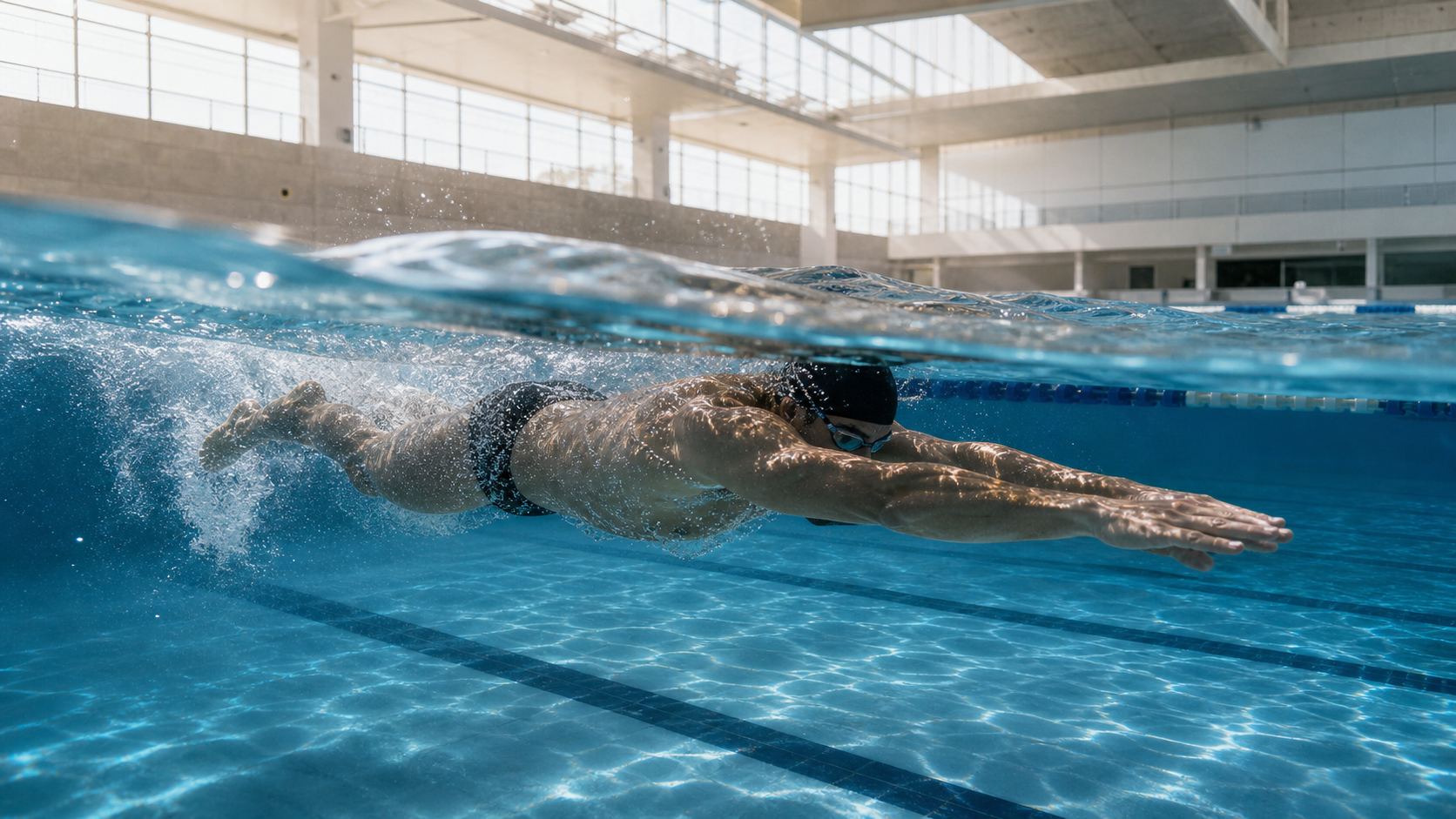
- Arms extended forward and together, legs together, body fully elongated
- Glide duration varies by distance and event
- 50m sprint: glide 0.2 seconds; 200m cruise: glide 0.6–0.8 seconds
- Time share: approximately 35%
3. Adam Peaty’s “Fast Breaststroke” Philosophy
World record holder Adam Peaty uses an extremely short glide rhythm:
| Event | Peaty’s Rhythm | Traditional Rhythm |
|---|---|---|
| 50m stroke count | 13–14 strokes | 18–20 strokes |
| Glide time | 0.1–0.2 seconds | 0.4–0.6 seconds |
| Speed per stroke | 1.95 m/s | 1.65 m/s |
Peaty’s approach is not about skipping the glide—it’s about “gliding fast.” His speed during the glide phase is far greater than that of most swimmers.
4. Common Mistakes and Fixes
Mistake 1: Arms and Legs Moving Simultaneously
Pulling and kicking at the same time creates overlapping drag.
Fix: Deliberately separate the phases; practice with a 1-2-3-4 count.
Mistake 2: Knees Opening Too Wide
During the recovery, the knees flare outward beyond shoulder width, creating significant drag.
Fix: Point the knees downward and draw the heels toward the buttocks (not the knees toward the chest).
Mistake 3: Feet Not Turned Outward
If the feet stay in a natural downward position during the kick, they cannot push water effectively.
Fix: Practice dorsiflexion plus eversion of the feet; this can be done against a wall.
Mistake 4: Lifting the Head Too High
Raising the entire head out of the water during the breath causes the lower body to sink.
Fix: Keep the chin close to the water surface; lift only enough for the mouth to inhale.
5. Optimizing the Pull-out
After the start and turns in breaststroke, one dolphin kick is permitted:
- Push off the wall and glide in a streamlined position for 1.2–1.5 seconds
- Pull the arms back to the thighs (with a wider range than in freestyle)
- One dolphin kick (added in 2014)
- Recover the hands to the chest
- Draw the legs in and perform the breaststroke kick
- Take the first breath with a head lift
The entire pull-out should be completed within 6–7 meters, taking approximately 4.5–5.5 seconds.
6. SWOLF Metric
Breaststroke SWOLF target (25m stroke count + time):
- Elite men: 35–40
- Elite women: 38–43
- Advanced amateurs: 45–55
Conclusion
The rhythm of breaststroke requires long-term accumulation. We recommend recording video analysis of your own timing to identify which beat is weakest, then train it specifically. A smooth breaststroke swimmer covering 100 meters doesn’t need to accelerate noticeably—they will naturally be faster than a swimmer who struggles and forces their way through.
Related Reading
- Breaststroke Arm-Leg Coordination: Biomechanics of Glide Timing and Knee Flexion Angle
- Breaststroke Technique Rebuild: How the Three-Phase Timing of Streamline, Catch, and Recovery Determines Your Efficiency
- Breaststroke 100m/200m Race Strategy: Glide Efficiency and Rhythm Control
- Biomechanics of the Breaststroke Leg Action: The Science of External Rotation and Propulsive Force
CT 喇低賽) 武嶺牽車 才是王道 西進牽車四小時內秘訣 攝手位置 如何判斷 防抽筋小秘訣
7 年前
Live) 備戰2019彰化經典百K 賽前攻略 (已完賽請看新影片
7 年前
[教學] Premiere 影片 手震 修正 教學 防抖 單眼 影像 GoPro 穩定 Video Stabilization
8 年前
[教學] Dashware 教學 如何製作有 速度 功率 心律的 騎車影片 Guages Video
8 年前
如何把 GoPro 影片 翻轉 批次 轉正?
6 年前
戰略) Zwift Race 如何咬在第一集團 如何評估自己要開多少推力 (請開1.5倍速看)
7 年前
滑雪新手們慘摔學習全紀錄(請開字幕),滑雪好好玩 | Snowboard + Ski | 岩原 スキー場 | 滑雪APP使用 | GoPro Max
6 年前
教學) 如何做出專業 慢動作 影片 Slow Motion 120fps GoPro 7 ActionCam AX700 A99II
7 年前