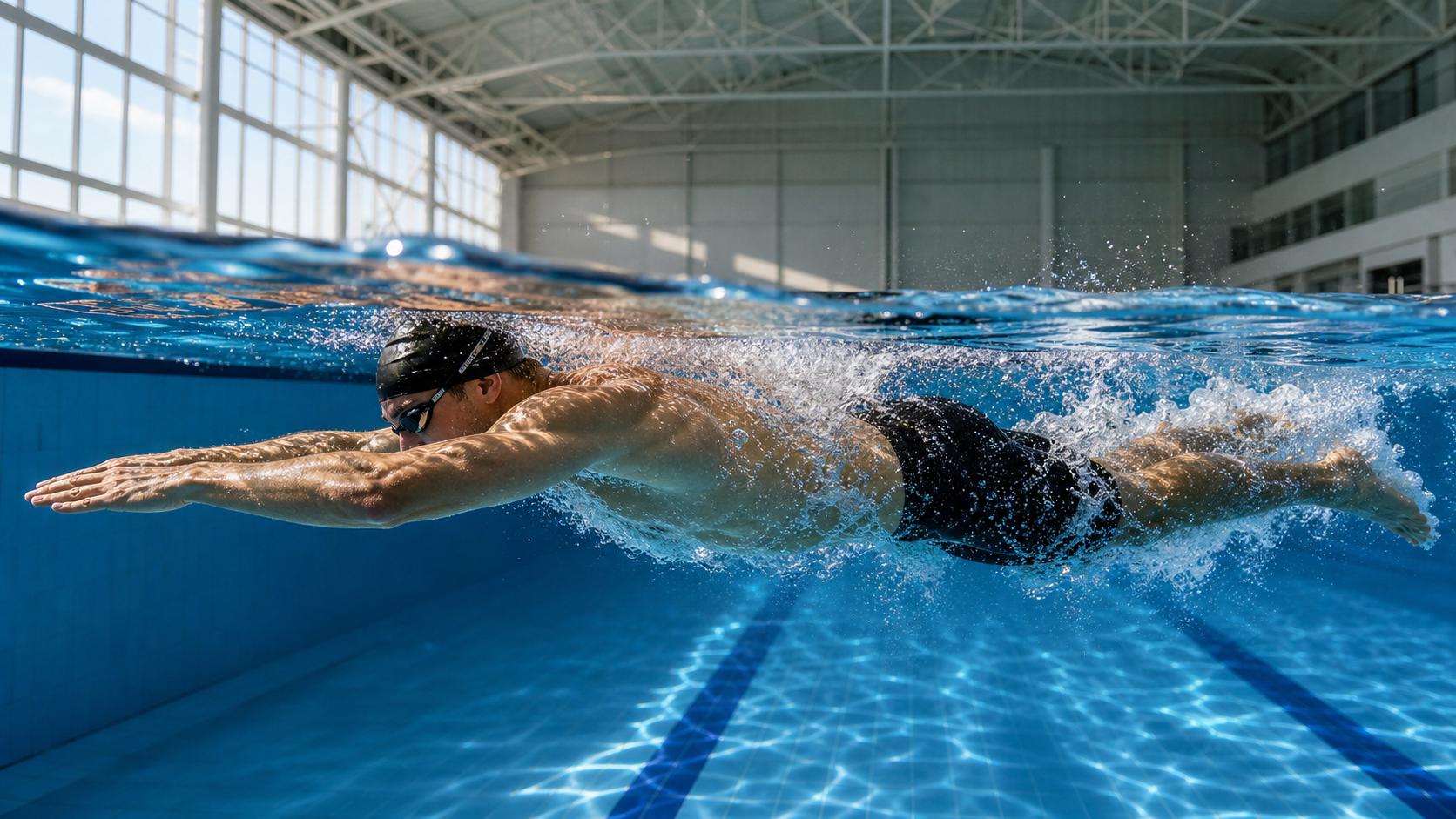
Butterfly Wave Rhythm: Force Distribution Between the Two Kicks
Butterfly is known as “the most beautiful stroke,” but it is also the most energy-demanding. Its signature movement is two dolphin kicks per stroke cycle—the “entry kick” and the “exit kick.” These two kicks are not applied with equal force; each has its own specific role.
1. The Roles of the Two Kicks
| Kick | Timing | Function | Force Share |
|---|---|---|---|
| First (entry kick) | When hands enter the water | Propulsion, balance | Approximately 40% |
| Second (exit kick) | At the end of the pull, when hands exit the water | Primary propulsion | Approximately 60% |
2. Four Key Points of the Wave Rhythm
Point 1: Hand Entry + First Kick
- Hands extend forward into the water, shoulders pressing forward
- Simultaneously, legs kick downward while the hips rise
- The body is at the lowest point of the “wave” shape
Point 2: Catch + Hip Rise
- Hands begin the catch (similar to freestyle EVF)
- Hips reach the highest point at the water surface
- This is the crest of the “wave”
Point 3: Pull + Second Kick Preparation
- Hands push through to the thighs
- Legs recover in preparation for the second kick
- Body prepares to breathe
Point 4: Exit and Breathe + Second Kick
- Hands exit the water and recover forward
- Simultaneously, legs kick forcefully downward
- Head lifts to breathe (breathe every 1 or 2 strokes)
3. Hip-Driven Principle
Butterfly kick is not “the legs kicking”—it is “the hips driving the legs”:
- The hips undulate up and down, like the root of a whip
- The motion transfers to the knees (middle of the whip)
- Finally reaching the feet (tip of the whip) to generate propulsion
Test: During kickboard butterfly kick, if the knees bend significantly while the hips stay still, that is an incorrect “leg kick” rather than a “hip kick.”
4. Breathing Rhythm Options
| Rhythm | Breathing Frequency | Suitable Distance |
|---|---|---|
| 1:1 | Breathe every stroke | 200m butterfly |
| 2:1 | Breathe every 2 strokes | 50–100m butterfly |
| Mixed | No breathing during sprint segment | Final 15m of 50m |
5. Elite Swimmer Data
Using elite men’s 100m butterfly (51 seconds) as an example:
- Stroke count: approximately 14–16 per 50m
- Breath count: approximately 7–8 per 50m
- Second kick amplitude: hips undulate approximately 30 cm
- First kick amplitude: approximately 20 cm
6. Common Mistakes
Mistake 1: Equal Force on Both Kicks
Causes rhythm disruption and wasted energy.
Correction: Deliberately kick lightly on the first kick and heavily on the second; practice with counting drills.
Mistake 2: Hips Not Moving
Kicking only with the knees creates excessive splash and insufficient propulsion.
Correction: Underwater kickboard butterfly kick—hold the kickboard against the water surface with both hands to force hip-driven movement.
Mistake 3: Breathing Too High
Lifting the head too high causes the lower body to sink, making the next stroke entry difficult.
Correction: Keep the chin close to the water surface; look forward rather than upward.
Mistake 4: Insufficient Arm Strength
Trying to muscle through the pull only leads to increasing fatigue.
Correction: Strengthen the latissimus dorsi and core; add pull-ups and lat pulldowns to strength training.
7. Progressive Training Plan
| Phase | Focus | Training Volume |
|---|---|---|
| 1 | Kickboard butterfly kick, find hip drive | 200m butterfly kick per session |
| 2 | Single-arm butterfly (one arm at side, one arm doing butterfly) | 4×50m |
| 3 | 3-stroke full stroke + 2-kick drill | 8×25m |
| 4 | Integration training | 50–100m repeats |
8. SWOLF Goals
25m butterfly SWOLF:
- Elite men: 30–35
- Elite women: 33–38
- Advanced enthusiasts: 40–50
Conclusion
Butterfly may appear to be dominated by strength, but it is entirely a display of rhythm and technique. A slender swimmer with precise rhythm can swim far faster than a strong swimmer with disordered timing. Refining the wave rhythm is the essential path to advancing in butterfly.
Related Reading
- Butterfly Dolphin Kick and Body Wave Coordination Training
- Butterfly Wave Movement: Chest and Hip Rise-and-Fall Coordination Training
- Butterfly Entry and Exit Rhythm: Balancing Streamlining and Propulsion
- Butterfly No Longer a Nightmare: A Scientific Breakdown of Dolphin Wave, Double Kick, and Energy-Saving Rhythm
西進武嶺 免費訓練分析服務 Intervals | 練不夠還是練過頭?你哪一種類型選手?AI模型告訴你! | 備戰神器 | 公路車 訓練 | CT Yeh
4 年前
西進武嶺 自製新版AI配速表產生器 x 賽前攻略 抱佛腳! 沒有功率計也可以產生配速表嗎?有什麼其他眉角賽前要注意的呢? | 西進武嶺 / 東進武嶺 KOM 攻略 | 公路車 | CT Yeh
4 年前
風櫃嘴 衝刺慢動作回放!
8 年前
CT 喇低賽) 武嶺牽車 才是王道 西進牽車四小時內秘訣 攝手位置 如何判斷 防抽筋小秘訣
7 年前
福隆鐵人團練隨拍
8 年前
武嶺配速表最佳使用方式 #bike
1 年前
下次拍照前要查清楚啦🤣 #cycling
7 個月前
單車 梅山36灣 坡度介紹 路段介紹 空拍 (相關遊記影片,請參考說明或我的頻道喔,歡迎訂閱)
6 年前