Swimming Straight in Backstroke: Visual Techniques for Ceiling, Pool Lines, and Sensory Integration
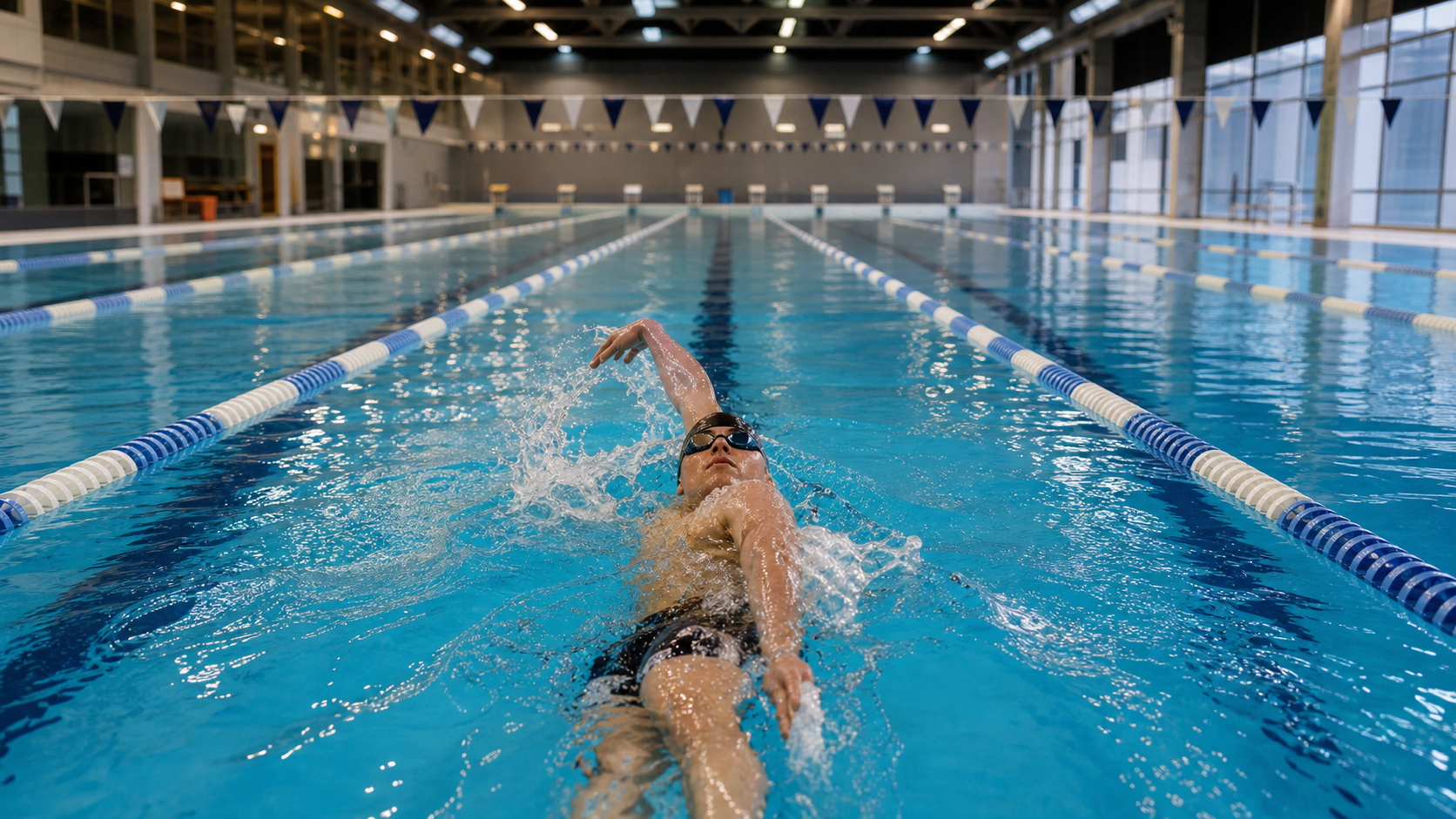
Swimming Backstroke in a Straight Line: Three Orientation Techniques
Backstroke is the only competitive swimming stroke performed face-up, which presents a unique challenge—you cannot directly see where you are going. Yet elite swimmers still manage to swim perfectly straight lines in a 50-meter pool. How do they do it?
1. Common Causes of Veering in Backstroke
- Imbalanced pulling strength between the left and right arms
- Asymmetrical kicking
- Head movement caused by breathing (backstroke still requires controlled breathing rhythm)
- Uneven body rotation on both sides
2. Three Key Orientation Techniques
Technique 1: Ceiling Landmark Method (Indoor Pools)
Most competition pool ceilings have fixed structures (beams, lights, strips) that can serve as visual references:
- Within the first 10 meters after starting, lock onto a fixed object directly overhead
- Keep your body’s central axis aligned toward that object
- Check your direction every 5 strokes
Note: Looking up at the ceiling will cause your lower body to sink. Your gaze should shift using only your eyes, not by turning your head.
Technique 2: Lane Line Awareness
Lane lines are the backstroke swimmer’s “direction sensors”:
- Use peripheral vision to sense the position of the lane lines on both sides
- If one lane line gets closer, it means your body is drifting toward that side
- Make immediate micro-adjustments to pulling force or leg direction
Advanced: Experienced swimmers can gauge how many centimeters they have drifted by feeling where their fingers touch the lane line.
Technique 3: Using the Backstroke Flags
Backstroke flags (a row of plastic pennant flags) are placed 5 meters from each wall. They are essential tools for backstroke swimmers to judge the distance to the wall:
- Start counting strokes after passing the flags
- Each swimmer should memorize “how many strokes it takes from the flags to the wall”
- Male swimmers: approximately 5–7 strokes
- Female swimmers: approximately 6–8 strokes
- The final stroke should be fully extended—never shortened midway
3. Body Position and Swimming Straight
The foundation of swimming backstroke in a straight line is body position:
| Body Part | Correct Position | Common Mistake |
|---|---|---|
| Head | Back of the head at the water surface, chin slightly tucked | Looking up toward the feet |
| Hips | Close to the water surface | Sinking below the water |
| Legs | Continuous, uninterrupted kicking | Stopping occasionally |
| Shoulders | Rotating side to side with each stroke | Completely flat and still |
4. Pulling Trajectory
There are two mainstream pulling trajectories in backstroke:
Straight-Arm Pull
- After the hand enters the water, pull straight from the shoulder line back to the thigh
- Simpler, suitable for beginners
- Lower propulsion efficiency
Bent-Arm Pull (EVF Version)
- After the hand enters the water, the elbow drops and the forearm is perpendicular to the water surface
- The pulling path resembles an “S shape”
- High propulsion efficiency; the mainstream choice among elite swimmers
5. Turn Judgment
Backstroke turns use the flip turn (permitted since the 1991 rule change):
- Count strokes after passing the backstroke flags
- Flip onto the stomach after the final stroke
- Push off the wall with both feet after completing the flip
- Roll back onto the back after pushing off
- Perform underwater dolphin kicks (within 15 meters)
6. Training Drills
Drill 1: Eyes-Closed Straight Swimming
- Spot a ceiling landmark before starting
- Swim 10 strokes with eyes closed
- Open your eyes and check whether you have drifted
Drill 2: Single-Arm Backstroke
- Keep one arm against your side while the other arm pulls
- Trains pulling strength balance on each side
- 25 meters on each side
Drill 3: 6-1-6 Drill
- 6 kicks (rotating to one side) + 1 stroke + 6 kicks (rotating to the other side)
- Trains coordination between body rotation and swimming straight
7. Quantitative Metrics
- 50m stroke count: Men 24–28 strokes, Women 28–32 strokes
- SWOLF: Men 35–40, Women 38–43
- Lateral deviation: After swimming 50m, your body should still be in the center of the same lane
Conclusion
Swimming backstroke in a straight line is not just about visual judgment—it is a comprehensive combination of strength balance, rhythm control, and muscular sensation. It is recommended to include at least one “eyes-closed backstroke” session per week to strengthen non-visual directional awareness.
Related Reading
- Core Backstroke Technique: The Triangular Relationship Between Body Roll, Straight-Arm Entry, and Consistent Kicking
- Sighting Technique: Key Training for Swimming in a Straight Line in Open Water
- Key Technical Points for Backstroke: Rotation Axis and Stroke Efficiency Improvement Guide
- Backstroke Race Strategy: Turn Counting, Turn Technique, and Sprinting
CT 喇低賽) 武嶺牽車 才是王道 西進牽車四小時內秘訣 攝手位置 如何判斷 防抽筋小秘訣
7 年前
西進武嶺 自製新版AI配速表產生器 x 賽前攻略 抱佛腳! 沒有功率計也可以產生配速表嗎?有什麼其他眉角賽前要注意的呢? | 西進武嶺 / 東進武嶺 KOM 攻略 | 公路車 | CT Yeh
4 年前
2024崇越盃西進武嶺/360VR昆陽坡定點直播/請用手指滑動畫面切視角/Panox /CT Yeh
2 年前
風櫃嘴 衝刺慢動作回放!
8 年前
[教學] Premiere 影片 手震 修正 教學 防抖 單眼 影像 GoPro 穩定 Video Stabilization
8 年前
類空拍神器 Feiyu Pocket 2s (有優惠連結)三軸穩定 運動攝影機 開箱!比GoPro 還強的滑順視角!三小時長時間錄影 行車記錄器 | 環花東365實測 | 公路車 CT Yeh
4 年前
DJI OSMO 360單車攝影 教學&技巧分享 / 概念、攝影手法、架設、後製 / 公路車 / CT Yeh
10 個月前
live) 超越北高 之一日北高12小時 策略
7 年前