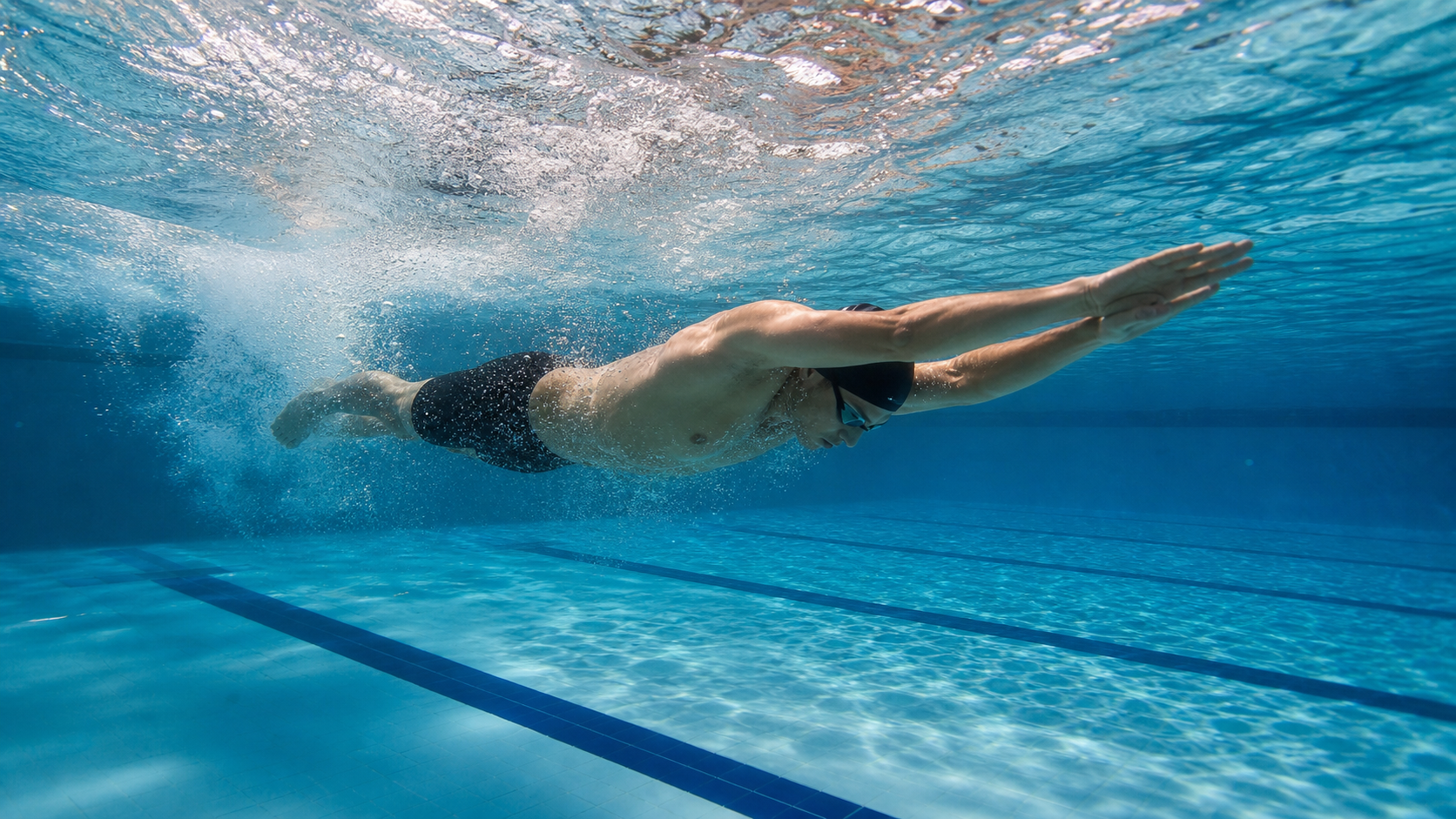
Underwater Dolphin Kick
The underwater dolphin kick, also known as the “Fifth Stroke,” is one of the most critical techniques in modern competitive swimming. It can reach speeds of 2.2–2.6 m/s, significantly faster than surface swimming at 1.9–2.1 m/s. However, FINA rules limit underwater swimming to no more than 15 meters. Maximizing propulsion within those 15 meters is the competitive focus of elite swimmers.
1. Why Is Underwater Faster Than Surface Swimming?
Surface swimming encounters two sources of drag: frictional drag and wave drag. Wave drag comes from the waves the body creates on the water’s surface, dissipating kinetic energy into the water.
When swimming underwater at a depth of approximately 0.5–0.7 meters, there is almost no wave drag, and energy conversion efficiency is 15–20% higher. This is the fundamental reason why the underwater dolphin kick is faster than surface swimming.
2. Technical Details of the Underwater Dolphin Kick
Body Position
- Hands in streamline: palms stacked, arms squeezing the ears, legs together
- The body undulates slightly, but with a smaller amplitude than the surface butterfly
- Hip-driven, with knee angle at approximately 30–40 degrees
Kicking Rhythm
- Frequency: 2.0–2.5 kicks per second
- Amplitude: hips oscillate 15–25 cm vertically
- Upkick vs. downkick force: the downkick should be slightly stronger than the upkick (approximately 60:40)
Depth
- Optimal depth: 0.5–0.7 meters
- Too shallow: generates wave drag
- Too deep: takes too long to surface
3. Underwater Dolphin Kick Strategies by Event
| Event | First Dive | Mid-Pool Turn | Final Turn |
|---|---|---|---|
| 50m FR | 6–10m | — | — |
| 100m FR | 10–12m | 8–10m | 6–8m |
| 100m Backstroke | 12–15m | 10–13m | 8–11m |
| 100m Butterfly | 12–15m | 10–12m | 6–10m |
| 200m Butterfly | 12–15m | 6–10m | 4–6m |
4. Elite Swimmer Case Studies
- Michael Phelps: 14.5m of underwater propulsion after the start in the 100m butterfly, reaching 2.4 m/s
- Caeleb Dressel: 14m underwater after the start in the 50m butterfly, a key factor in his record-breaking performance
- Ryan Lochte: Accumulated over 60 meters of underwater propulsion throughout the 200m IM
5. Training Methods
Drill 1: Timed Underwater Dolphin Kick
- Push off the wall and dolphin kick underwater for 15 meters
- Target: men under 6.5 seconds, women under 7.5 seconds
Drill 2: Vertical Kick
- In deep water, hold both arms above the surface and maintain body position using only the underwater dolphin kick
- 30 seconds per set, with 30 seconds rest between sets
- Complete 8–10 sets
Drill 3: Underwater Dolphin Kick Count
- Count how many dolphin kicks are needed to cover 15 meters
- Elite men: 8–10 kicks
- Elite women: 10–12 kicks
6. Core Strength Training
The underwater dolphin kick relies heavily on core strength:
- Dead Bug: 3 sets of 15 reps daily
- Supine Scissor Kicks: trains hip flexors and lower abs
- Air Dolphin Kick: lying on your back on the floor, simulate the underwater dolphin kick motion
- Core Power: medicine ball overhead throws
7. The Importance of Ankle Mobility
The underwater dolphin kick requires excellent ankle dorsiflexion and plantarflexion mobility:
- Plantarflexion (pointing toes): should reach 70 degrees or more
- Dorsiflexion (flexing toes upward): should reach 25 degrees or more
Improvement methods:
- Kneel sitting for 5 minutes daily (tops of feet flat on the floor)
- Roll a tennis ball under the soles of your feet
- Resistance stretching: use a resistance band to pull the foot
8. When to Surface?
Two indicators for deciding when to surface:
- Speed Decay: When underwater speed drops to 2.1 m/s (close to surface swimming speed), staying underwater no longer provides an advantage
- Oxygen Demand: If you feel the need to take a forced breath, you have been holding your breath too long, and the next lap will suffer
9. Applying the SWOLF Concept in Practice
A simple formula for calculating underwater propulsion efficiency:
- Efficiency Index = Underwater propulsion distance ÷ Underwater time
- Good: ≥ 2.2 m/s
- Excellent: ≥ 2.4 m/s
- World-class: ≥ 2.5 m/s
Conclusion
The underwater dolphin kick is often called “free speed” because it can significantly reduce race times within the rules. A 100-meter backstroke race has 1 start plus 1 turn, providing 2 underwater opportunities. Each additional 2 meters swum underwater means 2 fewer meters swum on the surface—often the difference between winning an Olympic medal or not.
Related Reading
- Underwater Dolphin Kick Distance After the Start: Rule Limits and Optimization Strategies
- Underwater Dolphin Kick: Don’t Waste the Fastest Position
- The Hidden Speed in Swimming Turns and Starts: Why the Underwater Dolphin Kick Is the Fastest Phase of the Race
- Streamline Glide After Entry: Drag Coefficient, Posture Checklist, and Training
CT 喇低賽) 武嶺牽車 才是王道 西進牽車四小時內秘訣 攝手位置 如何判斷 防抽筋小秘訣
7 年前
福隆鐵人團練隨拍
8 年前
戰略) Zwift Race 如何咬在第一集團 如何評估自己要開多少推力 (請開1.5倍速看)
7 年前
教學) 如何做出專業 慢動作 影片 Slow Motion 120fps GoPro 7 ActionCam AX700 A99II
7 年前
水金九不厭五分 10度寒流冷到不願停!feat. 卡卡 / 公路車 / CT Yeh
6 個月前
下次拍照前要查清楚啦🤣 #cycling
7 個月前
DJI Osmo Action 5 Pro 首發最強!單車運動攝影機! 一顆電池錄完KOM 西進武嶺? / 超狂夜拍效果 / 4奈米AI晶片/ 一鍵數據合成 / 公路車 / CT Yeh
1 年前
FTL 與 SYB 車隊專訪 西進武嶺 實用攻略分享! 2小時 如何練?!你不知道的眉角!新手準備武嶺必看 EP1 | 實力派女車友 | 精華版 | 公路車 | CTYeh
4 年前