Breathing Deceleration Study: The Speed Gap Between Breathing and Non-Breathing, and Training Strategies
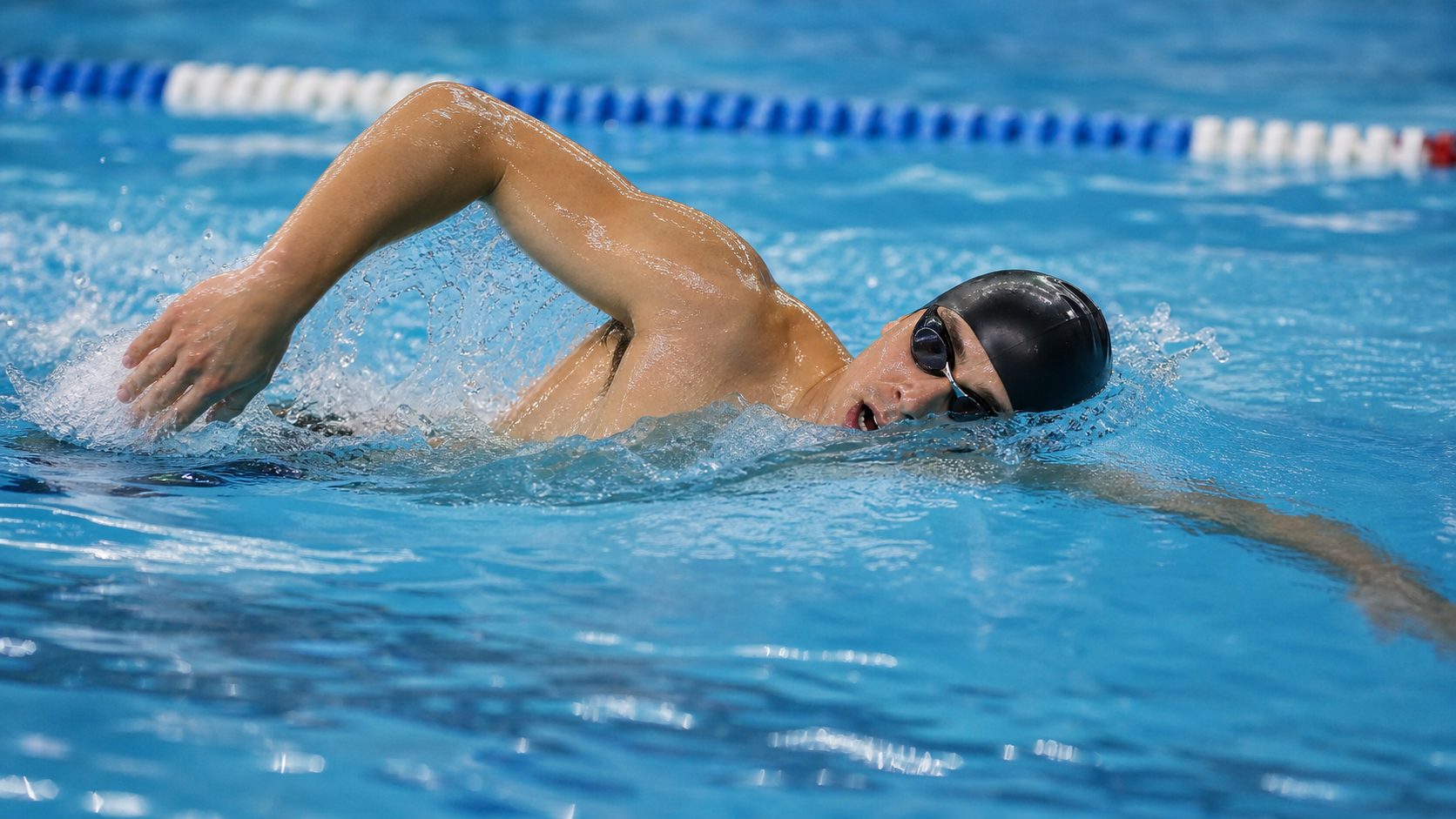
Breathing Deceleration Study: Magnitude of Deceleration and Training Strategies
Breathing is a necessary action in swimming, but it is also a speed killer. Research shows that each freestyle breath causes an instantaneous deceleration of approximately 0.05–0.08 m/s, equivalent to a time loss of 0.05 seconds. In a 100-meter freestyle with 30 breaths, this theoretically adds up to 1.5 seconds—but in reality, elite swimmers can reduce this loss to under 0.5 seconds. What’s the secret?
1. Why Does Breathing Cause Deceleration?
The three main reasons for breathing-induced deceleration:
- Head lift: The head leaves its normal horizontal position, causing the lower body to sink and increasing overall drag
- Excessive body rotation: To get the mouth above water, the body rotates extra, disrupting the streamlined position
- Interrupted stroke rhythm: The stroke taken during the breath is often weaker than a normal stroke
2. Quantitative Research Data
According to a 2018 study by the Australian Institute of Sport (AIS):
| Breathing Type | Speed Loss | Suitable Swimmers |
|---|---|---|
| Good breathing | 0.03–0.04 m/s | Elite |
| Moderate breathing | 0.05–0.06 m/s | Advanced |
| Poor breathing | 0.08–0.12 m/s | Beginner |
3. 5 Key Techniques to Reduce Breathing Deceleration
Technique 1: Minimize Head Position
When breathing, the head only needs to rotate, with the eyes looking to the side rather than upward. The lower eye remains in the water, with the waterline passing through the midline of the top of the head.
Test: When swimming, others should only see one eye and one nostril above the water, not your entire face.
Technique 2: Coordinate with Body Rotation
Breathing should be a “natural result of body rotation,” not an additional movement. A rotation angle of about 45 degrees is sufficient to meet breathing needs.
Technique 3: Exhale Fully Underwater
Many swimmers only begin exhaling at the moment they lift their head, causing most of the breathing time to be spent on “exhaling” rather than “inhaling.”
Correct approach: Exhale steadily and continuously while the head is underwater, so that only inhalation is needed the moment the head breaks the surface.
Technique 4: Don’t Slow Down the Stroke During Breathing
The stroke taken during a breath often unconsciously slows down, which is the main cause of deceleration.
Training method: Deliberately focus on the power of the breathing stroke, making it identical to the non-breathing stroke.
Technique 5: Timing of Head Return
The timing of the head returning to the water after breathing is critical:
- Too early: Insufficient inhalation
- Too late: The body has already started the next stroke, causing rhythm disruption
- Optimal: The head returns to the water just as the hand enters the water
4. Breathing Characteristics by Stroke
Freestyle
- Breathing deceleration: 0.05 m/s
- Room for improvement: Large
- Training focus: Head position, rhythm
Breaststroke
- Breathing deceleration: 0.10–0.15 m/s (breaststroke breathing is the most demanding)
- Room for improvement: Moderate
- Training focus: Breathing speed (quick in, quick out)
Butterfly
- Breathing deceleration: 0.08–0.12 m/s
- Room for improvement: Moderate
- Training focus: Don’t lift the head too high, synchronize breathing with the second kick
Backstroke
- Breathing deceleration: Almost none
- But a regular breathing rhythm is needed to avoid lactate buildup
5. Hypoxic Training
Hypoxic training improves the body’s tolerance to oxygen deprivation by reducing the frequency of breaths:
Training Example 1: 3-5-7-9 Ladder
- 25m × 4 reps
- Rep 1: Breathe every 3 strokes
- Rep 2: Breathe every 5 strokes
- Rep 3: Breathe every 7 strokes
- Rep 4: Breathe every 9 strokes
Training Example 2: No-breath 25m
- Complete 25m without breathing
- 8 reps, 30 seconds rest between sets
- Trains breath-holding capacity
Training Example 3: 5-3-5-3 Alternation
- Within a 50m, breathe every 5 strokes for the first 25m, then every 3 strokes for the last 25m
- Trains adaptation to changing oxygen demands
6. Precautions
Although hypoxic training is effective, it carries risks:
- Never do it alone (it is recommended to have a partner or coach supervising)
- Avoid surfacing to breathe after prolonged breath-holding (risk of shallow water blackout)
- Those with cardiovascular disease or asthma should consult a physician
7. Breathing Strategies in Competition
50m Freestyle
- 0–15m: No breathing (underwater dolphin kick)
- 15–35m: Breathe every 2 strokes
- 35–50m: Option to not breathe or breathe every 3 strokes
100m Freestyle
- First 50m: Breathe every 2 strokes
- Second 50m: Breathe every 2 or 3 strokes
- Final 15m: Option to hold breath and sprint
8. Quantifying Training Progress
Monthly testing:
- 25m no-breath time trial: Men’s target under 13 seconds
- 50m breathing vs. no-breathing time difference: Should be within 1.5 seconds
- 100m breathing vs. no-breathing time difference: Should be within 3.5 seconds
Conclusion
Breathing deceleration cannot be completely eliminated, but it can be minimized. A swimmer with refined technique can be only 1 second slower even with 40 breaths compared to not breathing; a swimmer with poor breathing technique may be 3 seconds or more slower. Training your breathing to be “almost imperceptible” is an essential skill for advanced swimmers.
Related Reading
- Swimming Breathing Technique: Pros and Cons of Side Breathing and Bilateral Breathing
- Not Breathing in the Final 5 Meters of a Sprint: Physiological Basis and Training Strategies
- Breathing Rhythm in Open Water: Techniques for Maintaining Long-Distance Performance
- Swimming Breathing Pattern Training: Building Tolerance for 3-Stroke and 5-Stroke Breathing
戰略) Zwift Race 如何咬在第一集團 如何評估自己要開多少推力 (請開1.5倍速看)
7 年前
碟煞公路車 優缺點?換車一年半實際經驗分享 / 公路車 / CT Yeh
2 年前
#公路車 #Vo2Max #最大攝氧量 測驗 體驗 | 心肺測試
6 年前
風櫃嘴 衝刺慢動作回放!
8 年前
SRAM FORCE E1 首發!/ 改成短腿了 / 煞車升級有感嗎? / TIME ADH 變速大升級 / 公路車 / CT Yeh
1 年前
下雨天就是要改車 #ceramicspeed #bike
1 年前
教學) 如何做出專業 慢動作 影片 Slow Motion 120fps GoPro 7 ActionCam AX700 A99II
7 年前
靠單車減肥35公斤 心得分享與整理
7 年前