Trail Running Shoe Selection: How Outsole Tread, Rock Plate, and Heel-Toe Drop Correspond to Terrain
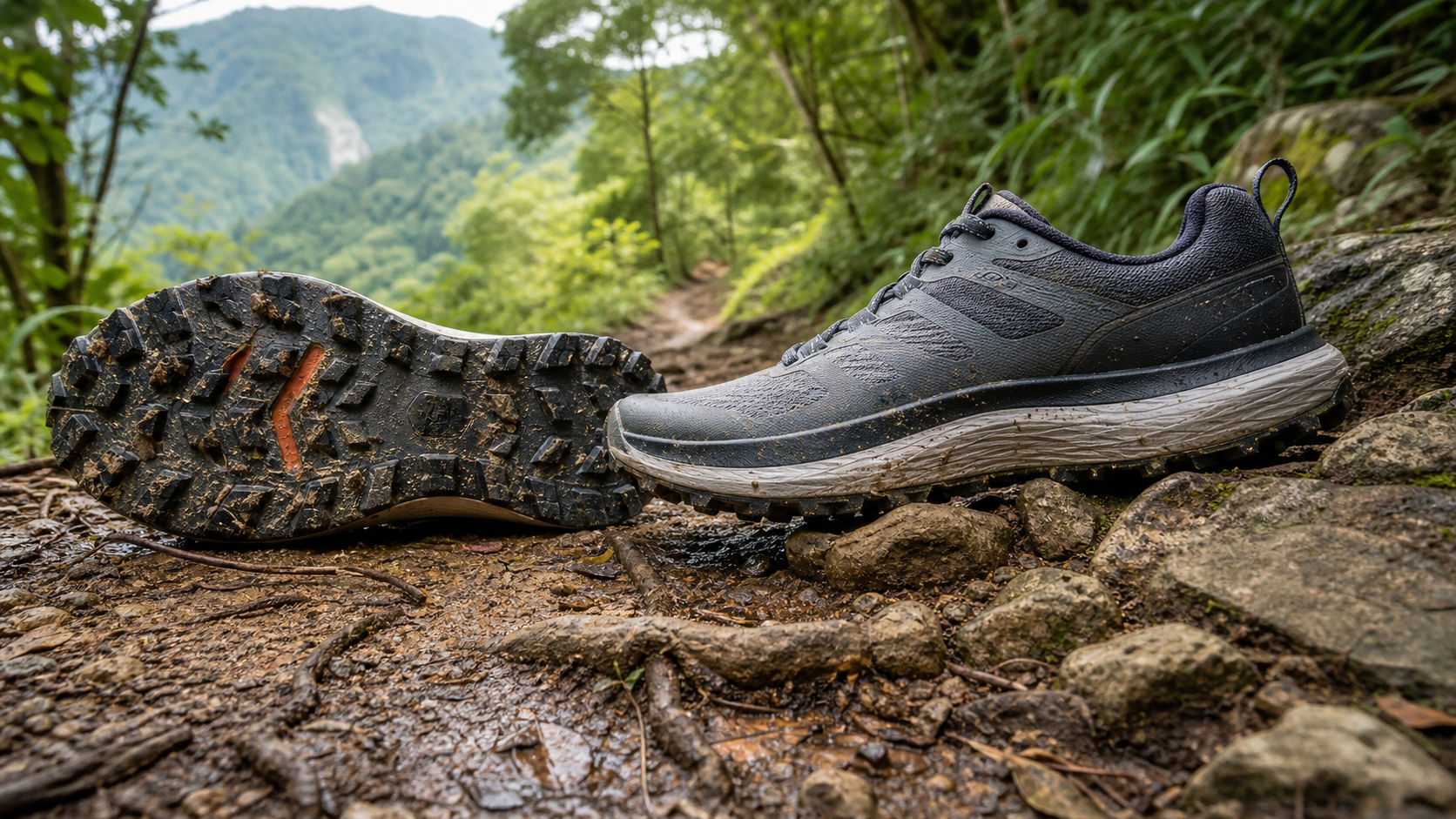
Three Key Specifications of Trail Running Shoes
When choosing shoes, don’t just look at colors and brands—look at:
- Outsole lugs: depth and shape
- Rock plate: stiffness and placement
- Drop: the height difference between heel and forefoot
Specification 1: Outsole Lugs
| Lug Depth | Suitable Terrain | Representative Shoe Type |
|---|---|---|
| 2-3mm | Hard-packed dirt, fire roads, light trails | Door-to-trail hybrid shoes |
| 4-5mm | General mountain trails, dry dirt paths | Mainstream trail shoes |
| 6-7mm | Muddy, soft ground, grass | Soft-ground specific |
| 8mm+ | Obstacle course racing, extremely muddy | OCR, military-grade trail |
Lug Shape
- Square lugs: Strong grip but noticeable braking on descents
- Diamond/triangular lugs: Multi-directional grip, balanced
- Barbed lugs: Good uphill propulsion but wear out quickly
Specification 2: Rock Plate
The rock plate is a protective layer beneath the insole that prevents rocks from jabbing into the bottom of your foot.
| Rock Plate Type | Weight | Suitable Terrain |
|---|---|---|
| No rock plate | Lightest | Soft mud, dirt paths |
| Soft rock plate (TPU) | +30-50g | General mountain trails |
| Hard rock plate (carbon/fiberglass) | +50-80g | Rocky paths, technical sections |
| Forefoot partial rock plate | +20g | Balanced choice |
Running on rocks without a rock plate will make your feet hurt so much you can’t focus; an overly stiff rock plate, however, reduces ground feedback.
Specification 3: Drop
| Drop | Characteristics | Suitable For |
|---|---|---|
| 0-4mm | Close to barefoot, forefoot-driven | Those with strong calves and Achilles tendons |
| 5-8mm | Balanced | Most trail runners |
| 9-12mm | Close to road running, heel-strike saves effort | Beginners transitioning from road to trail |
Note: Switching from a high drop to a low drop requires at least 4-6 weeks of adaptation, otherwise you risk calf and Achilles tendon inflammation.
Shoe Selection Guide for Different Terrains
Yangmingshan System, Taiwan
- Mix of hard mud, rock steps, and tree roots
- Recommended: 4-5mm lugs, with rock plate, 6-8mm drop
Datun Mountain Stream Valleys
- Primarily wet, slippery rocks
- Recommended: Sticky rubber (Vibram Megagrip), soft rock plate, avoid tall lugs
Wuling, Hehuan Mountain High-Altitude Trails
- Mix of scree and dirt paths, long distances
- Recommended: Medium lugs, with rock plate, long-distance trail shoes with generous cushioning
Snow or Ice (Yushan in Winter)
- Recommended: Use crampon-compatible shoes or choose GTX waterproof models compatible with ice spikes
Cushioning vs. Weight Trade-off
| Race Distance | Recommended Cushioning | Shoe Weight |
|---|---|---|
| <25K | Medium | 260-290g |
| 25-50K | Medium-high | 290-320g |
| 50-100K | High | 320-360g |
| 100K+ | High + wide toe box | 340-380g |
Feet swell 0.5-1 size during ultramarathons, so choose shoes half a size larger than your usual size.
Common Brand Positioning
- Salomon S/Lab: First choice for technical mountain trails
- Hoka Speedgoat: The cushioning king for ultramarathons
- La Sportiva Bushido / Mutant: Rocky terrain
- Inov-8 Mudclaw: Mud-specific
- Altra: For fans of wide toe boxes and zero drop
- Saucony Peregrine: High value all-rounder
Shoe Replacement Cycle
Trail shoe lugs wear out quickly:
- Average runner: 600-800km
- Heavy training volume: 500-600km
- Lugs worn flat by more than 50%: time to replace
Conclusion
There is no “best” trail running shoe—only trail running shoes that “match the terrain.” Look at the surfaces you run on most, then compare the three dimensions of lugs, rock plate, and drop. That’s far more reliable than trusting advertisements.
Related Reading
- Trail Running Shoe Buying Guide: A Comprehensive Comparison of Grip, Waterproofing, Protection, and Weight
- 2026 Trail Running Shoe Buying Guide: The Trade-offs Between Grip, Rock Plate, and Waterproofing
- Trail Running Shoe Buying Guide: Grip and Protection for Mountain Terrain
- The Complete Trail Running Shoe Buying Guide: From Terrain Analysis to Shoe Recommendations—Master the Art of Trail Running Shoe Selection
崇越盃武嶺冠軍高手 賽前JJSC 群峰會精華!對應大數據分析,會有落差嗎?/ feat. JJSC中部公路車約騎 /公路車 / CT Yeh
2 年前
2025 自行車錶排行榜 兩萬車友大數據 / Garmin Bryton 排名會大洗牌嗎? / 全新的碼表前身分析 /公路車 / CT Yeh
1 年前
Unaas X50 全碳纖幅條輪 數據實測對比PK | Lun Hyper 的高階版 | 板輪爬坡也可以很厲害? ! 武嶺2小時大師一起親測! CP值超高 | 公路車 | CT Yeh
4 年前
西進武嶺各路段 前8000名 大數據分析 配速攻略/功率/心律/推力比/維持率/踏頻/踏瓦比/牽車率 大公開 | 建大盃 NeverStop 可參考 | 公路車 | CT Yeh
5 年前
鉅齒紋輪組!? ControlTech MEG-T50 EVO 碳纖維幅條輪組/ 功率對比實驗 / 公路車 / CT Yeh
2 年前
單車 一日北高 ( 雙城 ) 肥宅雙人瘋狂行 紀錄片 REACTO
10 年前
單車 梅山36灣 坡度介紹 路段介紹 空拍 (相關遊記影片,請參考說明或我的頻道喔,歡迎訂閱)
6 年前
公路車 BB培林大升級! / 備戰海鷗繞圈賽 Canyon Aerod & TIME 一起改 / MIT大廠 CEMA對鎖式陶瓷培林BB & 導輪 / 公路車 / CT Yeh
2 年前