Ultramarathon Night Running Techniques: Headlamp Brightness, Nighttime Heart Rate, and Nighttime Fueling Rhythm
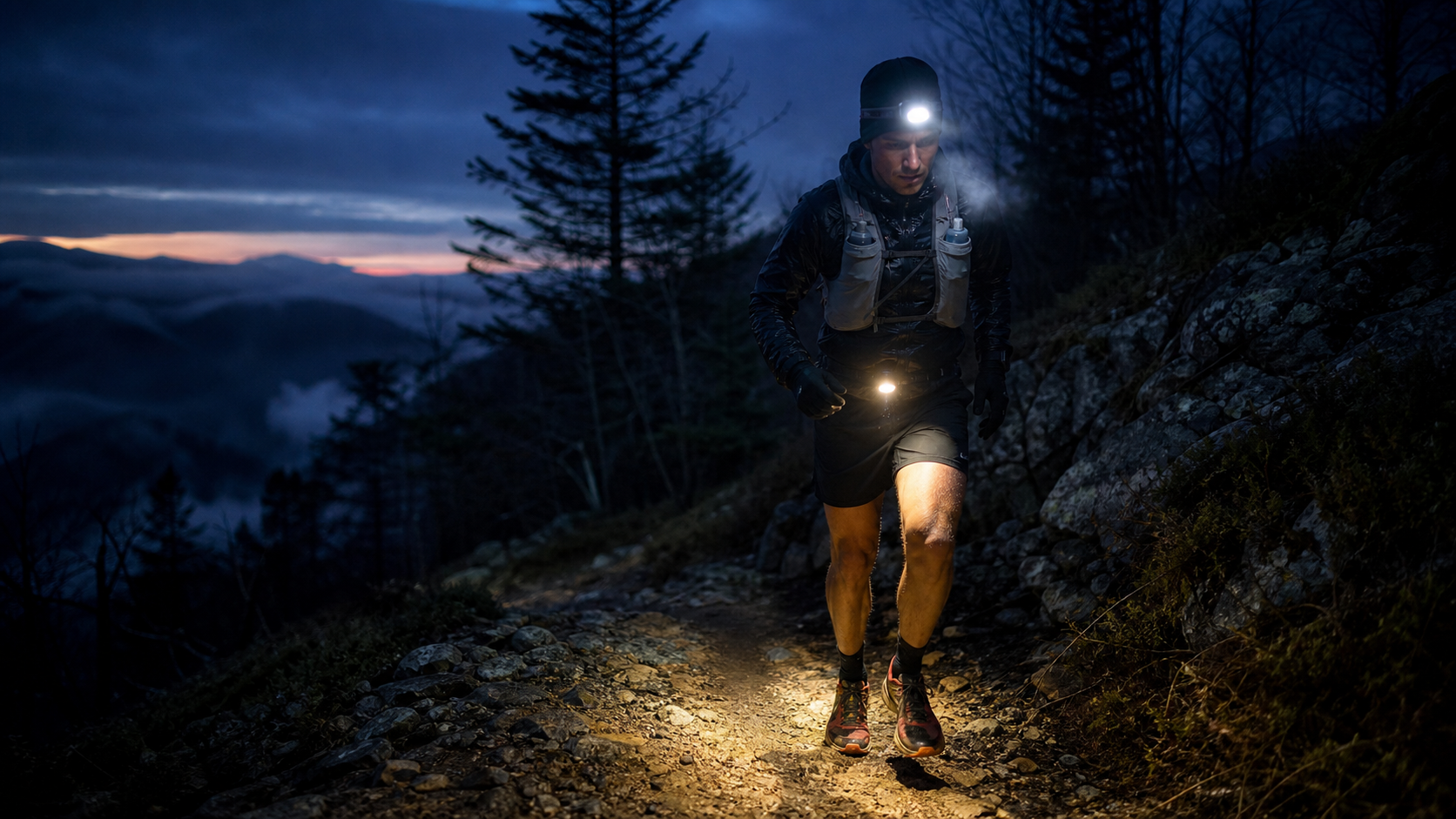
Three Core Issues of Nighttime Segments
- Limited Vision: Depth of field shortens, technical difficulty increases
- Dropping Body Temperature: Early morning cold can lead to hypothermia
- Physiological Fatigue: Circadian rhythm low point occurs between 3-5 AM
Headlamp Technique 1: Brightness Distribution
Lumen Segmentation by Use
| Scenario | Lumens | Battery Focus |
|---|---|---|
| Fire road / Gentle sections | 100-200 | Prioritize battery conservation |
| Moderately technical trails | 200-400 | Balance visibility and battery life |
| Steep descents / Rocky sections | 400-600 | Full brightness, prioritize depth of field |
| Aid station stops | 50-100 | Minimum brightness |
Dual-Headlamp Strategy
- Primary light: Mounted high on the head, illuminating 10-15m ahead
- Secondary light: Chest-mounted or waist-mounted, illuminating 2-3m at your feet
- Primary + secondary dual light sources eliminate head shadows, making depth perception more stable on descents
Headlamp Technique 2: Color Temperature Selection
| Color Temperature | Suitable Scenarios |
|---|---|
| Warm white (3500-4500K) | General trails, less eye fatigue |
| Neutral white (5000K) | All-purpose |
| Cool white (6000K+) | Rainy nights or heavy fog (stronger penetration) |
Headlamp Technique 3: Batteries and Insulation
- Lithium batteries in 0-5°C environments lose 20-30% of their charge
- Store spare batteries in the inner pocket of your vest (kept warm by body heat)
- Warm the headlamp against your body for 1-2 minutes before changing batteries
Nighttime Heart Rate Regulation
Why Is Nighttime Heart Rate Unreliable?
At night (especially 02:00-05:00):
- Parasympathetic nervous system dominates, resting heart rate can drop 8-12 bpm
- But during exercise, heart rate loses its daytime sensitivity
- At the same RPE, nighttime heart rate may be 10-15 bpm lower
How to Respond
- Switch to RPE instead of heart rate at night
- Don’t speed up just because your heart rate is low
- If your heart rate suddenly spikes, it may be a warning sign of hypoglycemia (not a signal to speed up)
Nighttime Physiological Low Point
Human core body temperature reaches its lowest point at 04:00-05:00, and athletic performance is also at its worst:
| Time Period | Performance | Response |
|---|---|---|
| 22:00-00:00 | Stable | Maintain pace |
| 00:00-02:00 | Slight decline | Increase nutrition intake |
| 02:00-04:00 | Death zone | Walk primarily, caffeine, stay warm |
| 04:00-05:00 | Lowest point | Accept slower pace, push through |
| 05:00-07:00 | Sunrise recovery | Resume pace |
Nighttime Nutrition Rhythm
Why Does Nighttime Nutrition Become Harder?
- Appetite decreases (circadian rhythm suppresses appetite)
- Taste changes (sweet foods become cloying, salty foods become more appealing)
- Cold drinks are hard to swallow
Nighttime Menu Adjustments
| Eat During the Day | Switch to at Night |
|---|---|
| Cold sports drinks | Warm soup (miso, onion soup) |
| Energy gels | Salty rice balls, potatoes |
| Bananas | Roasted sweet potatoes, bread |
| Cold water | Warm tea, hot cocoa |
Caffeine Rhythm
- No caffeine before 00:00: Save it as a weapon for alertness
- First dose at 02:00-03:00: 100-200mg (one strong coffee or 2 gels)
- Second dose at 05:00: Top up with another 100mg
- Avoid taking on an empty stomach: Pair with food to reduce stomach irritation
Nighttime Warmth
For every 5°C drop in temperature, energy expenditure increases by an additional 5-10%:
| Temperature | Recommended Gear |
|---|---|
| 15-20°C | Long-sleeve T-shirt, thin gloves |
| 10-15°C | Add an insulating layer, beanie |
| 5-10°C | Full insulation + windproof layer |
| <5°C | Waterproof jacket + buff/neck gaiter |
Key point: Add layers before you feel cold; having hot soup at aid stations adds 5-10°C of perceived warmth.
Nighttime Mental Battle
Coping with Loneliness and Fear
- Do 3-4 simulated night runs before race day (build familiarity)
- Set the next goal: “Get to the 65K checkpoint” instead of “35K to go”
- Think of pleasant things, avoid thoughts like “Will I DNF?”
Coping with Hallucinations
Common hallucinations in ultramarathons (rocks by the trail looking like animals, tree trunks becoming human figures):
- Mostly caused by fatigue and low blood sugar
- Countermeasure: Eat sugar + drink water + take a short 1-2 minute rest
- Don’t scare yourself
Night Running Training Recommendations
- Starting 8 weeks before the race, schedule 2-3 night runs per month
- Simulate race-night gear (headlamp, insulation)
- Do at least one overnight run (actually experience 2-5 AM)
Conclusion
Ultramarathon night running is a technical skill—headlamp, warmth, nutrition, and heart rate regulation are four essential elements, none of which can be overlooked. Training in advance, familiarizing yourself with your gear, and accepting that nighttime performance will inevitably decline are your greatest weapons for surviving the early-morning death zone.
Related Reading
- Ultramarathon Night Running Strategy: Headlamp Selection and Night Running Mental Preparation
- Ultramarathon Night Segments: Mental Coping in the Dark and Headlamp Selection
- Trail Race Night Pacing: The Lonely Battle Under the Headlamp—The Dual Challenge of Pacing and Psychology
- Night Road Race Gear and Safety Strategies: Lighting, Reflective Vests, and Nutrition Adjustments
西進武嶺 自製新版AI配速表產生器 x 賽前攻略 抱佛腳! 沒有功率計也可以產生配速表嗎?有什麼其他眉角賽前要注意的呢? | 西進武嶺 / 東進武嶺 KOM 攻略 | 公路車 | CT Yeh
4 年前
雷達尾燈 雷不雷? 邁金L508 智慧雷達尾燈 情境考驗實測 | 同場加映 2千元等級的專業車錶 C406 Pro | 公路車 | CT Yeh
3 年前
趣味單車配件:多功能智慧尾燈 / 有方向燈 可app編輯圖案!? / GRC x Lumii 聯名款 / 公路車 CT Yeh
9 個月前
一日北高前的高裝檢 | 北高 360 | 挑戰11小時的裝備 | 一日雙塔 | 補給
6 年前
西進武嶺 免費訓練分析服務 Intervals | 練不夠還是練過頭?你哪一種類型選手?AI模型告訴你! | 備戰神器 | 公路車 訓練 | CT Yeh
4 年前
FTL 與 SYB 車隊專訪 西進武嶺 實用攻略分享! 2小時 如何練?!你不知道的眉角!新手準備武嶺必看 EP1 | 實力派女車友 | 精華版 | 公路車 | CTYeh
4 年前
iPhone 12 Pro 夜間騎車動態錄影 效果屌打 GoPro Hero 9 | 公路車 團練
5 年前
CT 喇低賽) 武嶺牽車 才是王道 西進牽車四小時內秘訣 攝手位置 如何判斷 防抽筋小秘訣
7 年前