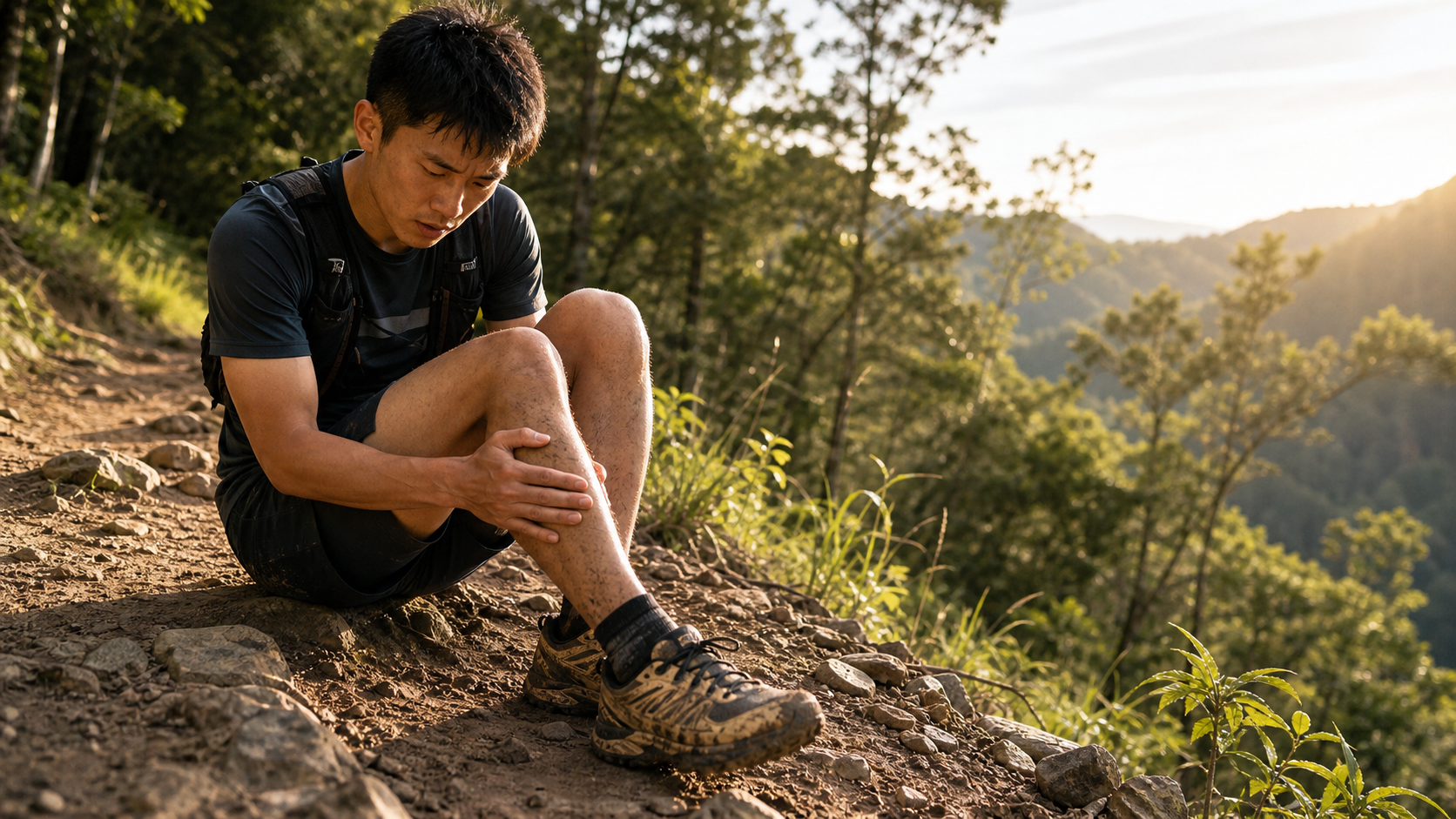
Why Are You Especially Sore After Trail Running?
Trail running (especially downhill sections) causes far more muscle damage than road running, due to Eccentric Contraction.
Eccentric vs Concentric Contraction
| Contraction Type | Example | Muscle State |
|---|---|---|
| Concentric | Uphill, standing up from a squat | Generating force while shortening |
| Isometric | Plank | Length unchanged |
| Eccentric | Downhill, lowering into a squat | Generating force while lengthening |
Characteristics of eccentric contraction:
- Force is 30-40% higher than concentric: Can bear greater loads
- Highest rate of micro-damage: Z-line tearing of muscle fibers
- Low metabolic cost but high tissue damage: Not tiring at the moment, but extremely sore the next day
The DOMS Timeline
Delayed Onset Muscle Soreness:
| Time | Condition |
|---|---|
| 0-6 hours post-race | Muscle tightness, mild discomfort |
| 12-24 hours | Soreness begins to rise |
| 24-48 hours | DOMS peak |
| 48-72 hours | Soreness still strong |
| 4-5 days | Soreness subsides |
| 5-7 days | Full recovery |
The higher the proportion of downhill and the poorer the downhill technique, the longer DOMS lasts. After a 100-mile race, soreness can even last 10-14 days.
Muscle Damage Indicator: CK Levels
Creatine Kinase (CK) is a blood marker for muscle damage:
| CK Level (U/L) | Status |
|---|---|
| < 200 | Normal |
| 200-500 | Light training |
| 500-2000 | After heavy training |
| 2000-10000 | After a marathon/trail race |
| > 10000 | Common after ultramarathons, can reach 100000 in extreme cases |
| > 50000 | Risk of rhabdomyolysis |
7-Day Recovery Plan
Day 0 (Race Day)
- Walk slowly for 10-15 minutes: Promote blood circulation
- Ice bath (5-10°C, 10 minutes) or cold compress
- Consume 30g protein + 100g carbohydrates
- Rehydrate + electrolytes
- Do not stretch: Muscles are already torn; excessive stretching worsens the damage
Day 1 (Day After the Race)
- DOMS peak
- Walk slowly for 20-30 minutes
- Light massage (avoid the most painful spots)
- High-protein diet (1.5-2g/kg body weight)
- No weight training, no running
Day 2-3
- Soreness still high
- Swimming or cycling is fine (low-impact exercise)
- Contrast showers (3 min hot + 1 min cold × 4 rounds)
- Get 8-9 hours of sleep
Day 4-5
- Soreness subsides
- Easy jog for 20-30 minutes
- Low-intensity strength training (skip leg work)
Day 6-7
- Full recovery
- Moderate-intensity training is acceptable
- Don’t rush into intervals or trail running
Scientific Methods to Speed Up Recovery
1. Active Recovery vs Complete Rest
Research shows that active recovery (walking, swimming, cycling) is better than complete bed rest, as it helps flush out metabolic waste.
2. Cold Therapy (Ice Bath / Cryotherapy)
- Most effective within 6-24 hours post-race
- Soak in 10°C ice water for 10-15 minutes
- Whole-body cryotherapy (-110°C × 3 minutes) is equally effective
3. Compression Garments
- Wearing them 24-48 hours post-race helps reduce swelling
- Doesn’t speed up tissue repair, but reduces discomfort
4. Massage
- Only light massage within 48 hours post-race
- Deep, heavy-pressure massage during the DOMS peak actually prolongs recovery
- Fascial release is fine from days 3-7 post-race
5. Anti-Inflammatory Diet
- Eat more: berries, dark leafy greens, turmeric, salmon, nuts
- Avoid: refined sugar, alcohol, fried foods
- Be careful with NSAIDs (non-steroidal anti-inflammatory drugs): Taking them immediately after the race may interfere with muscle repair
6. Sleep
- 70% of growth hormone is secreted during deep sleep
- Aim for 8-9 hours per night for the week after the race
- You can sleep an extra 1-2 hours on the first night post-race
Recovery Principles for Large Ultramarathons (100K+)
- First week post-race: Complete rest or very light activity
- Second week: Recovery runs (30-40% of normal volume)
- Third week: Return to 60-70%
- Fourth week: Return to normal training
- Do not schedule another major race within one month post-race
Warning Signs: When to See a Doctor?
- Urine is dark red or cola-colored (rhabdomyolysis)
- Kidney-area pain, decreased urination
- Soreness lasting more than 10 days without improvement
- Localized swelling, heat, redness (possible deep infection or blood clot)
- Abnormal heart rate or chest tightness
Conclusion
Soreness after trail running isn’t a flaw—it’s the beginning of muscle supercompensation. Master the four principles of “active recovery, moderate cold therapy, adequate nutrition, sleep first”, and you’ll be stronger at the next race. But remember: return to training gradually, and don’t ramp up early just because you “feel good.”
Related Reading
- Eccentric Contraction and Muscle Damage: Why Downhill Running Leaves You Sore for Three Days
- The Science of Eccentric Muscle Damage in Downhill Running: The Muscle Breakdown Mechanism Every Runner Must Know
- The Science of Post-Run Muscle Recovery: The Mechanism of DOMS (Delayed Onset Muscle Soreness)
- The Complete Guide to Downhill Running Technique: From Muscle Mechanics to Practical Training
一日北高/長距離團騎 常見問題補充篇 / 組團或跟團的眉角 / 壯車友容易被瘦車友慢性拉爆 / 原來屁股痛可能是這個原因...? / 風場配速法 / 公路車 / CT Yeh
2 年前
2019 夏季KOM 5小 完賽心得 準備攻略 東進武嶺 夏季登山王之路 Taiwan KOM Challenge
7 年前
崇越盃武嶺冠軍高手 賽前JJSC 群峰會精華!對應大數據分析,會有落差嗎?/ feat. JJSC中部公路車約騎 /公路車 / CT Yeh
2 年前
CT 喇低賽) 武嶺牽車 才是王道 西進牽車四小時內秘訣 攝手位置 如何判斷 防抽筋小秘訣
7 年前
FTL 與 SYB 車隊專訪 西進武嶺 實用攻略分享! 2小時 如何練?!你不知道的眉角!新手準備武嶺必看 EP1 | 實力派女車友 | 精華版 | 公路車 | CTYeh
4 年前
CT 喇低賽) 單車 比賽總是沒照片? 攝影師的觀點大公開 姿勢就是力量! 請加速1.25倍收看
7 年前
一起升級!海鷗盃LSD團練...JJSC Zone2招待 騎到手抖 / 公路車 / CT Yeh
2 天前
一日北高常見問題大集合 | 攻略 | 路線 | 訓練 | 補給 | 自行車 單車 | 一日雙城 | 雙塔 | TWB北高360 | 屁股痛
6 年前