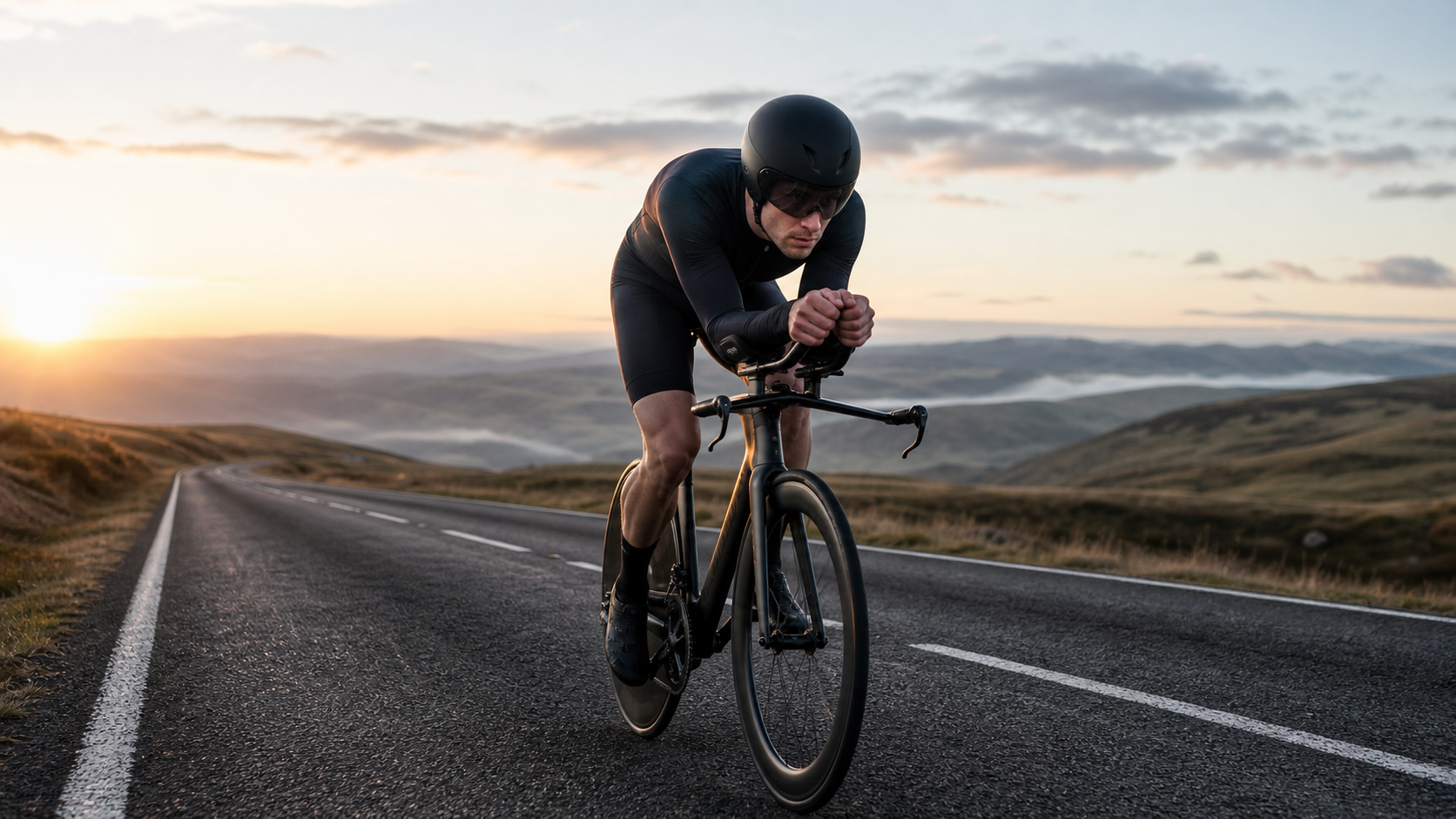
Time Trial (TT) Power Pacing: Why TT Pacing Isn’t FTP × 100%
Many cyclists participating in their first Time Trial (TT) assume, “FTP is your 1-hour power, so a 40K TT takes about 60 minutes—just pace at FTP × 100%.” In practice, almost everyone blows up—the first 20 minutes feel great, but after 30 minutes power drops to just 80% of FTP, and the last 10K becomes a crawl.
TT pacing is far more complex than a single FTP number. This article breaks it down from three angles: physiology, aerodynamics, and pacing strategy.
1. The True Definition and Limitations of FTP
FTP (Functional Threshold Power) is “the maximum average power you can sustain for approximately 60 minutes in a fresh state, in a single effort.” But this definition has two often-overlooked prerequisites:
- Fresh state: Just warmed up, with no accumulated fatigue from prior efforts
- Single maximal effort: Fully committed both mentally and physically
In a TT event, however:
- You may have been standing in the transition area for 20 minutes
- Oxygen uptake efficiency in the TT position is 3–5% lower than on a road bike
- The course has climbs, corners, and headwind sections, making power output uneven
2. Recommended Pacing for Different TT Distances
| Distance | Expected Time | Recommended Pacing (% of FTP) | Heart Rate Zone |
|---|---|---|---|
| 10K TT | 13–16 min | 105–110% | Upper LT2 |
| 20K TT | 28–32 min | 100–105% | LT2 |
| 40K TT | 55–65 min | 92–98% | Lower LT2 |
| 100K TT | 2.5–3 hr | 80–85% | Sweet Spot |
Key concept: The longer the distance, the further pacing falls below FTP, because anything over 60 minutes inevitably enters the realm of glycogen depletion and rising core body temperature.
3. The Physiological Cost of the TT Position
The aero bar position on a TT bike compresses the abdominal cavity, affecting diaphragm movement:
- Maximal oxygen uptake (VO2max) drops by 2–4%
- Heart rate rises 3–5 bpm at the same power
- Economy decreases (more oxygen consumed for the same output)
This means your “FTP” in the TT position is actually 3–5% lower than the FTP measured on a road bike. Many advanced riders test both “road bike FTP” and “TT bike FTP” separately, using the latter for pacing.
4. Pacing Strategy: Negative Split vs. Average Power
Research shows that a negative split—slightly lower early, slightly higher late—yields the best performance:
- First 1/3: 95% of target power
- Middle 1/3: 100% of target power
- Final 1/3: 102–105% of target power
In practice, however, most riders “go out too hard”—adrenaline plus environmental stimulation makes it easy to surge to target + 30W in the first 5 minutes. Use a power meter to enforce limits: for the first 5 minutes, absolutely do not exceed target + 10W.
5. The Impact of Terrain on Pacing
Variability Index (VI) = Normalized Power / Average Power.
- Flat TT: VI close to 1.00
- Rolling TT: VI of 1.05–1.10 is a reasonable range
- VI > 1.15 indicates pacing is out of control, and a late-race collapse is inevitable
On climbs, you can briefly go 5–10% above FTP; on descents, let power drop naturally but keep cadence up to avoid spinning freely.
6. Conclusion
TT pacing = FTP × distance factor × position factor × terrain factor. Simply applying FTP × 100% is the most common cause of blow-ups for beginners. Use a power meter with a preset target power range, and simulate race intensity in training to find your true “TT pacing.”
Related Reading
- Time Trial Power Pacing: The Science of Power Distribution in a 40K TT
- Predicting FTP from Short-Duration Tests: Accurate Estimation Without Riding a Full Hour
- How to Effectively Improve FTP: From Testing to Practical Training Plans
- A Comprehensive Comparison of FTP Testing Methods: Accuracy and Applicability of the 20-Minute Test vs. the Ramp Test
RAMP FTP Test 直播 究竟能撐到幾瓦 訓練台 Gravat Zwift
6 年前
西進武嶺 8000名單車友數據分析 PART1 | 從新手到高手數量/瓦數/推力比/FTP推力比/功率計使用率 大解析 | 公路車 | CTYeh
5 年前
西進武嶺配速器 3.0更新 / NEW 免功率FTP估算! / 大數據xAI體能模型 / 如何模擬人止關前集團效應 / 配速儲存功能 / AI全台自行車賽事行事曆 / 公路車 / CT Yeh
1 年前
西進武嶺 自製新版AI配速表產生器 x 賽前攻略 抱佛腳! 沒有功率計也可以產生配速表嗎?有什麼其他眉角賽前要注意的呢? | 西進武嶺 / 東進武嶺 KOM 攻略 | 公路車 | CT Yeh
4 年前
Live) 備戰2019彰化經典百K 賽前攻略 (已完賽請看新影片
7 年前
FTL 與 SYB 車隊專訪 西進武嶺 實用攻略分享! 2小時 如何練?!你不知道的眉角!新手準備武嶺必看 EP1 | 實力派女車友 | 精華版 | 公路車 | CTYeh
4 年前
車友來我家測FTP...好硬啊🤣 #cycling #公路車
2 年前
西進武嶺 免費訓練分析服務 Intervals | 練不夠還是練過頭?你哪一種類型選手?AI模型告訴你! | 備戰神器 | 公路車 訓練 | CT Yeh
4 年前