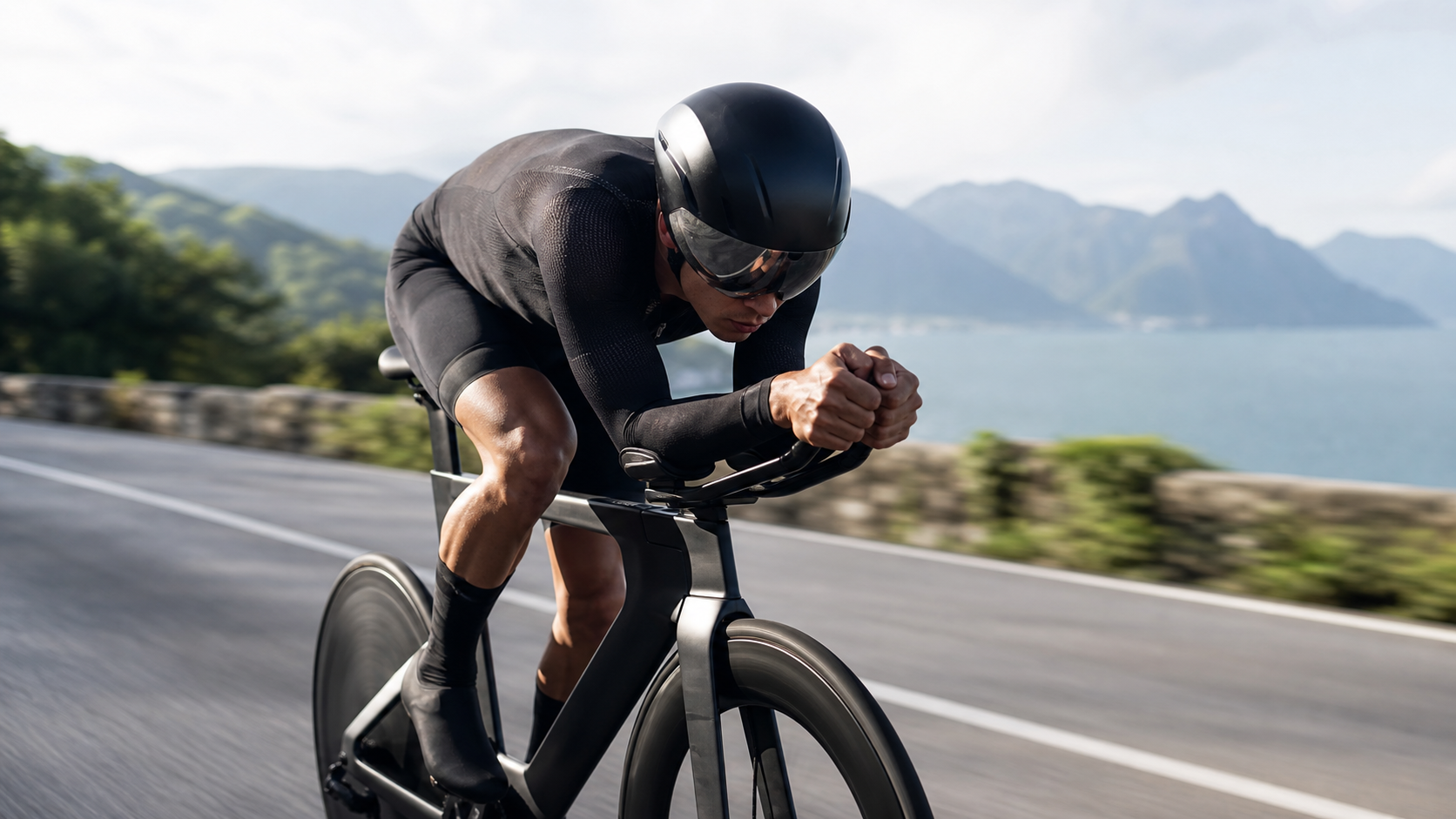
TT Bike Aero Position: The Impact of Armrests, Head, and Shoulders on CdA
In a 40K TT, aerodynamic drag consumes about 80–85% of a rider’s energy, with the remainder going to rolling resistance and gravity. In other words, reducing CdA (coefficient of drag area) by 0.01 ㎡ is equivalent to gaining about 8–12W of effective power output. Wind tunnel testing shows that position adjustments can reduce CdA by 0.02–0.05 ㎡ without changing any equipment—equivalent to getting a NT$150,000 TT bike for free.
1. Basic Concepts of CdA
CdA = drag coefficient (Cd) × frontal area (A), measured in square meters (㎡).
| Rider Position | Typical CdA (㎡) |
|---|---|
| Road bike, hoods | 0.36–0.40 |
| Road bike, drops | 0.30–0.34 |
| TT bike, general position | 0.24–0.28 |
| TT bike, optimized position | 0.20–0.23 |
| World-class TT riders | 0.18–0.20 |
2. Armrest Position
The armrests are the “anchor point” of the TT position, determining shoulder width, back angle, and pelvic position.
Width Settings:
- Armrest inner width = distance between elbows of 18–22cm is the sweet spot
- Too narrow (< 16cm): chest compression, restricted breathing
- Too wide (> 24cm): frontal area increases sharply, CdA +0.015–0.025 ㎡
Height Settings:
- Height difference between armrests and saddle: 8–15cm (drop); the larger the drop, the flatter the position, but flexibility must be considered
- Most amateur riders are overly ambitious; setting it too low causes the back to arch, which actually increases CdA
3. Head Position: The Most Underrated Variable
The head accounts for about 15–20% of the body’s frontal area and sits at the very front of the body.
Head Up vs. Head Down Differences:
- Head fully up (looking 50m ahead): CdA +0.020 ㎡
- Standard road view (looking 15m ahead): baseline
- Head tucked down (looking at the front wheel): CdA -0.015 ㎡, but you lose visibility—dangerous
Recommended Position:
- Tuck the chin slightly, look forward from above the brow bone
- Briefly lift the head every 5 seconds to check the road
- The tail of the helmet should be level with the back (not tilted up)
4. Relaxed Shoulders
Tense, shrugged shoulders can increase CdA by 0.015–0.020 ㎡ and cause early fatigue.
How to Check:
- If you hear the fabric around your shoulders “flapping” while riding → you are too tense
- Shoulders should sit slightly lower than the armrests, forming a “tucked turtle” curve
- There should be natural space between the biceps and ribs; don’t squeeze them together
5. Priority Order for Actual Adjustments
If you don’t have access to a wind tunnel or an aerosensor, make self-adjustments in this order:
- Narrow the armrest inner width to 18cm (easiest, biggest payoff)
- Lower the head until the chin is near the chest (allow 4–6 weeks to adapt)
- Actively drop and relax the shoulders (remind yourself on every ride)
- Flatten the back (keep it as straight as flexibility allows)
- Relax the fingers on the aero bars (avoid upper-body stiffness)
6. Balancing Comfort and Power Output
If an extreme aero position causes:
- Power drop exceeding 5%
- Heart rate increase exceeding 8 bpm
- Severe back pain after 30 minutes
Then that position “gains fewer watts than it loses.” The ideal TT position should achieve the following in a 20-minute test: lowest CdA + power output maintained above 95%.
7. Conclusion
TT aero optimization is the highest-ROI investment of “trading time for watts.” You don’t need to spend NT$300,000 on a disc wheel; spend 30 minutes adjusting your armrests and head position first. A single bike fit can save you 5–10W of free watts in every future TT.
Related Reading
- Aerodynamic Position for Road Bike Time Trials: Forward Lean Angle and Arm Support
- Aerodynamics and Cycling Speed: The Impact of CdA Values, Position Adjustments, and Equipment
- Interpreting Wind Tunnel Data: How Pro Teams Use Aero Data to Win Races
- Introduction to Road Bike Aerodynamics: How CdA Determines Your Watt Bill at 40 km/h
CT 喇低賽) 武嶺牽車 才是王道 西進牽車四小時內秘訣 攝手位置 如何判斷 防抽筋小秘訣
7 年前
西進武嶺 8000名單車友數據分析 PART1 | 從新手到高手數量/瓦數/推力比/FTP推力比/功率計使用率 大解析 | 公路車 | CTYeh
5 年前
再一組! 全碳幅條 碟煞/無內胎輪組 開箱! 到底好騎嗎? UNAAS X40 | 公路車 | CT Yeh
4 年前
碟煞公路車 優缺點?換車一年半實際經驗分享 / 公路車 / CT Yeh
2 年前
ThinkRider 智騎 XXPRO 訓練台,高階機種功能 只要 1/3價格!? 實測功率對比、噪音實測 / 公路車 / CT Yeh
1 年前
風櫃嘴 | 全台最多大砲的單車路線 | 尋寶網攝影師告訴你怎麼擺拍起來才好看 | 熱門攝影地點巡禮
6 年前
公路車 BB培林大升級! / 備戰海鷗繞圈賽 Canyon Aerod & TIME 一起改 / MIT大廠 CEMA對鎖式陶瓷培林BB & 導輪 / 公路車 / CT Yeh
2 年前
RAMP FTP Test 直播 究竟能撐到幾瓦 訓練台 Gravat Zwift
6 年前