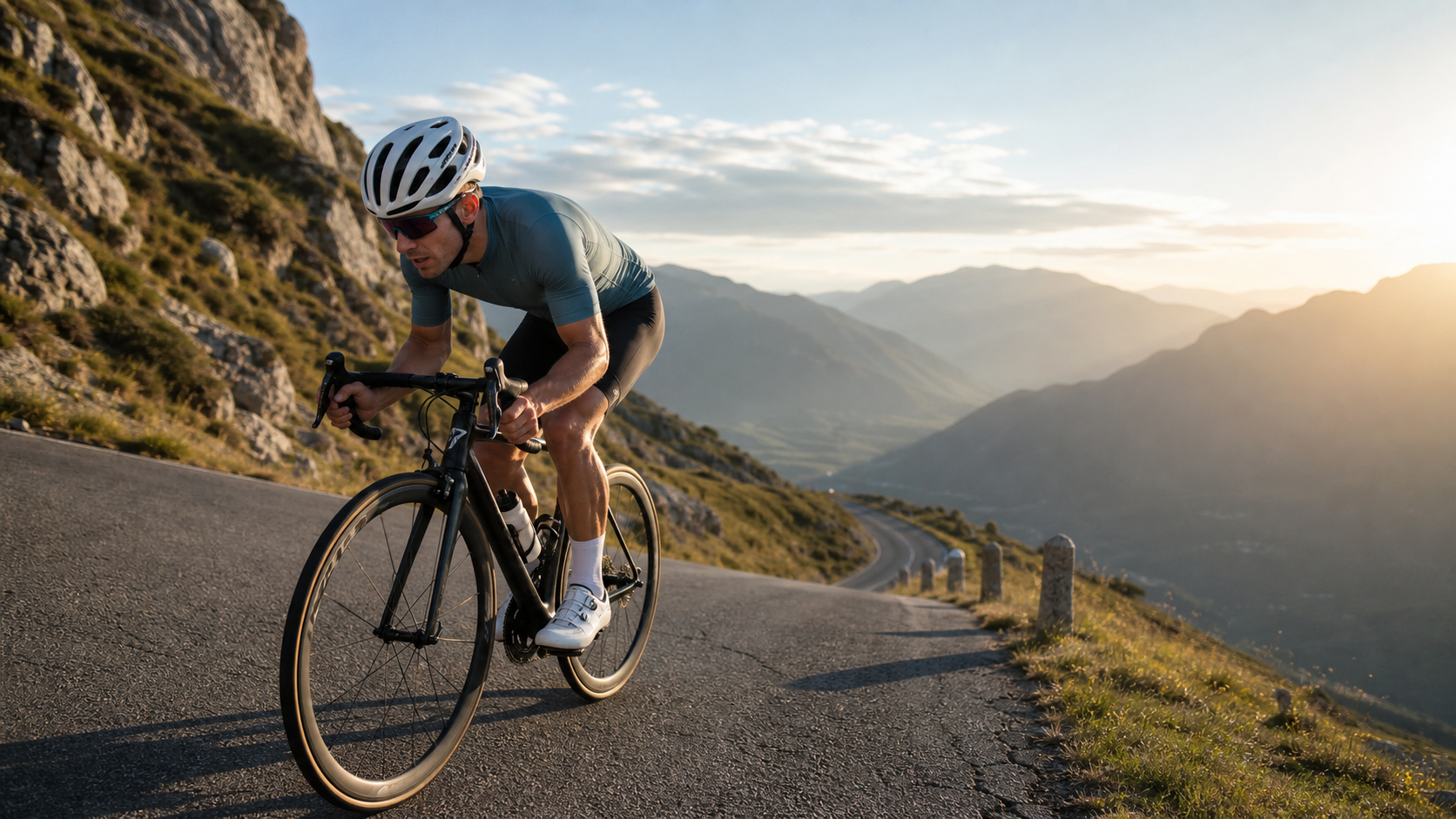
Climbing Wind Resistance Reduction Tips: The Significance of Aerodynamics on Gradients > 6%
A common saying goes: “Climbing is all about weight; aerodynamics don’t matter.” This holds partially true in pure climbing scenarios (gradient > 6%, speed < 18 km/h), but completely ignoring aerodynamics will cost you 5–15W of free watts.
This article clarifies the real impact of aerodynamics on steep climbs and provides recommendations on the trade-offs between position and equipment.
1. The Relationship Between Gradient and Speed
On steep climbs, speed drops significantly, and the “absolute impact” of aerodynamics indeed decreases:
| Gradient (%) | Typical Amateur Speed (km/h) | Aerodynamic Drag Share |
|---|---|---|
| 4 | 22 | 50% |
| 6 | 17 | 30% |
| 8 | 14 | 20% |
| 10 | 12 | 12% |
| 12 | 10 | 8% |
Conclusion: At gradients of 6–8%, aerodynamics still accounts for 20–30% of total resistance. Even at 8%, reducing CdA by 0.05 m² can save 3–5W.
2. Aerodynamic Numbers on a 6% Gradient
Assuming a rider + bike weight of 80kg, climbing an 8% gradient for 60min (approximately 4.5km):
| Position | Estimated CdA | Average Power Requirement | 60min Completion Time |
|---|---|---|---|
| Upright seated (hoods) | 0.42 m² | 285W | 27 minutes |
| Standard climbing position (lower hoods) | 0.36 m² | 278W | 26.5 minutes |
| Drops position | 0.32 m² | 273W | 26 minutes |
| Advanced low tuck position | 0.28 m² | 269W | 25.5 minutes |
Conclusion: Over a full 8% 60-minute climb, position differences can result in a 1.5-minute time gap—enough to rewrite KOM rankings.
3. Aerodynamic Position Adjustments on Steep Climbs
You can’t use a TT position on steep climbs (both stability and power output will collapse), but you can make the following adjustments:
Seated Position
- Lower your upper body: Hands on the hoods but with elbows bent and upper body slightly lowered
- Tilt your head forward: Tuck your chin slightly, looking at the road from under your brow
- Round your back: Rather than sitting completely upright
- Keep knees tucked in: Avoid knees splaying outward, which increases frontal area
Estimated CdA reduction: 0.04–0.06 m² (from 0.36 → 0.30)
Standing Position
Standing CdA is 0.03–0.05 m² higher than seated, so frequent standing on steep climbs “costs you aerodynamically.” But if you must stand:
- Place hands deeper on the hoods: Rather than on the handlebar tops
- Lean your body forward: Don’t stand upright with chest out
- Engage your core: Reduce side-to-side sway that increases frontal area
4. Equipment Selection Trade-offs
Wheels
Deep-section wheels (50mm+):
- Clear aerodynamic advantage on flats and gentle climbs
- Advantage diminishes on steep climbs (> 8%)
- But weight penalty: Typical deep-section wheels weigh 200–400g more than climbing wheels
- Recommendation: Use lightweight climbing wheels for pure steep-climb races (primarily > 8% gradient); use 40–50mm mid-section wheels for mixed-gradient races (primarily gentle climbs)
Helmets
Aero helmet vs. ventilated helmet:
- Aero helmet: CdA -0.01 m² (saves 1–2W)
- Ventilated helmet: Better heat dissipation, heart rate 3–5 bpm lower on hot climbs
- Recommendation: Use a ventilated helmet for long climbs above 25°C (cooling benefit > aero benefit)
Apparel
Skinsuit vs. regular jersey and bibs:
- Skinsuit CdA -0.02 m² (saves 2–4W)
- But poorer ventilation and comfort
- Recommendation: Wear a skinsuit on race day, regular kit for training
5. Practical Advice: Switching Focus by Gradient
| Gradient | Primary Focus | Aerodynamic Importance |
|---|---|---|
| 0–3% | Aerodynamics is king | ★★★★★ |
| 3–6% | Aerodynamics + W/kg equally | ★★★★ |
| 6–10% | W/kg primary, aerodynamics secondary | ★★★ |
| 10–15% | W/kg dominant | ★★ |
| > 15% | Pure W/kg | ★ |
6. Easily Overlooked Details
The following small things can save 1–3W on steep climbs:
- Gloves: Well-fitted thin gloves have a slightly lower CdA than loose-fitting ones
- Socks: Taller socks are more aerodynamic than short socks (sounds odd but it’s true)
- Bottles: You don’t need two bottles on steep climbs; keep only one on the downtube to reduce drag
- Jersey zipper: Zip it all the way up to avoid airflow turbulence from an open chest
- Hair: Tie back long hair or tuck it into the helmet (an advantage of short hair)
7. Mixed-Course Strategy
Most Taiwanese climbing races are a mix of “gentle climbs followed by steep climbs”:
Example: Wuling Challenge (Puli → Wuling, approximately 55K)
- First 40K: Average gradient < 4% → Aerodynamics is king
- 40–50K: Average gradient 5–7% → W/kg + aerodynamics
- Final 5K: Average gradient 8–12% → Pure W/kg
Equipment selection: Mid-section wheels (40–50mm), aero helmet, form-fitting kit. Overall finish time can be 2–5 minutes faster than using all lightweight climbing equipment.
8. Conclusion
“Ignoring aerodynamics on climbs” is the biggest misconception among amateur riders. Only on pure steep gradients > 12% can aerodynamics truly be ignored. Most Taiwanese climbing race segments average 5–8% gradient, where aerodynamic positioning and equipment can still provide 3–10W of free power. Next time you climb, remember it’s not just about “pushing hard,” but also “riding quiet (aerodynamically efficient).”
Related Reading
- Trail Running Uphill Technique: Cadence, Push-off, and Efficient Power Distribution
- Lightweight Climbing Setup: How to Optimize Bike Weight and Air Resistance for Climbs
- Weight Strategy for Climbing Races: Evaluating the Real Impact of Pre-Race Weight Loss on W/kg
- Climbing Weight Management: The Truth About W/kg and Healthy Weight Loss Strategies
公路車 爬坡 破PR 紀錄 小技巧 分享
6 年前
#公路車 #西進武嶺 配速配瓦實驗 坡度分析 四小時內攻略 建大盃 NeverStop #西進武嶺攻略
6 年前
風櫃嘴時間 預測西進武嶺時間?13000名車友統計數據分析告訴你 !
5 年前
西進武嶺 8000名單車友數據分析 PART1 | 從新手到高手數量/瓦數/推力比/FTP推力比/功率計使用率 大解析 | 公路車 | CTYeh
5 年前
大武山後門26%歡樂陡坡!JJSC南台灣單車行Day2 / 被颱風追著跑 / 公路車 / CT Yeh
2 年前
單車 梅山36灣 坡度介紹 路段介紹 空拍 (相關遊記影片,請參考說明或我的頻道喔,歡迎訂閱)
6 年前
如果Pogačar騎西進武嶺可以多快?會破2嗎?各種情況深度推估探討 / 公路車 / CT Yeh
2 年前
ThinkRider 智騎 XXPRO 訓練台,高階機種功能 只要 1/3價格!? 實測功率對比、噪音實測 / 公路車 / CT Yeh
1 年前