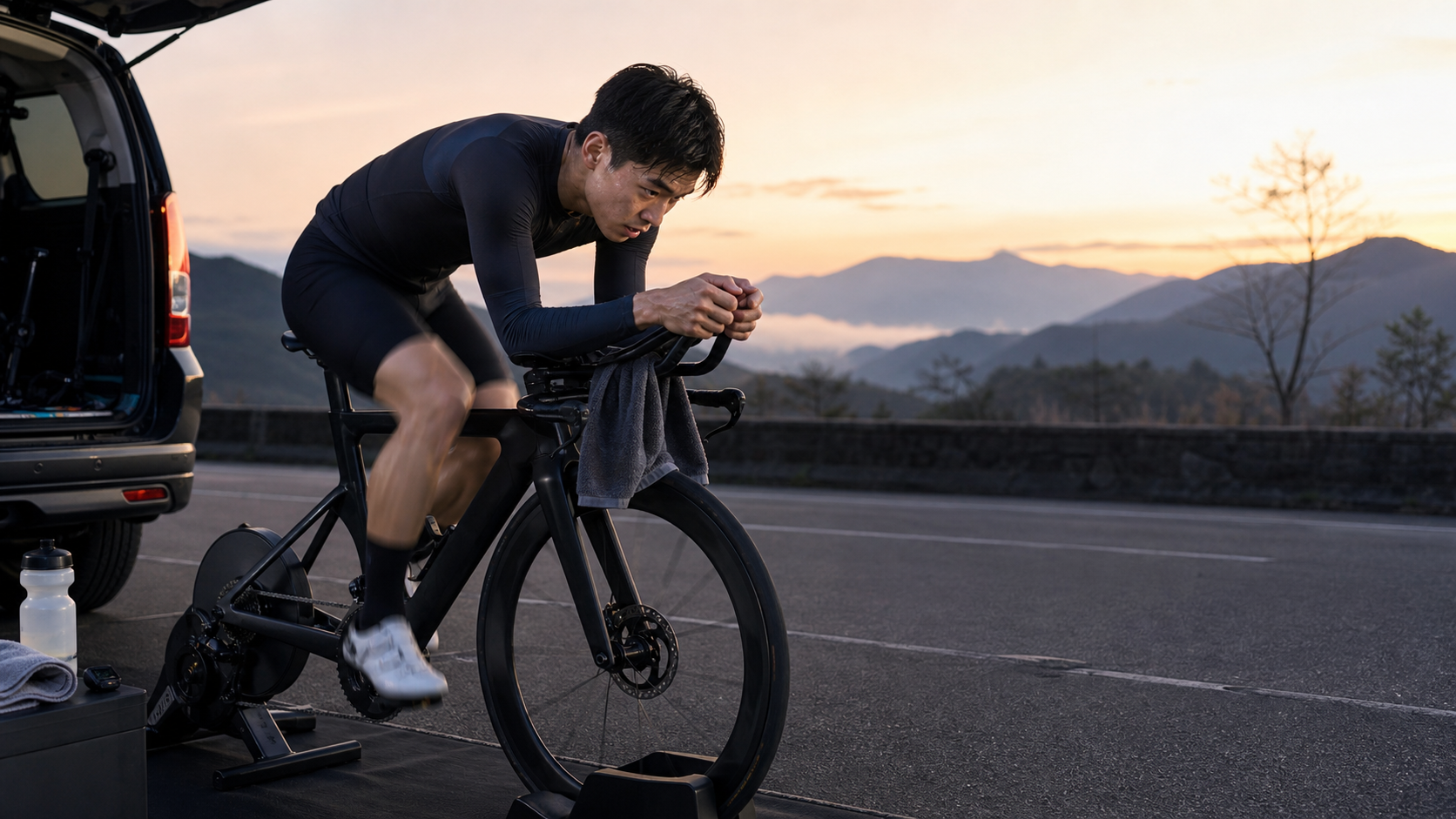
Pre-TT Warm-Up Protocol: 30-Minute Standard Warm-Up Routine
In a TT race, the first 10 minutes often determine the entire result. But 60% of your performance in those first 10 minutes depends on—how well you warmed up. Riders who start cold produce 8–15% less power in the first 5 minutes compared to those who are fully warmed up, which can translate to a 2–3 minute difference in a 40K TT.
This article provides a 30-minute warm-up protocol based on exercise physiology.
1. The Physiological Purpose of Warming Up
The physiological changes a warm-up should achieve:
- Muscle temperature rise of 1–2°C: Improved muscle contraction speed and force
- Core body temperature rise of 0.5–1°C: Increased enzyme activity
- Capillary dilation: 6–10× increase in blood flow
- Anaerobic energy system activation: Phosphocreatine + glycolysis primed
- Cardiovascular adaptation: Increased heart rate and stroke volume
- Neuromuscular activation: Improved recruitment rate and coordination
Consequences of an incomplete warm-up:
- Insufficient oxygen uptake in the first 5 minutes, rapid lactate accumulation
- Heart rate can’t keep up with demand, oxygen delivery lags behind
- Delayed neural recruitment, limited power output
2. The 30-Minute Standard Warm-Up Protocol
Phase 1: Low-Intensity Activation (0–10min)
- Intensity: 50–65% FTP (Zone 1–2)
- Heart rate: Below LT1
- Cadence: 80–95 rpm
- Purpose: Initiate blood flow, secrete joint synovial fluid, raise muscle temperature
What to do:
- Ride easy on flat or slightly rolling terrain
- Chat, listen to music, relax
- Drink 100–150ml of water, take your last gel
Phase 2: Progressive Intensity (10–18min)
- Intensity: 65% → 85% FTP (progressive)
- Heart rate: LT1 → lower edge of LT2
- Cadence: 85–95 rpm
- Purpose: Fully activate the cardiovascular system, adapt the aerobic system
What to do:
- Increase power by 5% every 2 minutes
- You should start to feel “slightly uncomfortable” by the end
- Breathing heavily but still able to speak short sentences
Phase 3: Threshold Activation (18–24min)
- Intensity: 3×2min @ 95–105% FTP (1min rest)
- Heart rate: LT2
- Cadence: 90–100 rpm
- Purpose: Activate the anaerobic system, stimulate neuromuscular pathways, adapt to race intensity
What to do:
- Simulate TT position (complete this phase on the aero bars)
- Ride easy for 1 minute between intervals
- Heart rate should reach 90% HRmax by the end
Phase 4: High-Intensity Breakthrough (24–28min)
- Intensity: 2×30sec @ 120–130% FTP (90sec rest)
- Heart rate: 95% HRmax
- Cadence: 100–110 rpm
- Purpose: Activate the phosphocreatine system, maximize neural recruitment
What to do:
- Go hard but don’t blow up
- Recover fully during the 90 seconds between efforts
- You should be sweating and your heart rate should clearly spike by the end
Phase 5: Cool-Down and Recovery (28–30min)
- Intensity: 50% FTP
- Purpose: Bring heart rate down to a controllable level before the race start (approximately 120–140 bpm)
What to do:
- Ride easy for 2 minutes
- Take your last sip of water
- Mental preparation (deep breathing, visualize the race)
3. Time Management from Warm-Up Completion to Start
The “waiting time” between finishing your warm-up and starting is the most common mistake:
| Waiting Time | Impact | Strategy |
|---|---|---|
| 0–5min | Optimal | Get straight on the TT bike and race |
| 5–10min | Heart rate slightly down but still warm | Do 1×15sec sprint 1min before the start to wake up |
| 10–20min | Already cooling down, critical! | Do 1min @ 100% FTP 5min before the start |
| > 20min | Completely cold | Must re-warm up for 5–10min |
Ideal flow: Finish warm-up → reach the start within 5 minutes → start
4. Race Day Schedule (Assuming 9:00 AM Start)
| Time | Action |
|---|---|
| 7:00 | Wake up, breakfast (carbohydrate-focused) |
| 7:30 | Check-in, pick up race number |
| 8:00 | Equipment check, bike adjustments |
| 8:15 | Bathroom, hydration |
| 8:25 | Begin 30min warm-up |
| 8:55 | Warm-up complete, head to the start |
| 9:00 | Start |
5. Warm-Up Adjustments for Special Conditions
Cold Weather (< 10°C)
- Extend warm-up to 40min
- Emphasize Phase 1 (15min low intensity) to fully raise core temperature
- Wear a warm-up jacket, remove it only in the final 5min
Hot Weather (> 28°C)
- Shorten warm-up to 20–25min
- Do Phase 1 in the shade to avoid overheating
- Keep drinking water during the warm-up, pour water on yourself to cool down
High Altitude (> 1500m)
- Extend warm-up to 35–40min
- Reduce intensity by 5% (power output is lower at the same heart rate)
- Take multiple small breaths rather than deep breaths
6. Mental Warm-Up
After the physical warm-up is complete, the mental warm-up is equally important:
- Visualization: Close your eyes and imagine the entire race
- Goal Confirmation: Reconfirm pacing, heart rate limits, and fueling timing
- Self-Motivation: Say 3 positive phrases to yourself
- Ritual Behavior: Do the same small routine before every race (tying shoes, putting on gloves)
7. Training the Warm-Up Protocol
You should rehearse this warm-up at least 5 times in training to confirm:
- Whether your power output at the end is truly “up” (test with a 1min maximal effort)
- Your optimal warm-up duration (some riders need only 25min, others need 40min)
- Your heart rate response in each phase
Don’t try a new warm-up protocol for the first time on race day—this is the most common failure among amateur riders.
8. Conclusion
The 30-minute standard warm-up protocol is an effective, sports-science-validated approach, but individualization is the key. Rehearse it multiple times in training and find the fine-tuning that works for you. A complete warm-up can improve your performance in the first 10 minutes of a TT by 10–15%, which is often the difference between finishing in the top 10 and staying in the middle of the pack.
Related Reading
- Time Trial Warm-Up Protocol: The Best 30-Minute Pre-Race Preparation
- Warm-Up Workout Design: A Progressive Morning Activation Session for Race Day
- Climbing Warm-Up Strategy: Activating Muscles and the Nervous System Before the Race
- The Science of Warming Up: The Balance Between Raising Temperature, Post-Activation Potentiation, and ‘Not Warming Up the Race’
FTL 與 SYB 車隊專訪 西進武嶺 實用攻略分享! 2小時 如何練?!你不知道的眉角!新手準備武嶺必看 EP1 | 實力派女車友 | 精華版 | 公路車 | CTYeh
4 年前
西進武嶺 免費訓練分析服務 Intervals | 練不夠還是練過頭?你哪一種類型選手?AI模型告訴你! | 備戰神器 | 公路車 訓練 | CT Yeh
4 年前
西進武嶺 自製新版AI配速表產生器 x 賽前攻略 抱佛腳! 沒有功率計也可以產生配速表嗎?有什麼其他眉角賽前要注意的呢? | 西進武嶺 / 東進武嶺 KOM 攻略 | 公路車 | CT Yeh
4 年前
Live) 備戰2019彰化經典百K 賽前攻略 (已完賽請看新影片
7 年前
CT 喇低賽) 武嶺牽車 才是王道 西進牽車四小時內秘訣 攝手位置 如何判斷 防抽筋小秘訣
7 年前
西進武嶺 8000名單車友數據分析 PART1 | 從新手到高手數量/瓦數/推力比/FTP推力比/功率計使用率 大解析 | 公路車 | CTYeh
5 年前
崇越盃武嶺冠軍高手 賽前JJSC 群峰會精華!對應大數據分析,會有落差嗎?/ feat. JJSC中部公路車約騎 /公路車 / CT Yeh
2 年前
實景訓練台) 彰化經典百K 高強度喵團 90分鐘 跟著一起練功 2019 Indoor workout Changhua Classic 100 Taiwan
7 年前