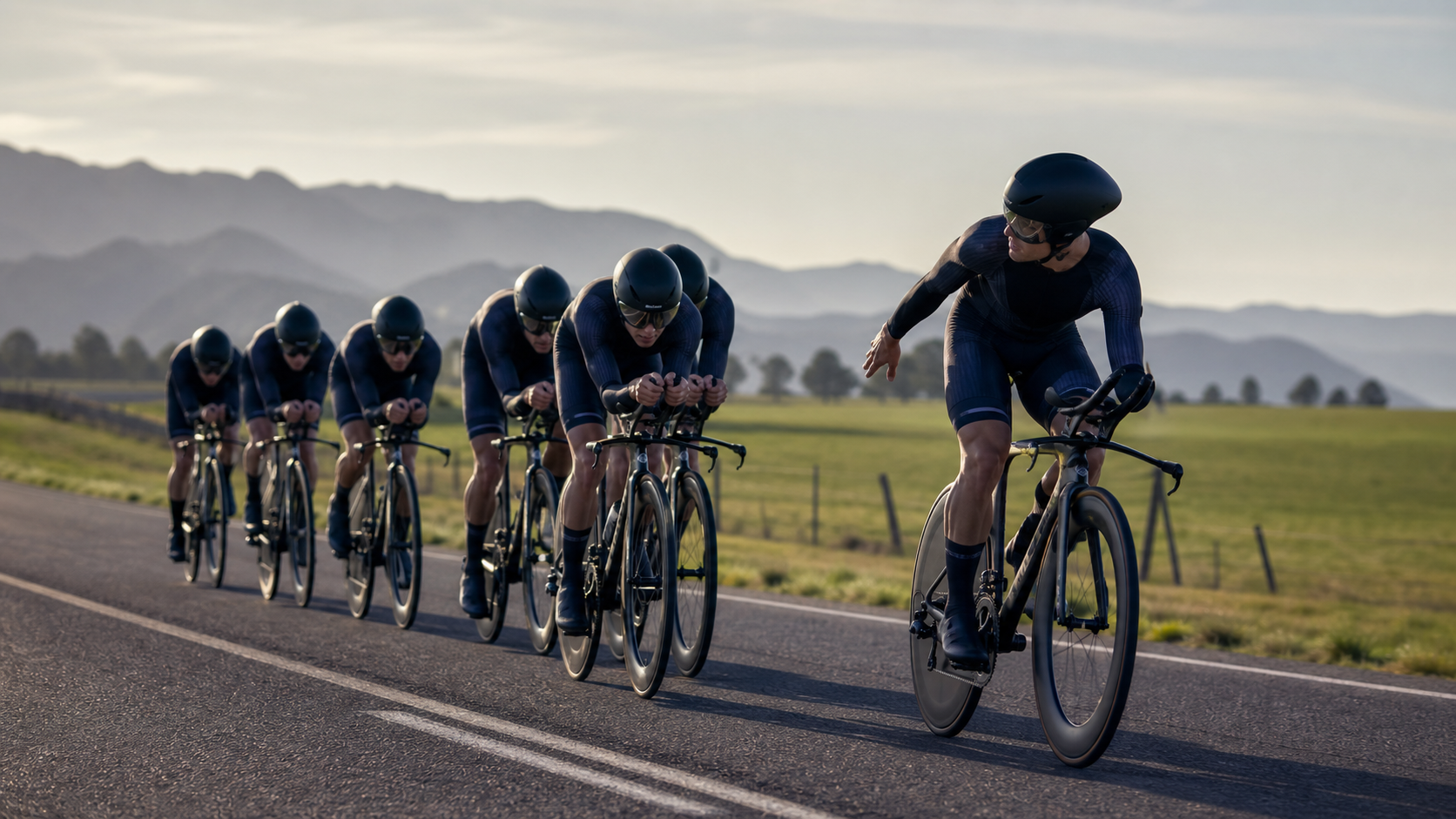
Individual TT vs. Team TT (TTT) Tactical Differences: Pulling Rhythm, Formation
An Individual Time Trial (ITT) is a battle of “man against the clock”—a pure display of physiological limits. A Team Time Trial (TTT) is “team against the clock”—where tactics, cohesion, and configuration are all essential. Although both are called TTs, the training and racing logic for each is completely different.
This article breaks down the core tactics of TTT and compares common approaches used by professional teams.
1. Basic TTT Rules
- Team size: Usually 4–6 riders (8 riders in the Tour de France TTT)
- Timing method: The time of the 4th (or 5th) rider across the finish line counts as the team’s time
- Dropping rules: Dropped riders may continue and finish but their time does not count toward the team result
- Pacing strategy: Keep at least 4–5 riders; the others can be “burned”
2. Aerodynamic Benefits: How Many Watts Do You Save by Drafting?
The core of TTT is aerodynamic cooperation. Drafting energy savings:
| Position | Energy saved (vs. leading) |
|---|---|
| 2nd | 25–30% |
| 3rd | 30–35% |
| 4th | 35–40% |
| 5th | 35–40% |
| 6th | 35–40% |
Actual numbers: If the lead rider outputs 400W to maintain 55 km/h, the 4th rider only needs 250W to keep up. So in a TTT, the leader is the “donor” and the drafter is the “beneficiary”—rotating pulls balances the load.
3. Pulling Rhythm
Short Pulls (10–20 seconds)
- Time per rider at the front: 10–20 seconds
- Best for: High-speed flat roads, riders of similar ability
- Advantages: Fatigue accumulates evenly for everyone, heart rate stays manageable
- Disadvantages: More pull changes, higher technical demands
Professional team examples: INEOS and Jumbo-Visma commonly use 15-second short pulls in TTTs
Long Pulls (30–60 seconds)
- Time per rider at the front: 30–60 seconds
- Best for: Rolling terrain, technical courses, when there are strength differences
- Advantages: Fewer pull changes, steadier rhythm
- Disadvantages: The leader accumulates fatigue quickly
Customized Pulls (Based on Strength)
- Stronger riders pull for 30–45 seconds, weaker riders pull for 10–15 seconds
- Avoids weaker riders “not pulling” (which can be seen as freeloading) while reducing their fatigue
- Requires thorough communication and practice before the race
4. Formation Setup
Standard Single Paceline
Leader → 2nd → 3rd → 4th → 5th → 6th
- Most common, best aerodynamic efficiency
- Pull change method: Leader swings left and drops to the back
Double Paceline
Leader L  → Rider 2L → Rider 3L
Leader R  → Rider 2R → Rider 3R
- Used at the start or at slower speeds
- Pull change method: Left line moves forward, right line moves back (rotating)
Wedge
      Leader
   2nd    3rd
4th  5th  6th
- Used in strong crosswinds
- Rear riders can shelter from the wind
5. Pacing Strategy
TTT pacing is more complex than ITT because you must consider:
- The ability of the weakest rider: The result depends on the 4th rider
- Number of pull rotations: How many turns each rider can do before fading
- Energy management: Preserve strength for the middle and later stages
Suggested Stage Pacing (40K TTT)
| Stage | Distance | Intensity | Focus |
|---|---|---|---|
| Start | 0–3K | Leader at 90% FTP | No sprinting, settle in steadily |
| Early-middle | 3–20K | Leader at 95% FTP | Find the rhythm |
| Mid-late | 20–35K | Leader at 100% FTP | Start pushing hard |
| Final | 35–40K | Leader at 105% FTP, weaker riders drop | Stronger riders go all the way |
6. Common Tactics of Professional Teams
Jumbo-Visma (High-Efficiency Pulling)
- 6-rider team, 15-second short pulls
- Strongest rider (Wout van Aert) finishes solo in the final stretch
- Deliberately “sheds” weaker riders in the mid-late stages to secure the top 4
Ineos Grenadiers (Steady)
- 6-rider team, 20–30-second pulls
- Emphasizes consistent pacing among riders
- Even output throughout, no deliberate shedding
UAE Team Emirates (Explosive)
- Full gas in the first 5K (build a speed advantage)
- Slightly ease off in the middle
- Accelerate again in the final stretch
7. Technical Details of Pull Changes
The Pull Change Process
- The leader finishes their turn and swings left 30–50cm
- Slightly ease off 1–2 km/h (do not brake suddenly)
- After the team passes, accelerate to the back
- Re-enter the draft position at the rear
Common Mistakes
- Changing too abruptly: Sudden deceleration causes riders behind to crash into you
- Staying on the front too long: Fatigue builds up, disrupting the pull-change rhythm
- Relaxing too much when dropping back: Can’t match the team’s speed and loses contact
- Gaps too large in the formation: Gaps > 30cm significantly reduce drafting benefits
8. Training Recommendations
Individual Training
- Build short-interval capacity: 8×30sec @ 130% FTP
- TT position adaptation: aero position training at least 2 times per week
Team Training
- Formation training: One team time trial rehearsal per week
- Pull rhythm practice: Practice fixed 20-second pulls during training
- Contingency drills: Simulate a rider getting dropped and formation changes
- Course reconnaissance: Ride the actual course one week before the race
9. Psychological Factors
The mental battle in a TTT is more complex:
- When leading: Others are behind you; you carry the most pressure
- When drafting: Protect yourself and save energy for your next pull
- When about to get dropped: Be honest with the captain to avoid holding the team back
- After a teammate gets dropped: Morale can waver; goals need to be readjusted
10. Conclusion
An ITT is a lonely race of “bearing the clock alone,” while a TTT is a collaborative art of “sharing the clock as a team.” Pulling rhythm, formation setup, and pacing strategy—these three factors determine a TTT result. TTT events are rare in Taiwan, but team training (relay riding, formation drafting) is a skill worth practicing for every cyclist, because it is also the foundational ability for team road racing.
Related Reading
- Team Time Trial (TTT) Tactics: Why Formation and Positioning Matter More Than Individual Power
- In-Depth Time Trial Technique: The Art of Speed in ITT and TTT
- Team Time Trial (TTT) Training and Tactics: The Science from Rotating to Handover
- Pull Rotation in Team Time Trials: Energy Distribution for 30-Second Pulls
Zwift跨國線上追逐賽 第二站 台灣 TTR vs. 日本 JETT 第二場 (台灣追日本) | 數百位國內外公路車高手,同場較勁 | 多視角賽事直播
4 年前
Live) 備戰2019彰化經典百K 賽前攻略 (已完賽請看新影片
7 年前
西進武嶺 免費訓練分析服務 Intervals | 練不夠還是練過頭?你哪一種類型選手?AI模型告訴你! | 備戰神器 | 公路車 訓練 | CT Yeh
4 年前
CT 喇低賽) 武嶺牽車 才是王道 西進牽車四小時內秘訣 攝手位置 如何判斷 防抽筋小秘訣
7 年前
2024桃園團體自由車邀請賽!4K環台賽等級拍攝 全賽事精華!/ 集團大摔車 / 60隊菁英好手衝線 / 公路車 CT Yeh
1 年前
戰略) Zwift Race 如何咬在第一集團 如何評估自己要開多少推力 (請開1.5倍速看)
7 年前
單車AI教練!全新 ChatGPT4o 幫你分析訓練成果!排武嶺課表,分析騎車姿勢! 太神了! / 公路車 / CT Yeh / feat. 緯緯
2 年前
實景訓練台) 彰化經典百K 高強度喵團 90分鐘 跟著一起練功 2019 Indoor workout Changhua Classic 100 Taiwan
7 年前