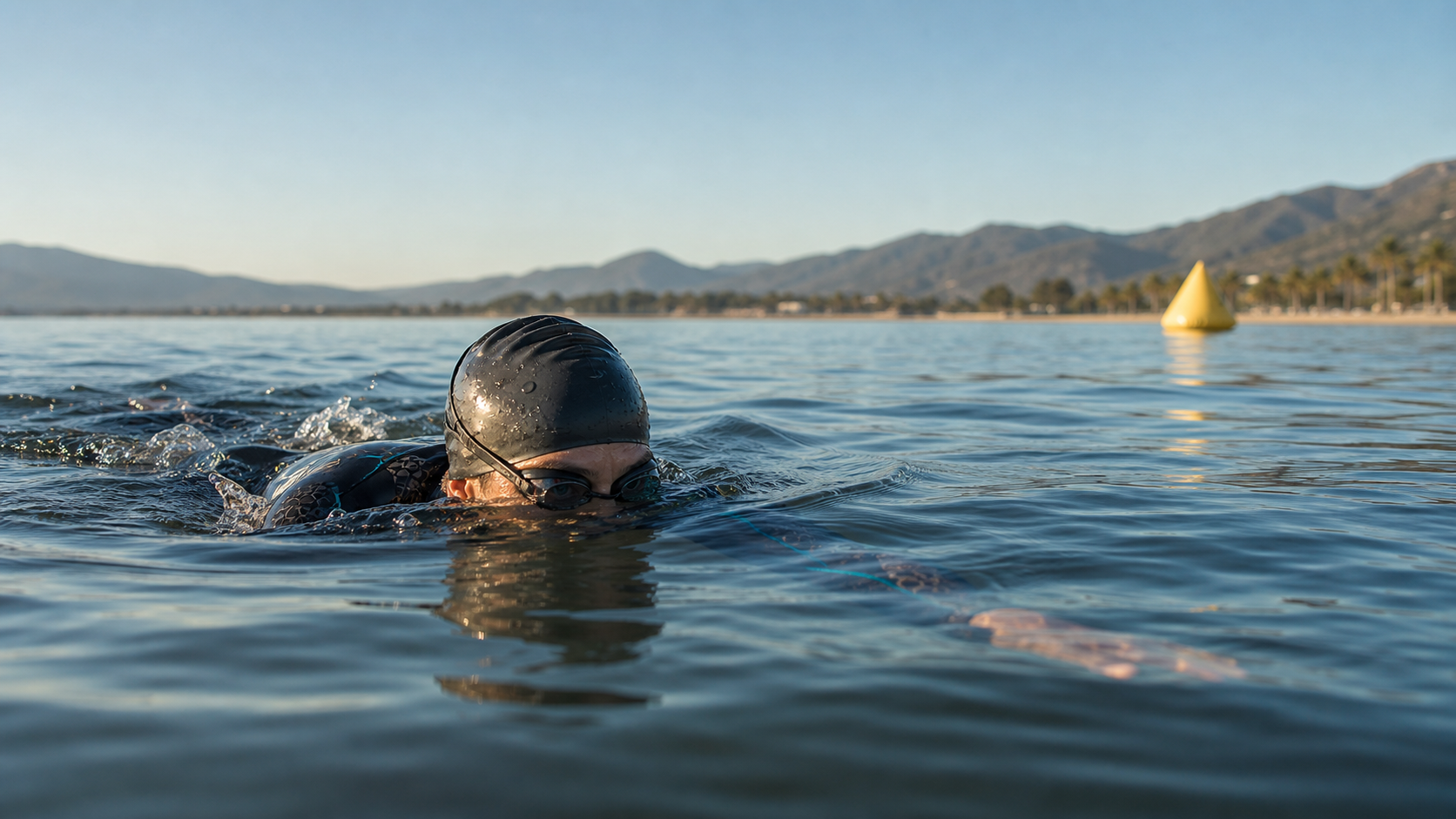
Why Sighting Affects Performance More Than Swimming Itself
Statistics show that amateur triathletes swim an average of 80–150 meters farther than the straight-line distance in a 1,500-meter open-water swim, equivalent to swimming 5–10% extra. Converted to time, that means wasting 1.5–3 minutes. Sighting is the lowest-energy way to lift your head and orient yourself, ensuring your swim line stays correct.
The Crocodile-Eye Head-Lift Technique
Beginners lift their entire head out of the water, causing the lower body to sink and the rhythm to break. The correct “crocodile-eye head lift” exposes only from the eyes to the bridge of the nose:
| Movement Element | Incorrect Example | Correct Example |
|---|---|---|
| Head-lift height | Entire head leaves the water | Only the upper edge of the eyes is exposed |
| Head-lift timing | Lift head before breathing | Push the head up naturally during the catch phase of the stroke |
| Head-lift duration | 0.8–1.5 seconds (too long) | 0.3–0.5 seconds (a quick glance) |
| Subsequent action | Breathe immediately after lifting | Lift head → drop head → breathe to the side |
| Lower-body state | Sinks immediately | Stays horizontal |
The Golden Rule of Head-Lift Frequency
More head lifts are not always better—too frequent costs energy, too few causes deviation. Adjust based on water conditions:
- Calm lake surface, visible buoys: Lift head once every 10–12 strokes
- Small waves, open sea: Lift head once every 6–8 strokes
- Large waves, poor visibility: Lift head once every 4–6 strokes
- Within 50 meters of a buoy: Lift head once every 3–4 strokes to confirm the turning point
Each head lift costs roughly the energy of 2 normal strokes, so averaging 30–40 head lifts over 1,500 meters is a reasonable range; exceeding 60 will noticeably affect performance.
Three Sighting Variations
1. Head-Lift–Breath Linkage
At the moment of lifting your head, glance forward → immediately roll to the side to breathe after the head drops. Two tasks in one motion, without breaking rhythm.
2. Side Sighting
Turn your head a bit more during breathing and glance at the buoy ahead with your peripheral vision. Ideal for sea swimming with side swells, allowing you to spot the buoy and avoid waves simultaneously.
3. Two-Stage Sighting
Lift your head once to locate the buoy’s direction, then lift again on the next stroke cycle to confirm. Suitable for those with poor eyesight or fogged goggles.
Buoy Distance and Target Selection
When a buoy is more than 200 meters away, it is often invisible due to surface undulation. In this case, choose “background reference points”:
- Shoreline structures: tall buildings, bridges, lighthouses
- Large landmarks: mountain silhouettes, cloud formations
- Other swimmers: find a swimmer with a stable stroke and correct direction to follow
Only within 100 meters of the buoy should you aim directly at the buoy itself.
Practice Methods
- Swim 25 meters with eyes closed: Test in the pool which side you naturally drift toward (most people drift toward their preferred breathing side)
- Mark your goggles: Place a small piece of tape on the upper part of the goggles to simulate the head-lift field of view
- Open-water session once a week: Practice Sighting in a familiar area to build a sense of buoy distance
- Count your strokes: Record your stroke count for 50 meters in the pool, then compare in open water—the difference is your deviation loss
Conclusion
Sighting is the most critical skill in open water. Skilled athletes may swim only 20–30 meters extra in 1,500 meters, while those with poor technique can swim 200 meters or more extra. Investing 30 minutes per week in Sighting practice often yields greater performance gains than adding extra fitness training.
Related Reading
- The Science of Open-Water Sighting: Head-Lift Frequency, Crocodile Eyes, and the Key to Saving 15% of Distance
- Open-Water Swimming Navigation: Head-Lift Breathing and Target Locking
- Open-Water Positioning and Navigation: Visual Correction and Energy-Saving Strategies for Swimming Straight
- Open-Water Sighting: How Often to Lift Your Head? Energy Efficiency Calculations for Triathletes
CT 喇低賽) 武嶺牽車 才是王道 西進牽車四小時內秘訣 攝手位置 如何判斷 防抽筋小秘訣
7 年前
西進武嶺 免費訓練分析服務 Intervals | 練不夠還是練過頭?你哪一種類型選手?AI模型告訴你! | 備戰神器 | 公路車 訓練 | CT Yeh
4 年前
戰略) Zwift Race 如何咬在第一集團 如何評估自己要開多少推力 (請開1.5倍速看)
7 年前
風櫃嘴 衝刺慢動作回放!
8 年前
西進武嶺 自製新版AI配速表產生器 x 賽前攻略 抱佛腳! 沒有功率計也可以產生配速表嗎?有什麼其他眉角賽前要注意的呢? | 西進武嶺 / 東進武嶺 KOM 攻略 | 公路車 | CT Yeh
4 年前
FTL 與 SYB 車隊專訪 西進武嶺 實用攻略分享! 2小時 如何練?!你不知道的眉角!新手準備武嶺必看 EP1 | 實力派女車友 | 精華版 | 公路車 | CTYeh
4 年前
邁金 T500 訓練台開箱!有下坡輔助、路感模擬、不用插電、直驅電機 !兩萬級距頂規享受新選擇!/ 公路車 / 室內訓練 / CT Yeh
1 年前
Live) 備戰2019彰化經典百K 賽前攻略 (已完賽請看新影片
7 年前