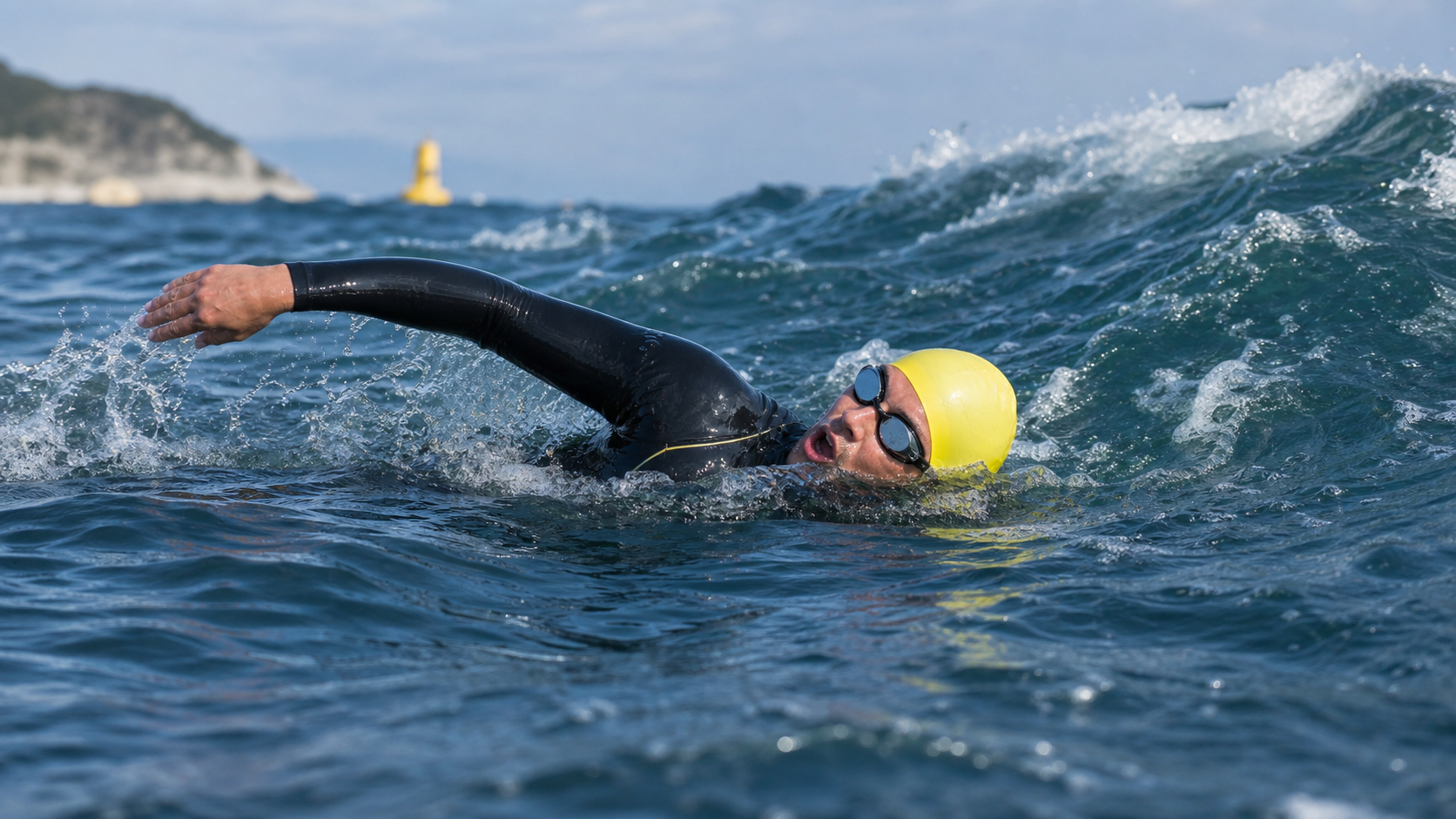
How Swells Affect Swimming
A swimmer who can hold a 1:30/100m pace in a calm pool will commonly drop to 1:45-2:00/100m in seas with 0.8m wave heights—a pace loss of 20-30%. The impact of swells goes beyond drag; it also includes:
- Getting hit by a wave and swallowing water while breathing
- The arm catching nothing (in a trough) or slapping the surface (on a crest) during the pull
- Vision blocked, making it hard to navigate
- Psychological tension causing excessive head lifting and a breakdown in rhythm
Wave Height Classification and Response Strategies
| Wave Height | Level | Breathing Adjustment | Kick Rhythm | Sighting Frequency |
|---|---|---|---|---|
| 0-0.3m | Calm | Normal bilateral | 6-beat | Every 10 strokes |
| 0.3-0.6m | Small waves | Bias toward the sheltered side | 4-6 beat | Every 6-8 strokes |
| 0.6-1.0m | Moderate waves | Fixed unilateral | 2-4 beat | Every 4-6 strokes |
| 1.0-1.5m | Big waves | Breathe in the trough | 2-beat steady | Every 3-4 strokes |
| 1.5m+ | Extreme waves | Race usually cancelled | - | - |
Breathing on the Leeward Side vs. the Windward Side
When there is a noticeable side wind or side swell, the direction you breathe can decide success or failure:
Breathing on the Leeward Side (Recommended)
If the waves are coming from the right, breathe to the left. The wave hits the back of your head, so the space for your face to breathe is not covered by water. Advantages: no water swallowed, clear vision.
Breathing on the Windward Side (Not Recommended, but Useful)
If the wind is strong and the air feels thin, breathing into the wind lets you take in more air. But this requires the “trough breathing” technique—wait until you feel your body sink into the trough before turning your head, avoiding the wave crest.
Sighting on the Wave Crest
In big waves, your vision is blocked 70% of the time. Master the “crest lift”:
- Feel the moment your body is pushed up by the wave
- Use the height of the wave top to lift your head and take a quick glance
- Drop your head back into the water as soon as the wave passes
- It takes 2-3 consecutive lifts to piece together a full bearing
Why Switch to a 2-Beat Kick
In calm water, most swimmers use a 6-beat kick (3 kicks per arm stroke), but in swells:
- A 6-beat kick consumes too much oxygen and can easily lead to hypoxia in big waves
- Kicking too frequently increases the risk of leg muscle cramps
- Switching to a 2-beat kick (1 kick per arm stroke) saves energy for the pull and for fighting the waves
The 2-beat kick has become the mainstream choice for long-distance open-water swimming (1500m and above), and even world champions use this rhythm.
Pull Adjustment: High-Elbow Catch + Accelerated Finish
The most common points where the pull breaks down in big waves:
- Hand entry position: It may land on a wave crest or in a trough, making the catch point unstable
- Solution: Increase the range of the “high-elbow catch,” keeping the elbow 5-10 degrees higher than normal to ensure you still catch water even with large height differences
- Accelerated finish: Speed up the finish phase by 20% to generate stronger propulsion and resist the pull of the waves
Mental Approach: Rhythm Over Speed
The worst thing you can do in big waves is “try to power through with brute force.” The right mindset:
- Accept that your pace will drop 15-25%
- Maintaining your stroke rhythm matters more than pace
- If you swallow water, don’t panic—spit it out and keep swimming
- If you drift off course, don’t turn sharply; correct in 2-3 gradual adjustments
Training Methods
- Pool wave-making drill: Have a teammate create waves in the next lane using a large kickboard
- Unilateral breathing drill: Once a week, swim 1500m breathing on only one side
- Ocean experience swim: Once a month, go to a familiar stretch of sea to feel the swells
- Wave-resistant kicking: Use a pull buoy between your legs to practice simulating a non-kicking state
Conclusion
Swells are the norm in open-water racing, not the exception. The swimmers who can hold their pace in big waves are often not the fittest, but the ones with the steadiest technique and the strongest minds. Getting at least 2 open-water sessions per month is key and cannot be replaced by pool training.
Related Reading
- Breathing Slowdown Study: Speed Difference Between Breathing and Non-Breathing, and Training Solutions
- Breathing Rhythm in Open Water: Maintaining Technique Over Long Distances
- The Physiological Challenges of Open-Water Swimming: Waves, Currents, Navigation, and Psychology
- Swimming Breathing Pattern Training: Building Tolerance for 3-Stroke and 5-Stroke Breathing
西進武嶺 自製新版AI配速表產生器 x 賽前攻略 抱佛腳! 沒有功率計也可以產生配速表嗎?有什麼其他眉角賽前要注意的呢? | 西進武嶺 / 東進武嶺 KOM 攻略 | 公路車 | CT Yeh
4 年前
風櫃嘴 衝刺慢動作回放!
8 年前
西進武嶺 免費訓練分析服務 Intervals | 練不夠還是練過頭?你哪一種類型選手?AI模型告訴你! | 備戰神器 | 公路車 訓練 | CT Yeh
4 年前
教學) 如何做出專業 慢動作 影片 Slow Motion 120fps GoPro 7 ActionCam AX700 A99II
7 年前
#公路車 #西進武嶺 配速配瓦實驗 坡度分析 四小時內攻略 建大盃 NeverStop #西進武嶺攻略
6 年前
[教學] Premiere 影片 手震 修正 教學 防抖 單眼 影像 GoPro 穩定 Video Stabilization
8 年前
戰略) Zwift Race 如何咬在第一集團 如何評估自己要開多少推力 (請開1.5倍速看)
7 年前
一日北高前的西濱集訓 | 跟著11小時軍團 | 300W踩不動的大逆風 | 輪車破風差幾瓦?
6 年前