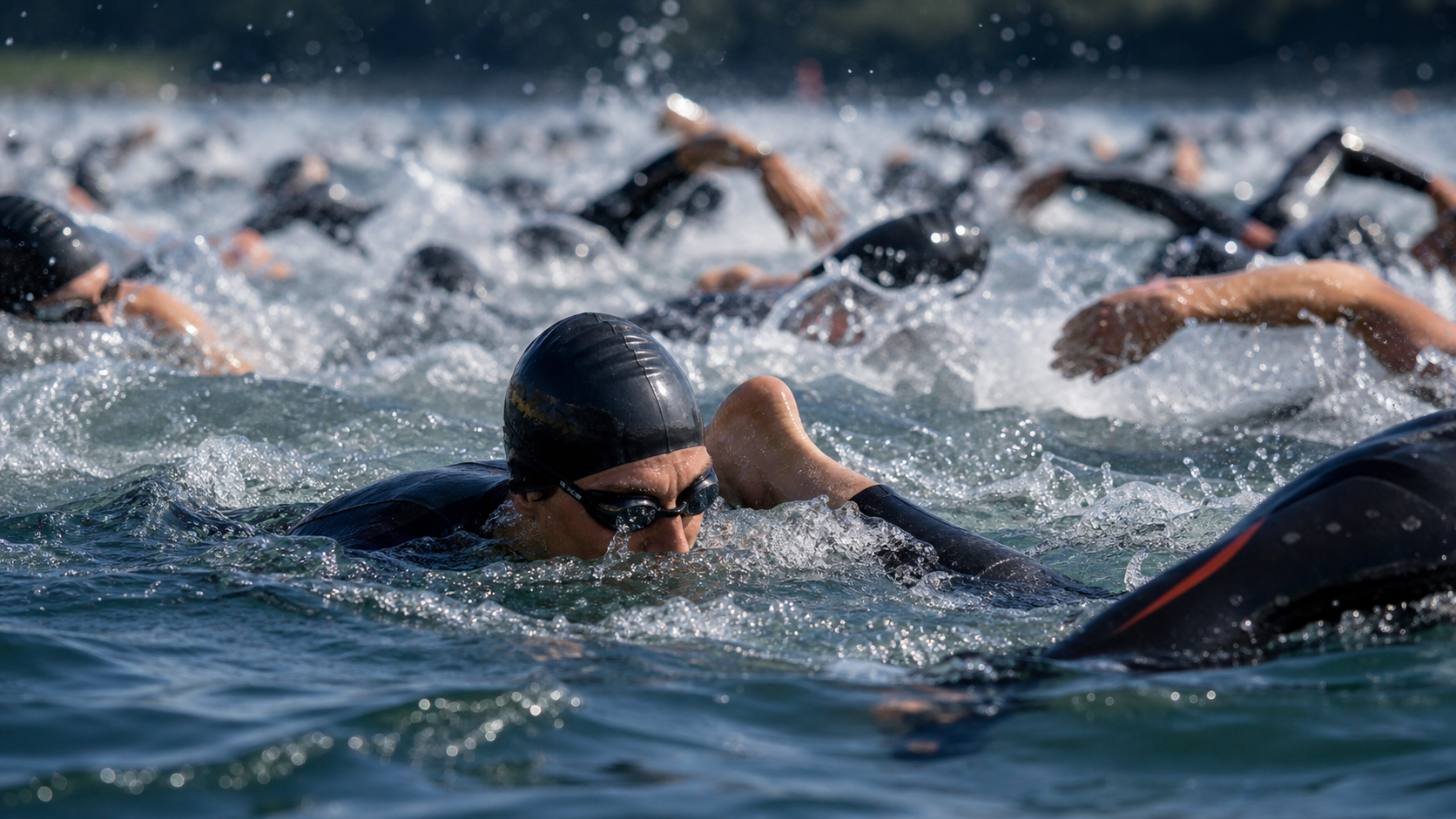
Why Group Swimming Is So Chaotic
Large triathlon starts often have 200-2000 people entering the water simultaneously, with extremely high density in the first 500 meters. Actual statistics show:
- About 60% of athletes get kicked at least once during the race
- About 25% of athletes get their goggles kicked off
- About 5% of athletes are forced to withdraw due to collisions
- About 10% of athletes experience a panic reaction
But group swimming also has benefits—drafting can save 10-30% of energy, and nearly all of the top 5% of athletes draft within a group.
Common Kick Areas and Protection
| Kick Area | Probability | Consequence | Prevention Method |
|---|---|---|---|
| Wrist, forearm | High | Pain, disrupted rhythm | High-elbow pull, don’t extend hands forward |
| Head, back of head | Medium | Dizziness, goggles knocked off | Tuck your head, maintain rhythm |
| Eyes, nose | Medium | Bleeding, withdrawal | Tighten goggle straps, use double layers |
| Chest, ribs | Medium | Difficulty breathing | Swim on your side, don’t face others head-on |
| Legs, feet | High | Cramps, pain | Maintain 0.5m distance when drafting |
Head-Tucking Technique to Avoid Kicks
When the swimmer ahead kicks, the most likely target is the head of the drafter behind. Defensive moves:
- Tuck your chin slightly: Keep your head 5-10 degrees lower than normal
- Look down and forward: Watch the heels of the swimmer ahead to anticipate kick trajectories
- Maintain distance: When drafting, don’t let your hands extend past the swimmer ahead’s feet
- Prepare to veer off: If you notice the swimmer ahead kicking hard, immediately shift 30 centimeters to the side
Three Drafting Position Options
1. Directly Behind the Heels (Draft Zone A)
30-50 centimeters behind the swimmer ahead, offers the best energy savings (25-30%), but carries the highest risk of being kicked. Suitable for athletes with strong technique and mental toughness.
2. Beside the Hip (Draft Zone B)
Parallel to the swimmer ahead, with your head level with their hip, at a distance of 50-80 centimeters. Saves 15-20% energy with a low risk of being kicked. This is the most common position.
3. Behind the Shoulder (Draft Zone C)
Slightly behind the swimmer ahead by about one body length, saves 10-15% energy, and is almost never kicked. Suitable for a conservative strategy.
Escape Techniques When Squeezed
When you’re sandwiched between swimmers on both sides:
- Don’t fight it: There’s no point in comparing physiques with the other swimmer
- Slow down for 1 stroke: Let yourself fall slightly behind, then swim out from the rear
- Accelerate for 3 strokes: Use explosive power to burst out of the squeeze zone
- Swim on your side for 5 meters: Temporarily switch to a one-sided sidestroke to avoid the crowd
What to Do When Someone Is on Top of You
In extreme cases, someone may climb on top of you. Emergency response:
- Don’t panic: The other person is also acting unconsciously
- Sink for 1-2 seconds: Deliberately dive underwater; once the other person loses support, they’ll move away
- Roll onto your side: Do 2 cycles of backstroke to reposition yourself
- Raise your hand for help: If you truly can’t break free, raise your hand and let the lifeguard handle it
Starting Line Tactics: Choosing the Right Position Beats Brute Force
Choose your starting position based on your ability level:
- Top 10% ability: Stand in the first row near the inside of the buoy
- Top 30% ability: Stand in the second or third row
- Mid-pack ability: Stand on the edges (left or right sides), avoiding the central conflict zone
- Back-of-pack ability: Stand in the last row, wait for the front to spread out before entering the water
Training Methods
- Mixed group swim training: 3-5 people swimming in the same lane to simulate the feeling of being squeezed
- Kick adaptation: Ask teammates to deliberately kick lightly to build mental tolerance
- One-sided swimming practice: Practice 200 meters of sidestroke on each side so you can switch in turbulent conditions
- Pre-race simulation: At least 1 group swimming session 2 weeks before the race
Conclusion
Pack swimming is the biggest difference between open water and the pool. No matter how strong a pool swimmer you are, without experience swimming in a crowd, you’ll often fall apart at a triathlon. Train in a group at least 5-8 times a year to handle race day with composure.
Related Reading
- Handling Conflict in a Swim Pack: Staying Calm and Recovering After Being Kicked or Pinned
- Triathlon Swim Crowd Tactics: A Survival Guide from the Start to the First Buoy
- Triathlon Swim Mass Start Strategy: Position Selection and Handling Physical Contact
- Mass Start Collisions: Body Protection and Position Selection in the Triathlon Swim
戰略) Zwift Race 如何咬在第一集團 如何評估自己要開多少推力 (請開1.5倍速看)
7 年前
一日北高/長距離團騎 常見問題補充篇 / 組團或跟團的眉角 / 壯車友容易被瘦車友慢性拉爆 / 原來屁股痛可能是這個原因...? / 風場配速法 / 公路車 / CT Yeh
2 年前
Live) 備戰2019彰化經典百K 賽前攻略 (已完賽請看新影片
7 年前
福隆鐵人團練隨拍
8 年前
CT 喇低賽) 武嶺牽車 才是王道 西進牽車四小時內秘訣 攝手位置 如何判斷 防抽筋小秘訣
7 年前
[教學] Premiere 影片 手震 修正 教學 防抖 單眼 影像 GoPro 穩定 Video Stabilization
8 年前
Never Stop 西進武嶺 前後雙機 完整全程錄影 訓練台 實境
8 年前
下次拍照前要查清楚啦🤣 #cycling
7 個月前