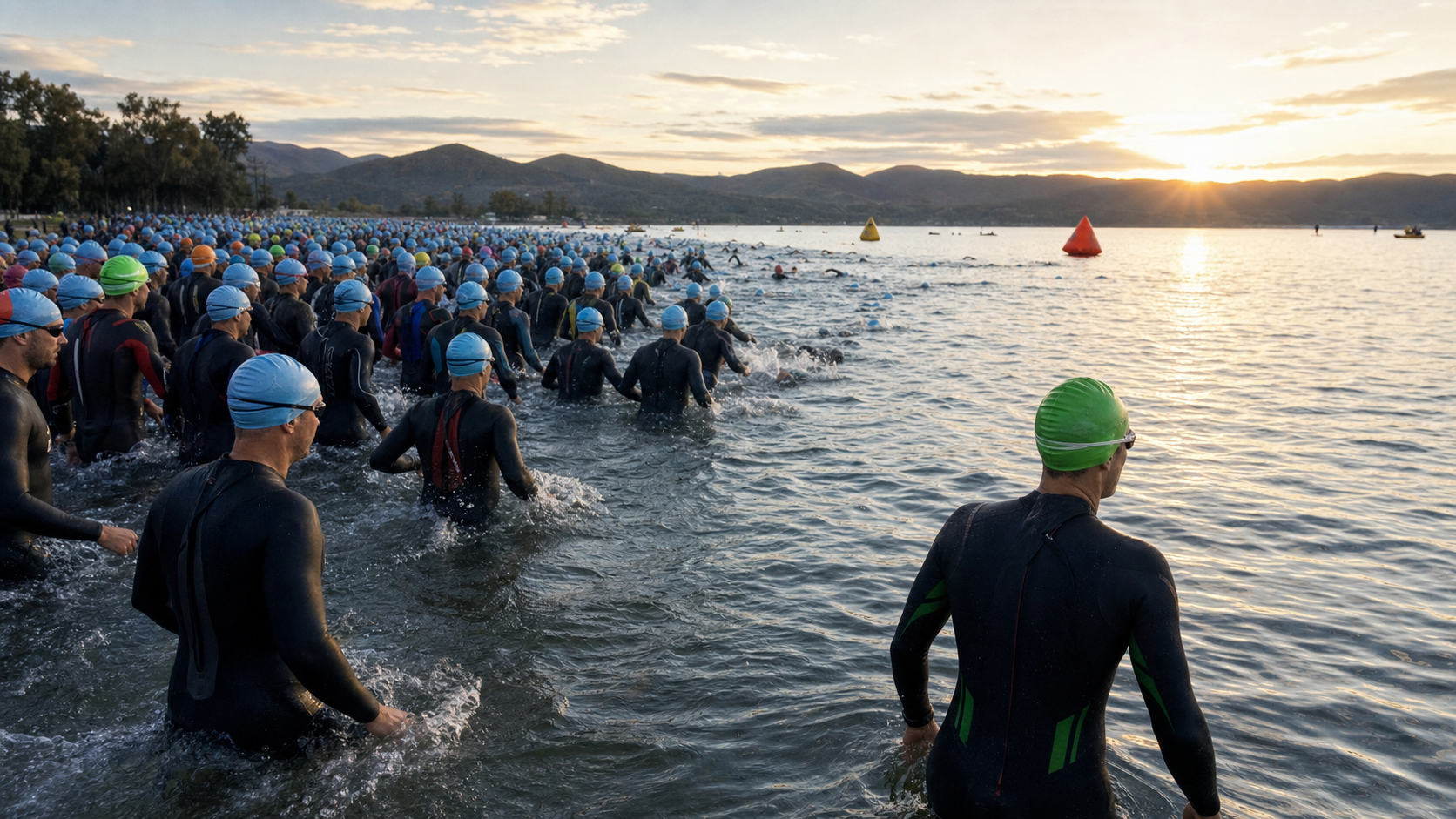
Why the Start Is So Intimidating
Large triathlon starts often have 200–2,000 people setting off at once. The first 30 seconds to 2 minutes are the most crowded period:
- 2–4 athletes per square meter
- 5–10 physical contacts per second
- 80% of in-water collisions happen in the first 200 meters
- 90% of panic cases occur at the start
Choosing the right starting position means avoiding 90% of the trouble.
Analysis of Starting Lineup Configurations
Most race starts are 5–10 rows deep, fanning out from the buoy:
         Buoy direction →
  [Inside] [Center] [Center] [Center] [Outside]
   Row 1    Row 1    Row 1    Row 1    Row 1
   Row 2    Row 2    Row 2    Row 2    Row 2
   Row 3    Row 3    Row 3    Row 3    Row 3
   ...
Tactical Analysis of Five Starting Positions
1. Inside Front Row (Elite Zone)
Best for: Top 5% of the field, swimmers confident in leading
Pros: Shortest route, can follow the elites ahead, directly sees the buoy
Cons: High pressure, highest chance of being hit, requires extreme mental toughness
2. Center Front, Rows 1–2 (Positioning Zone)
Best for: Top 10–30% of the field, those wanting to join a good pack
Pros: Can stay with the main pack, more drafting opportunities
Cons: Crowded on both sides, the first 100 meters after the start are chaotic
Warning: Not recommended for age-group athletes
3. Side Front Row (Smart Zone)
Best for: Top 20–50% of the field, athletes wanting to avoid collisions
Pros: Only one side is crowded, easier to find a rhythm, smooth start
Cons: Slightly longer route by 5–10 meters, fewer drafting opportunities
Rating: ★★★★★ (best choice for age-group athletes)
4. Back Center (Conservative Zone)
Best for: Bottom 30–60% of the field, beginners or those feeling nervous
Pros: Athletes ahead have already spread out, lower chance of being kicked
Cons: Need to constantly overtake slower swimmers
Note: Suitable for triathlon, not for pure swimming races
5. Last Row or Delayed Start (Refuge Zone)
Best for: Athletes aiming to finish, first-time racers
Pros: No collisions at all, can gradually adapt
Cons: Significant time loss, cannot catch any pack
Detailed Look at the “Side Refuge Point” (Most Recommended)
Choose the far left or right edge of the start:
- Route loss: Only swim 5–10 meters extra (in the first 50 meters)
- Chance of being hit: Reduced by 70%
- Mental stability: Greatly improved
- When to cut back inside: 100 meters before the first buoy
Delayed Start Tactic (A Must-Learn for Beginners)
If this is your first large open-water race:
- Delay your start by 5–10 seconds: Wait until the swimmers ahead have moved 5–10 meters before entering the water
- Time lost: 5–10 seconds
- Collisions avoided: Over 90%
- Mental benefit: You can start swimming with a calm mindset
Key Actions in the First 30 Seconds After the Start
Don’t:
- Sprint all-out for the first 100 meters
- Try to overtake everyone around you
- Stare at the buoy without watching for people
Do:
- Start at 70% effort
- Find someone with a stable stroke to draft behind
- Sight every 6 strokes
- Accept that being bumped is normal
Strategy for Turning at the First Buoy
The first buoy is where the most intense fighting happens. Recommendations:
- Elite athletes: Take the inside line and round the shortest path
- Age-group athletes: Round wide, adding 3–5 meters, to avoid the crowd
- Beginners: Wait for the crowd to pass before rounding; spend an extra 10–15 seconds for safety
Differences Between Starting Formats
| Start Type | Characteristics | Position Suggestion |
|---|---|---|
| Beach start | Run into the water from shore | Sides + advantage to fast runners |
| In-water floating start | Wait in the water for the gun | Back rows + conserve energy |
| Dive platform | Jump from a dock | Both ends + avoid the dead center |
| Wave start | Groups enter the water in sequence | Any position is relatively safe |
Training Methods
- Simulate the start: Practice crowded entries with 3–5 teammates
- Pre-race course inspection: Visit the venue 1 day early to check the start layout
- Mental rehearsal: Every day for the week before the race, visualize the start process
- Practice at smaller races: First join races with 100–200 participants to adapt
Conclusion
There is no absolute right or wrong in start tactics—choose honestly based on your own level. The biggest mistake beginners make is “overestimating themselves” and standing in the front row, only to be battered and lose confidence. Remember: in open water, choosing the right position matters more than swimming fast. Finishing safely is the foundation for improvement.
Related Reading
- Open Water Swimming Start Strategy: Position and Pacing in a Group Start
- Mass Start Collisions: Body Protection and Position Choice in the Triathlon Swim Leg
- Open Water Start Chaos Strategy: How to Find Your Own Rhythm in the Crowd
- Open Water Start Strategy: Positioning, Contact, and Establishing Pacing
CT 喇低賽) 武嶺牽車 才是王道 西進牽車四小時內秘訣 攝手位置 如何判斷 防抽筋小秘訣
7 年前
戰略) Zwift Race 如何咬在第一集團 如何評估自己要開多少推力 (請開1.5倍速看)
7 年前
西進武嶺 免費訓練分析服務 Intervals | 練不夠還是練過頭?你哪一種類型選手?AI模型告訴你! | 備戰神器 | 公路車 訓練 | CT Yeh
4 年前
#公路車 #西進武嶺 配速配瓦實驗 坡度分析 四小時內攻略 建大盃 NeverStop #西進武嶺攻略
6 年前
FTL 與 SYB 車隊專訪 西進武嶺 實用攻略分享! 2小時 如何練?!你不知道的眉角!新手準備武嶺必看 EP1 | 實力派女車友 | 精華版 | 公路車 | CTYeh
4 年前
福隆鐵人團練隨拍
8 年前
Live) 備戰2019彰化經典百K 賽前攻略 (已完賽請看新影片
7 年前
#東進武嶺 全程實況錄影 5小時半 #夏季KOM #太魯閣 Taiwan KOM Challenge Reality Video Taroko scenery
7 年前