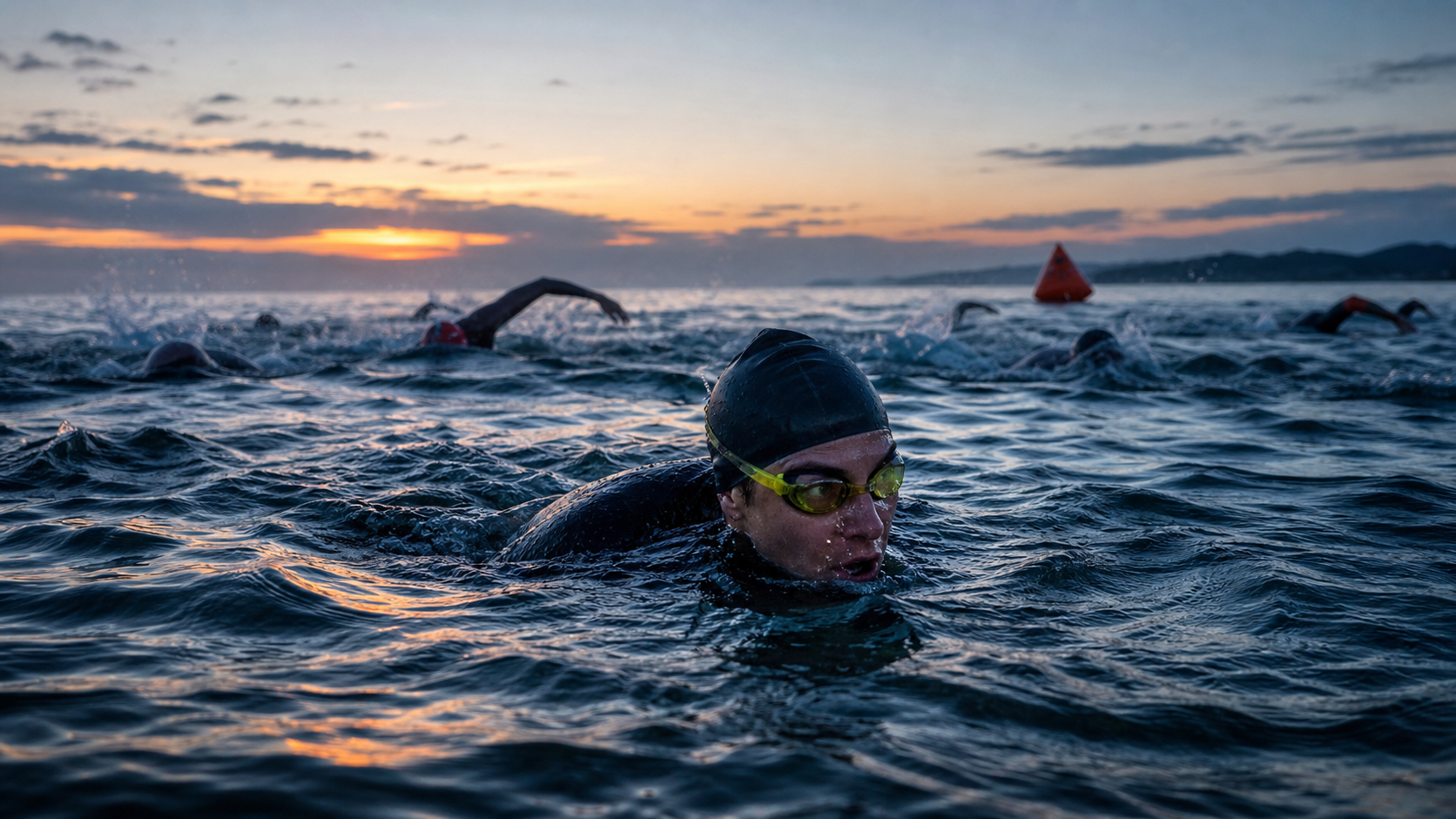
Why Triathlons Start in the Early Morning
Statistics on start times for major triathlons:
- 70% start between 06:00-07:00
- 20% start between 05:30-06:00
- 10% start after 07:00
Reasons for early morning starts: avoiding midday heat, road traffic control, and preventing heatstroke among athletes. But the trade-off is that the swim leg takes place in low-light conditions.
Visual Challenges in Low-Light Environments
Comparison of Light Conditions
| Time Period | Illuminance | Visual Challenge |
|---|---|---|
| Noon | 100,000 lux | None |
| 9-10 AM | 30,000-50,000 lux | Slight glare |
| 7-8 AM | 5,000-15,000 lux | Slightly dark |
| 6-7 AM | 1,000-5,000 lux | Noticeably dim |
| 5:30-6 AM | 200-1,000 lux | Severely insufficient |
| 5 AM before dawn | 50-200 lux | Nearly pitch black |
Problems Caused by Low Light
- Buoys Hard to Spot: Orange-yellow buoys turn dark gray in low light
- Loss of Depth Perception: Can’t tell if the water is 1 meter or 5 meters deep
- Flat Water Surface: Can’t see wave height clearly
- Other Athletes Hard to See: Black wetsuits become invisible in dark water
- Loss of Directional Sense: No shoreline reference points
Choosing Goggles
Lens Color and Light Matching
| Light Condition | Recommended Lens | Effect |
|---|---|---|
| Strong midday light | Mirrored, dark | Anti-glare |
| Moderate morning light | Gray, blue | Balanced |
| Dim morning light | Yellow, orange | Enhanced contrast |
| Extremely dark at dawn | Clear, light pink | Maximum light transmission |
| Indoor pool | Clear | Natural vision |
The Magic of Yellow Lenses
In low light, yellow lenses are an open secret in the industry:
- Enhanced contrast: Orange buoys stand out more
- Filters out blue light: Blue-green scattered light in the water is filtered
- Protects the optic nerve: Reduces eye fatigue
- Enhanced depth perception: Can judge water depth
Fluorescent Assistance
Some high-end goggles feature a “fluorescent coating”:
- Fluorescent color on the lens edges
- Slight reflection in dark water
- Makes you visible to other athletes
- You can also see the frame’s reflection
Pre-Race Light Adaptation
Training 1 Week Before the Race
- Swim in low-light environments (early morning or evening)
- Train with the goggles you’ll wear on race day
- Adapt to buoy recognition under different light conditions
1 Day Before the Race
- Don’t stay up late; ensure clear vision
- Avoid looking at your phone screen 1 hour before the race (it strains the eyes)
- Prepare goggle anti-fog solution
30 Minutes Before the Race
- Put on goggles to let your eyes adapt
- Look at distant buoys from the shore for 1-2 minutes
- Confirm you can identify buoy positions
The “Follow a Swimmer, Not a Buoy” Tactic
In low light, buoys are hard to spot, but athletes are easier to identify (especially by their splash and white swim caps):
Finding the Right Swimmer to Follow
- Find an athlete with a stable stroke and a pace similar to yours
- Observe whether their direction choices are correct
- Follow them for 200-500 meters
Positioning When Drafting
- Stay 1.5-2 meters behind, where you can see their splash
- Don’t get too close (in dark water, you can’t see well and might collide)
- Don’t fall too far back (you’ll lose your visual reference)
Risks of Drafting
- If the athlete you’re following gets lost, you’ll go wrong too
- Confirm your own direction every 20-30 strokes
- Lift your head to sight on your own when you’re 50 meters from a buoy
Dealing with Loss of Depth Perception
Fear When Entering the Water
Entering the water in low light, unable to see the bottom, can trigger an instinctive fear:
- Don’t look down: Staring at the bottom deepens the fear
- Keep your eyes on the surface: Focus on buoys and other athletes
- Take 3 deep breaths: Calm your emotions
- Make your first stroke slow: Start swimming in slow motion
Mental Preparation
- Accept that “not seeing the bottom” is normal
- Remind yourself that lifeguards are nearby
- Think about the target ahead, not what’s beneath you
Special Notes for Pre-Race Course Reconnaissance
Recommended times for course recon of early morning races:
- 18:00 the evening before the race: Simulates the dawn light of the next day
- 05:30 the morning before the race: Same time as the actual race
- Don’t recon at noon: The light is completely different
Key points during recon:
- Memorize buoy positions (can’t rely on vision)
- Shoreline reference points (tall buildings, towers)
- Sense of direction from the start to the first buoy
Recommended Safety Gear
Essential
- Brightly colored swim cap: Orange or fluorescent yellow (usually provided by the race)
- Goggle anti-fog solution: Fog is harder to deal with in low light
- Backup goggles: Keep a spare pair in T1
Advanced
- Ankle glow band: Makes it easier for lifeguards to spot you
- Tow float: Use during training to increase visibility
- Wrist GPS: Can help you locate yourself if you get lost
Training Methods
- Early morning open water swims: At least 1 early morning session per week
- Yellow lens adaptation: Start using yellow lenses in the pool
- Blind swimming drills: Swim 25 meters with your eyes closed to practice navigating without visual cues
- Low-light drafting: Swim with teammates in the early morning to practice switching drafting targets
Conclusion
Low-light swimming is the most neglected training item among amateur athletes. Many people swim well in the pool but completely fall apart in early morning open water. Through proper gear selection, mental preparation, and drafting tactics, you can turn the disadvantage of low light into an advantage. Remember: staying calm in dark water is more important than swimming fast.
Related Reading
- The Unique Challenges of the Triathlon Swim Leg: Differences Between Open Water and Pool Technique
- Open Water Triathlon Swim Start Strategy: Crowd Conflict Management and Sighting Techniques
- Triathlon Swim Leg Finish Strategy: Full Planning from Start to T1
- Triathlon Swim Training: Key Technical Points for Open Water Swimming
CT 喇低賽) 單車 比賽總是沒照片? 攝影師的觀點大公開 姿勢就是力量! 請加速1.25倍收看
7 年前
2019 夏季KOM 5小 完賽心得 準備攻略 東進武嶺 夏季登山王之路 Taiwan KOM Challenge
7 年前
下次拍照前要查清楚啦🤣 #cycling
7 個月前
Live) 備戰2019彰化經典百K 賽前攻略 (已完賽請看新影片
7 年前
#東進武嶺 全程實況錄影 5小時半 #夏季KOM #太魯閣 Taiwan KOM Challenge Reality Video Taroko scenery
7 年前
FTL 與 SYB 車隊專訪 西進武嶺 實用攻略分享! 2小時 如何練?!你不知道的眉角!新手準備武嶺必看 EP1 | 實力派女車友 | 精華版 | 公路車 | CTYeh
4 年前
全段數據 2024富士山登山賽 ((銅環)) 請開字幕! /全程解說版 4K高畫質/ feat. 樂華演城旭 / 公路車 / CT Yeh / 第20回Mt.富士ヒルクライム
2 年前
雨戰! 西進武嶺員工旅遊 加料 各路段大數據分析 | 同事端出5公斤的公路車來挑戰!? EP1
4 年前