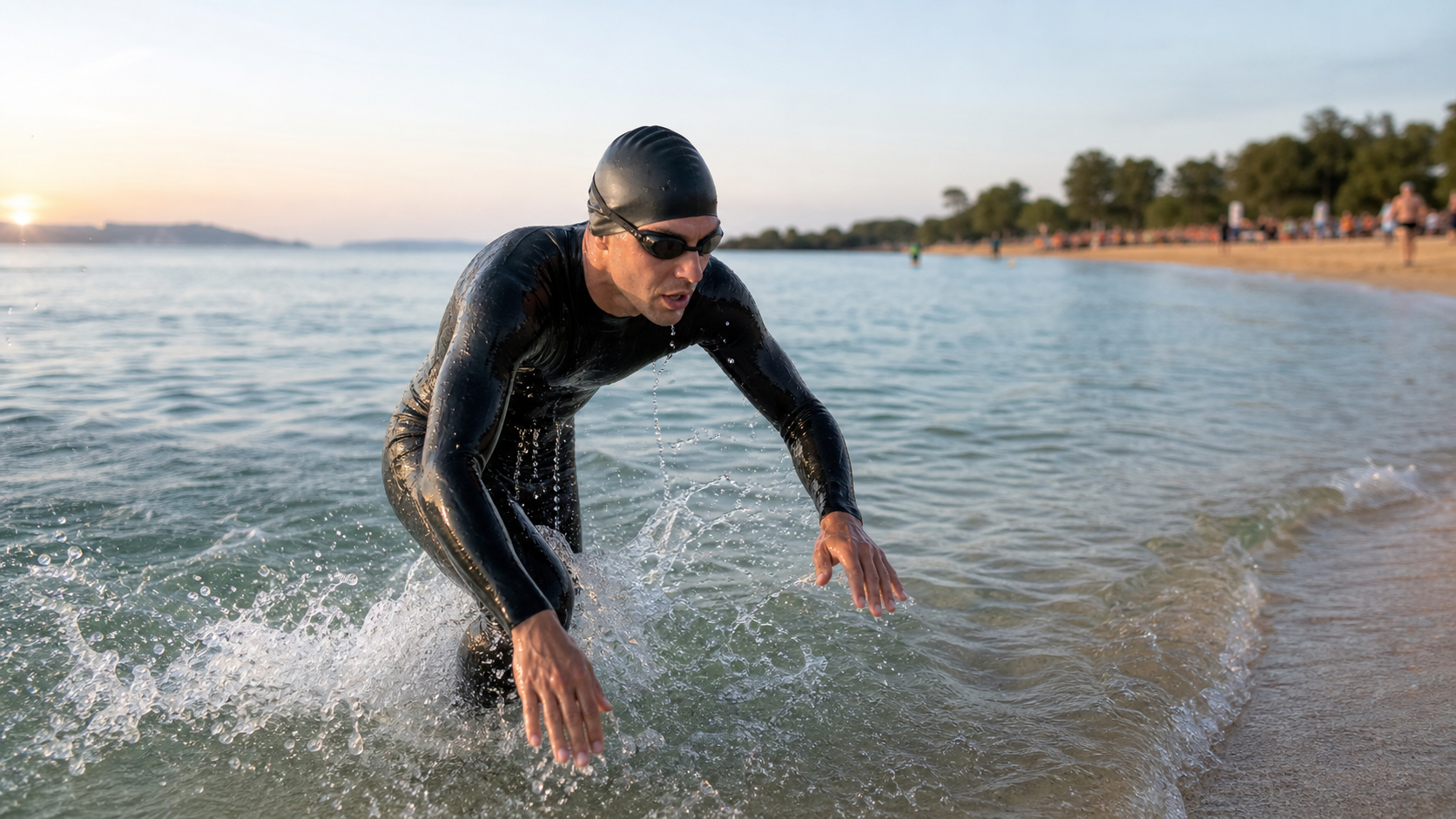
Why the Final 50 Meters Before Exiting Matter
Statistical analysis shows:
- Age-group athletes spend an average of 60-90 seconds exiting the water and entering T1
- Elite athletes take only 25-40 seconds
- The gap mainly comes down to “reading water depth” and “transition movements”
- In a 1500-meter race, the difference in results is often decided in these 50 meters
Three Exit Techniques
Technique 1: Keep Swimming (Deep Water > 1.2m)
When the water is deeper than your thighs, swimming is still the fastest option:
- Keep pulling, but reduce kicking
- Increase sighting frequency to every 3-4 strokes
- Focus your gaze on the exit point (path, crowds)
- Keep pulling until your fingers touch the bottom
Technique 2: Dolphin Dive (Water Depth 0.5-1.2m)
When the water is waist-deep, the dolphin dive is the fastest option:
Movement breakdown:
- Push off the bottom with both feet to launch
- Lean your body forward at a 45-degree angle
- Extend both arms forward into the water
- Dive into the next step like a dolphin
- Push off the bottom with both feet and launch again
Timing judgment:
- When your hand touches the bottom, stand up immediately and try the dolphin dive
- If the water is too deep, keep swimming
- If the water is too shallow, run directly
Speed comparison:
- Water depth 0.8-1.0m: Dolphin dive is 20-30% faster than swimming
- Water depth 0.5-0.8m: Dolphin dive is 10-20% faster than running
- Water depth < 0.5m: Running is faster
Technique 3: Running (Water Depth < 0.5m)
When the water is below knee level, run directly:
- Lift your knees high (to overcome water resistance)
- Take short, quick strides
- Lean your body forward
- Swing your arms to help with balance
Water Depth Reading Skills
Visual Reading
Look at the change in water color:
- Dark blue: Water depth > 2m
- Blue-green: Water depth 1-2m
- Light green: Water depth 0.5-1m
- Murky yellow: Water depth < 0.5m (sand stirred up from the bottom)
- Bottom visible: Possibly < 0.5m
Tactile Reading
Your fingers touch the bottom while pulling:
- Fingertips scraping sand: Water depth approximately 60-70cm
- Entire palm touching the bottom: Water depth approximately 50cm
- Elbow touching the bottom: Water depth approximately 30cm
- Stomach touching the bottom: Stand up and run
Choosing Your Exit Point
1. Find the Shortest Path
Exit points usually have a 5-10 meter “exit zone,” and you don’t have to be right in the center:
- Observe which side has gentler terrain
- Avoid rocks and reefs
- Choose the spot closest to the T1 entrance
2. Avoid the Crowd
If a group exits together, it can get bunched up:
- Veer 1-2 meters to the side
- Lose 2-3 seconds, but avoid being knocked over
- Faster overall
3. Pre-Race Course Recon
Exit point terrain:
- Sand: Soft, tiring to run on
- Rocky reef: Hard but slippery
- Grass: Stable, easiest to run on
- Concrete: Hard and stable
Post-Exit Transition Movements
Step 1: Remove Goggles
- Push your goggles up to your forehead as you stand up
- Don’t take them off completely (you need both hands for other things)
- Remove them fully in T1
Step 2: Remove Swim Cap
- Take it off while running toward T1
- Pull with one hand, hold the top of your head with the other
- Don’t drop it on the ground (you’ll be penalized)
Step 3: Remove Wetsuit (Upper Body)
- Start unzipping while running toward T1
- Peel the sleeves down to your wrists
- Roll the wetsuit down to your waist
- Remove the lower half once you reach T1
Common Problems When Starting to Run
Problem 1: Dizziness
Cause: Sudden shift from a horizontal to vertical position changes blood flow
Solution: Stand up more slowly, take 3 deep breaths
Problem 2: Leg Cramps
Cause: Leg muscles are fatigued from swimming, then suddenly running
Solution: Jog slowly for the first 20 meters after exiting, don’t sprint immediately
Problem 3: Disorientation
Cause: Just switched from a water-level perspective to land
Solution: Remember the T1 entrance location during pre-race recon, use landmarks for reference
Problem 4: Heart Rate Spike
Cause: Heart rate response differs between water and land
Solution: Accept the temporary heart rate spike; it will settle after running 50 meters
Exit Specifics for Different Races
Beach Exit
- Sand gets into the wetsuit
- Running is tiring
- May need to run 50-200 meters to T1 after exiting
Pier Exit
- Use the ladder to climb out
- Pay attention to hand grip
- Start running immediately after exiting
Rocky Reef Exit
- Highest risk level
- Move slowly to avoid cuts
- Course recon before the race is mandatory
Direct Exit to T1
- Rare but the fastest
- Remove wetsuit immediately upon exiting
- Suitable for short-distance triathlons
Training Methods
- Pool exit practice: Practice the transition from swimming to standing at the pool edge
- Beach dolphin dive: Train the rhythm of dolphin dives at the beach
- Run transition: Swim 200m + immediately run 100m to simulate the transition
- Pre-race recon: Walk the exit route at the actual race venue
Conclusion
The exit technique is the most overlooked aspect for age-group athletes. Many focus on swimming speed, only to waste 30 seconds in the final 50 meters. With proper water depth reading, dolphin dive technique, and transition movements, you can save precious time in T1. Remember: the swim doesn’t end with your last stroke—it ends with the next movement in T1.
Related Reading
- Open-Water Run-In Technique: Dolphin Dive Skills for Charging from the Beach into the Water
- Open-Water Exit Technique: Footwork for Running from the Swim Finish onto the Beach or Shore
- Triathlon Swim Exit and T1 Transition Speed Optimization: The Critical 120 Seconds from Water to Bike
- T1 Transition Tactics: The 30 Seconds from Exiting the Water to Mounting the Bike That Can Save You Time
FTL 與 SYB 車隊專訪 西進武嶺 實用攻略分享! 2小時 如何練?!你不知道的眉角!新手準備武嶺必看 EP1 | 實力派女車友 | 精華版 | 公路車 | CTYeh
4 年前
CT 喇低賽) 武嶺牽車 才是王道 西進牽車四小時內秘訣 攝手位置 如何判斷 防抽筋小秘訣
7 年前
西進武嶺 免費訓練分析服務 Intervals | 練不夠還是練過頭?你哪一種類型選手?AI模型告訴你! | 備戰神器 | 公路車 訓練 | CT Yeh
4 年前
Live) 備戰2019彰化經典百K 賽前攻略 (已完賽請看新影片
7 年前
風櫃嘴時間 預測西進武嶺時間?13000名車友統計數據分析告訴你 !
5 年前
海豚島滑沙
11 年前
備戰 戀戀197 賽前關門點分析 西濱團練 #公路車 4K高畫質
6 年前
戰略) Zwift Race 如何咬在第一集團 如何評估自己要開多少推力 (請開1.5倍速看)
7 年前