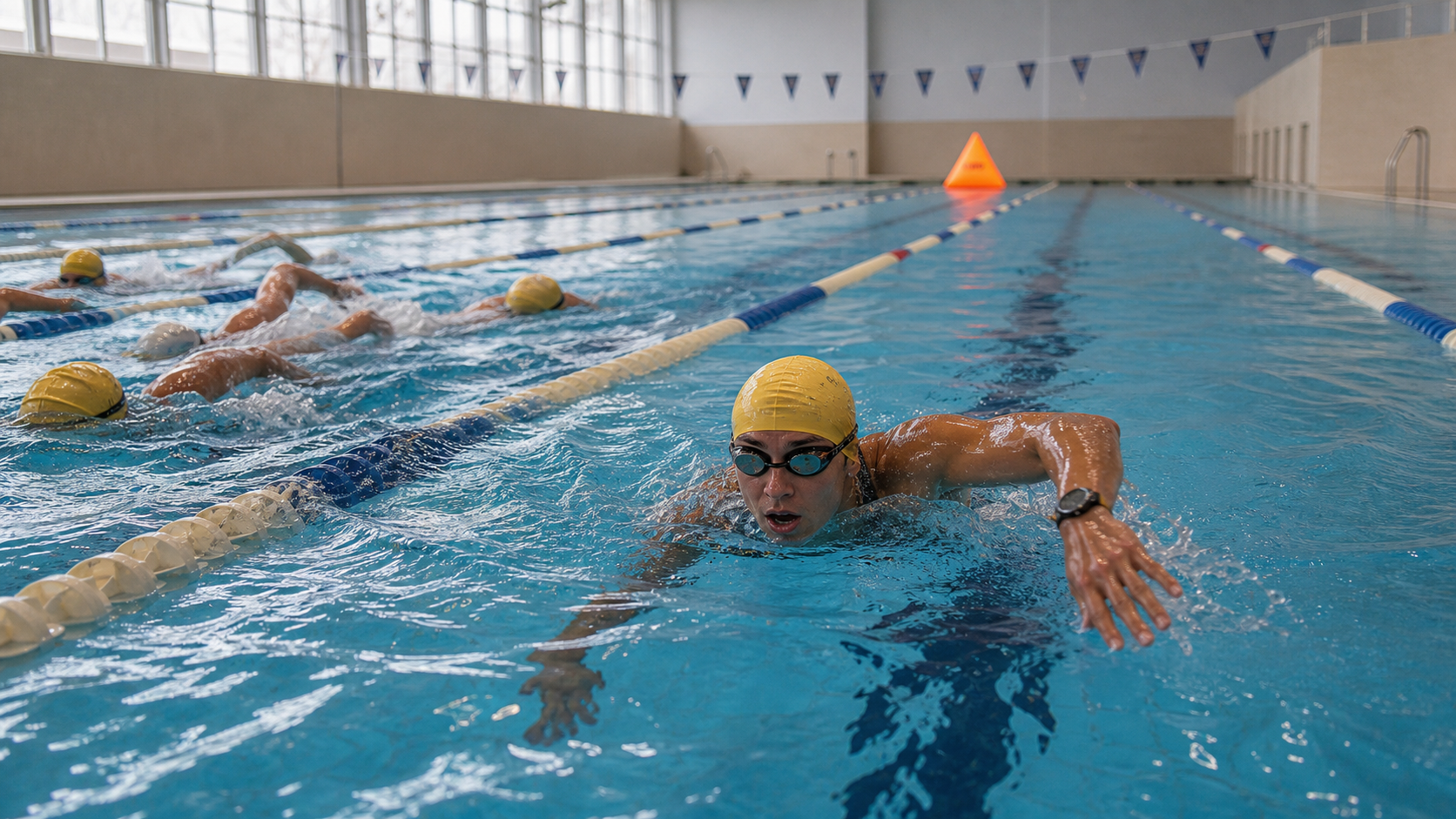
Why Simulate Open Water in the Pool
Limitations of open-water training:
- Affected by weather (typhoons, cold water make swimming impossible)
- Limited by geography (inland cities make it hard to find a venue)
- Limited by time (only available early morning or on holidays)
- Limited by companions (cannot go alone; a lifeguard is required)
Advantages of pool training:
- Available year-round
- Precise distances (every 25m or 50m)
- Accurate timing
- Safe with lifeguards on duty
The key point: 80% of open-water skills can be simulated in the pool.
Simulated Skill 1: Sighting (Straight-Line Navigation)
Drill 1: Regular Head Lifts
- In a 50m lane, lift your head every 6 strokes
- Simulate the motion of spotting buoys in a race
- Train the “lift—breathe—submerge” sequence
Drill 2: Varying Sighting Frequency
- First 100m: sight every 10 strokes
- Second 100m: sight every 6 strokes
- Third 100m: sight every 4 strokes
- Simulate different sighting frequencies under varying conditions
Drill 3: Target Sighting
- Place a highly visible object (brightly colored item) at the end of the lane
- Aim at the target when lifting your head
- Train visual target-locking ability
Simulated Skill 2: Straight-Line Swimming with Eyes Closed
Method
- In an empty lane, swim 25 meters with your eyes closed
- Keep one hand on the lane line (for safety reference)
- Feel whether your body drifts to one side
Advanced Version
- Start from the middle of the lane
- Swim 25m with eyes closed
- Open your eyes and see how far you’ve drifted
- Most people drift toward their preferred breathing side
Corrective Adjustments
- Drifting left: Strengthen the depth of your right arm pull
- Drifting right: Strengthen the depth of your left arm pull
- After 4-8 weeks of training, you can swim perfectly straight
Simulated Skill 3: Crowded Pack Swimming
Drill 1: Two Swimmers in One Lane
- Two swimmers share a lane, swimming one behind the other
- The rear swimmer maintains a 30-50cm distance
- Simulate the feeling of drafting
Drill 2: Three Swimmers Side by Side in One Lane
- Three swimmers swim side by side in the same lane
- The middle swimmer experiences being boxed in
- Practice breaking free by turning sideways
Drill 3: Intentional Bumping
- Two swimmers in the same lane deliberately nudge each other lightly
- Practice staying calm when pushed
- Practice the timing of pushing back
Drill 4: Start Simulation
- 5 swimmers line up at one end of the lane
- Start simultaneously and swim 25 meters
- Simulate the chaos of a race start
Simulated Skill 4: Long-Distance Endurance
Drill 1: Continuous Long Distance
- Swim 1500m without stopping
- Simulate a full triathlon swim leg
- Pace 5-10% slower than usual
Drill 2: Pyramid Long Distance
- 100 + 200 + 400 + 800 + 400 + 200 + 100
- Total 2200m
- Each segment slightly faster than the previous one
Drill 3: Open-Water Pace Simulation
- Swim continuously for 30 minutes
- Do not look at the clock or the distance
- Simulate the sense of time during a race
Simulated Skill 5: Low Visibility
Method
- Use black or dark-tinted goggles
- Simulate low light conditions at dawn
- Adapt even in a brightly lit pool
Advanced Version
- Wear prescription glasses but non-prescription goggles
- Simulate blurred vision
- Train not to rely on vision
Simulated Skill 6: Wave Effects
Drill 1: Artificial Waves
- A teammate in the next lane kicks hard with a kickboard
- Create side waves
- Practice breathing at the wave peak
Drill 2: Self-Made Instability
- Deliberately kick unevenly (alternating strong and weak)
- Simulate the instability of being pushed by waves
- Train core stability
Drill 3: Slow Motion
- Swim in slow motion
- Simulate having your speed dragged down by big waves
- Practice maintaining rhythm at a slow pace
Simulated Skill 7: Breathing Difficulty
Drill 1: Restricted Breathing
- Swim 100m breathing every 5 strokes
- Swim 50m breathing every 7 strokes
- Simulate being unable to breathe due to wave pressure
Drill 2: Deliberate Water Intake and Recovery
- Midway through the swim, deliberately inhale a mouthful of water
- Immediately switch to backstroke to recover
- Resume swimming
Drill 3: High Heart-Rate Swimming
- Sprint 50m first (high heart rate)
- Immediately follow with 200m of easy swimming
- Simulate recovery after the race start
Simulated Skill 8: Exit and Transition
Drill 1: Pool Exit
- Swim to the edge of the lane
- Push yourself forcefully out of the water
- Immediately run 20 meters
- Simulate the T1 transition
Drill 2: Dolphin Dive
- In shallow water (e.g., a children’s pool)
- Practice the dolphin dive motion
- Experience the difference from normal swimming
Complete Simulation Training Workouts
Workout 1: Sighting + Straight Line (45 minutes)
- Warm-up 400m
- 4 x 200m, sight every 6 strokes (30-second rest)
- 4 x 100m with a closed-eye segment (20-second rest)
- Cool-down 200m
- Total 2000m
Workout 2: Pack + Drafting (60 minutes)
- Warm-up 400m
- Swim side by side with a teammate 8 x 100m
- Draft front-to-back with a teammate 4 x 200m
- Simulate start sprint 3 x 50m
- Cool-down 200m
- Total 2050m
Workout 3: Endurance + Pacing (75 minutes)
- Warm-up 400m
- 1500m continuous swim (race simulation)
- 5 x 100m sprint (30-second rest)
- Cool-down 200m
- Total 2600m
Workout 4: Combined Skills (90 minutes)
- Warm-up 400m
- 4 x 100m Sighting (sight every 6 strokes)
- 2 x 400m bilateral breathing
- 8 x 50m sprint
- 1 x 800m continuous swim
- Cool-down 200m
- Total 3000m
Training Periodization
12 Weeks Before Race
- 80% pool + 20% open water
- Focus: foundational technique
8 Weeks Before Race
- 60% pool + 40% open water
- Focus: skill simulation
4 Weeks Before Race
- 40% pool + 60% open water
- Focus: race-pace practice
1 Week Before Race
- Mostly pool-based fine-tuning
- Do not try new skills
Training Methods
- At least 3 pool sessions per week
- At least 2 open-water sessions per month
- Keep a training log: note which skills improved and which remain weak
- Observe each other with teammates: identify problems others can see but you cannot
Conclusion
Pool simulation training is the primary training method for most amateur athletes. With the right simulation techniques, you can combine the safety of the pool with the realism of open water. Remember: pool simulation is not a “replacement” for open-water training, but a “reinforcement.” Get to real open water at least twice a month to translate the skills learned in the pool into race-day performance.
Related Reading
- Open-Water Swimming 1km Training Plan: A Transition Program from Pool to Sea Swimming
- Fitness Differences Between Pool and Open Water: How to Simulate Open-Water Intensity in Pool Training
- Open-Water Training Science: Five Major Adaptation Gaps from Pool to Sea and How to Close Them
- The Complete Guide to Open-Water Swimming: Transition Training from Pool to Ocean
相關影片
訂閱CT的頻道 FTL 與 SYB 車隊專訪 西進武嶺 實用攻略分享! 2小時 如何練?!你不知道的眉角!新手準備武嶺必看 EP1 | 實力派女車友 | 精華版 | 公路車 | CTYeh
4 年前
一日北高前的高裝檢 | 北高 360 | 挑戰11小時的裝備 | 一日雙塔 | 補給
6 年前
live) 超越北高 之一日北高12小時 策略
7 年前
實景訓練台) 彰化經典百K 高強度喵團 90分鐘 跟著一起練功 2019 Indoor workout Changhua Classic 100 Taiwan
7 年前
CT 喇低賽) 武嶺牽車 才是王道 西進牽車四小時內秘訣 攝手位置 如何判斷 防抽筋小秘訣
7 年前
西進武嶺 免費訓練分析服務 Intervals | 練不夠還是練過頭?你哪一種類型選手?AI模型告訴你! | 備戰神器 | 公路車 訓練 | CT Yeh
4 年前
Zwift 元宇宙單車世界 如何與全世界同步騎車運動
6 年前
一個測試有沒有認真練車的方法😂 #公路車
10 個月前