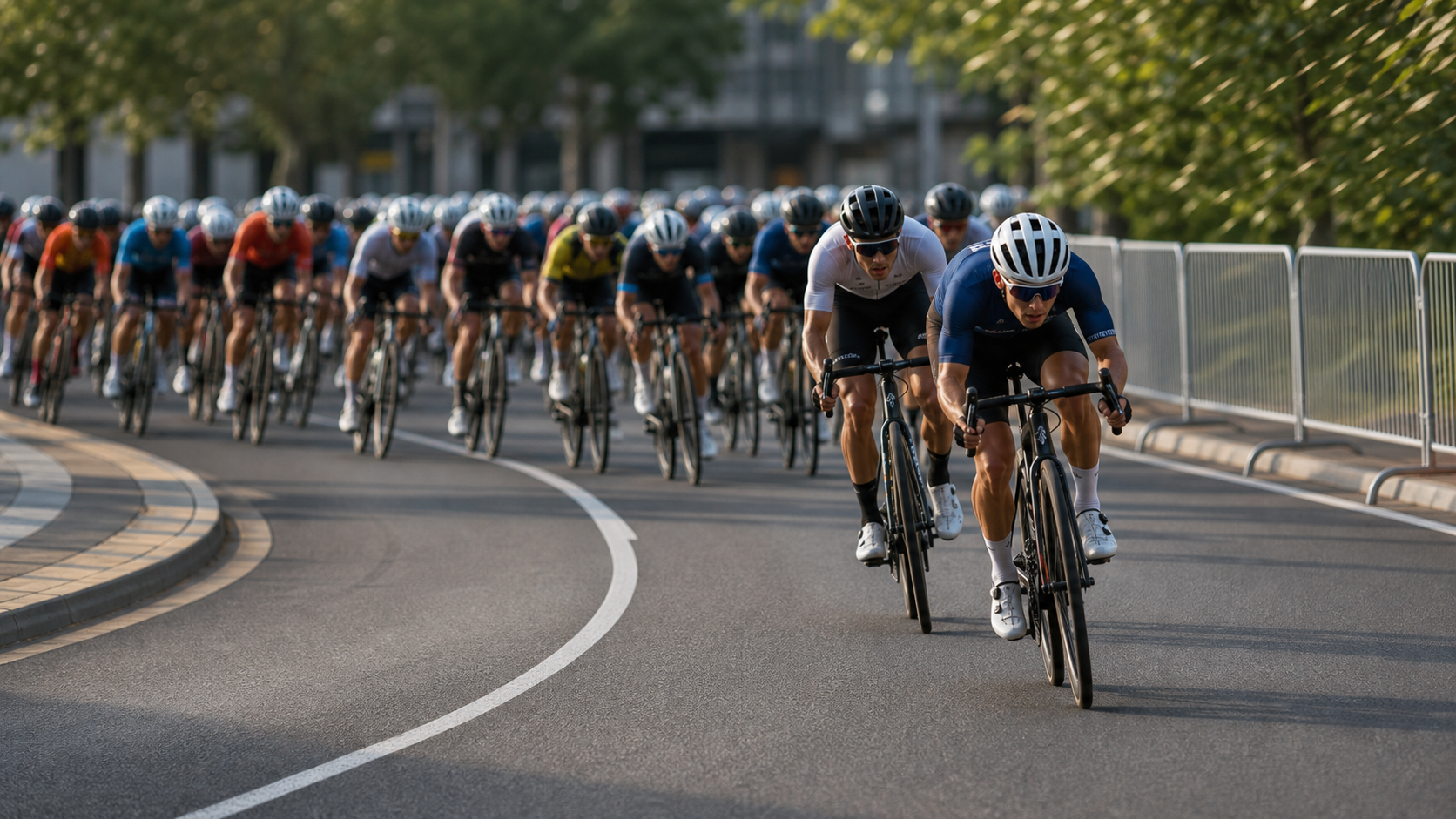
Sprint Route Selection: Tactical Use of Corners and Tailwinds
Sprint winners are often not the riders with the highest Peak Power, but the ones who choose the best route. In the final 500 meters, picking the right line can save 50-100 watts—equivalent to a free bike-length advantage.
1. Inside Line on Corners: Shortest Distance
Physics Principle
With corner radius R, the distance difference between inside and outside lines is approximately 2π × (R_outer - R_inner). For a 90-degree corner, a 1-meter difference between inside and outside means a 1.57-meter difference in distance.
The Cost: Speed Loss
- Inside line: Smaller radius requires braking; cornering speed 35 km/h
- Outside line: Larger radius allows higher speed; cornering speed 42 km/h
Decision Principle:
- Distance to finish after the corner < 200 meters → take the inside line (fight for position)
- Distance after the corner > 500 meters → take the outside line (preserve speed)
2. Tailwind Direction: The True Weight of the Draft
Wind Calculation
- Direct tailwind: Drafting saves 30% of watts
- Cross-tailwind (30°): Drafting saves 20%
- Crosswind: Drafting benefit drops to 10%; an echelon is needed
- Direct headwind: Drafting saves 40% (maximum benefit)
Sprint Timing: In a direct headwind section, stay in the draft until the final 200 meters, then swing out; in a direct tailwind, swing out earlier to fight for position (drafting benefit is smaller).
3. Position in the “Wall” of the Peloton
In the final kilometer of a sprint, the peloton compresses into a “wall,” where position determines everything:
| Position | Wind Resistance | Visibility | Risk |
|---|---|---|---|
| 3rd–5th in the center of the wall | Lowest | Good | Boxed in, unable to get out |
| 3rd–5th on the edge of the wall | Moderate | Best | Can swing out at any time |
| 10th or further back | Low | Poor | Launch too late |
Ideal Position: 500 meters from the finish, 3rd–5th position, on the right side of the wall (or the left, depending on which side has less wind).
4. Road Surface Conditions
Slopes
- Slight descent before the finish (-1 to -3%): Speed can reach 70 km/h, launch 300 meters early
- Slight ascent before the finish (+1 to +3%): Speed drops to 50 km/h, delay the launch to 150 meters
Road Width
- Road narrows before the finish: Move up for position earlier, at 1 kilometer out
- Road widens before the finish: Can overtake in the later stages; no need to fight for position early
5. Real-World Case: Tour de France Flat-Stage Sprint
Assume the course conditions:
- A left-hand corner 800 meters from the finish
- 800 meters of straight after the corner, with a slight tailwind
- A speed bump 200 meters from the finish
Best Route:
- 1.2 km before the corner: Hold a position in the top 8
- Through the corner: Take the outside line (preserve 45 km/h exit speed)
- 800 meters after the corner: Draft to save energy, lock in 3rd position
- 250 meters from the finish: Launch before the speed bump → use the bump’s rebound to accelerate
- 100 meters from the finish: Throw the bike across the line
6. Course Recon Checklist
The day before the race, be sure to confirm:
- [ ] Number and angle of corners in the final 3 km
- [ ] Wind direction (ideally ride the course once)
- [ ] Changes in road width
- [ ] Elevation changes (record with GPS)
- [ ] Whether there are road patches or speed bumps in the final 200 meters
Conclusion
Sprinting is 50% power + 50% intelligence. Reconning the course is more important than adding 100 W to your training. Professional sprint coaches often know every detail of each kilometer of the course better than they know their own home address.
Related Reading
- Road Bike Drafting Techniques: How to Effectively Use Others’ Airflow to Save Energy
- Wind Utilization in Cycling Races: Speed Optimization Strategies for Tailwinds and Crosswinds
- Tour de Taiwan Tactics Classroom: A Complete Analysis of the Art of Attack and Defense in Group Sprints
- Positioning Strategy in Group Sprints: Timing for Rotating and Choosing the Launch Point
CT 喇低賽) 武嶺牽車 才是王道 西進牽車四小時內秘訣 攝手位置 如何判斷 防抽筋小秘訣
7 年前
#公路車 #西進武嶺 配速配瓦實驗 坡度分析 四小時內攻略 建大盃 NeverStop #西進武嶺攻略
6 年前
如果Pogačar騎西進武嶺可以多快?會破2嗎?各種情況深度推估探討 / 公路車 / CT Yeh
2 年前
一日北高前的西濱集訓 | 跟著11小時軍團 | 300W踩不動的大逆風 | 輪車破風差幾瓦?
6 年前
西進武嶺 8000名單車友數據分析 PART1 | 從新手到高手數量/瓦數/推力比/FTP推力比/功率計使用率 大解析 | 公路車 | CTYeh
5 年前
西進武嶺各路段 前8000名 大數據分析 配速攻略/功率/心律/推力比/維持率/踏頻/踏瓦比/牽車率 大公開 | 建大盃 NeverStop 可參考 | 公路車 | CT Yeh
5 年前
西進武嶺 自製新版AI配速表產生器 x 賽前攻略 抱佛腳! 沒有功率計也可以產生配速表嗎?有什麼其他眉角賽前要注意的呢? | 西進武嶺 / 東進武嶺 KOM 攻略 | 公路車 | CT Yeh
4 年前
台北闊瀨陡坡 騎旅 / 日本單車雜誌編輯車友臨時加入!/ 髮香才是最強的 / feat. 北迴歸線小隊 / 公路車 CT Yeh
6 個月前