/no_think
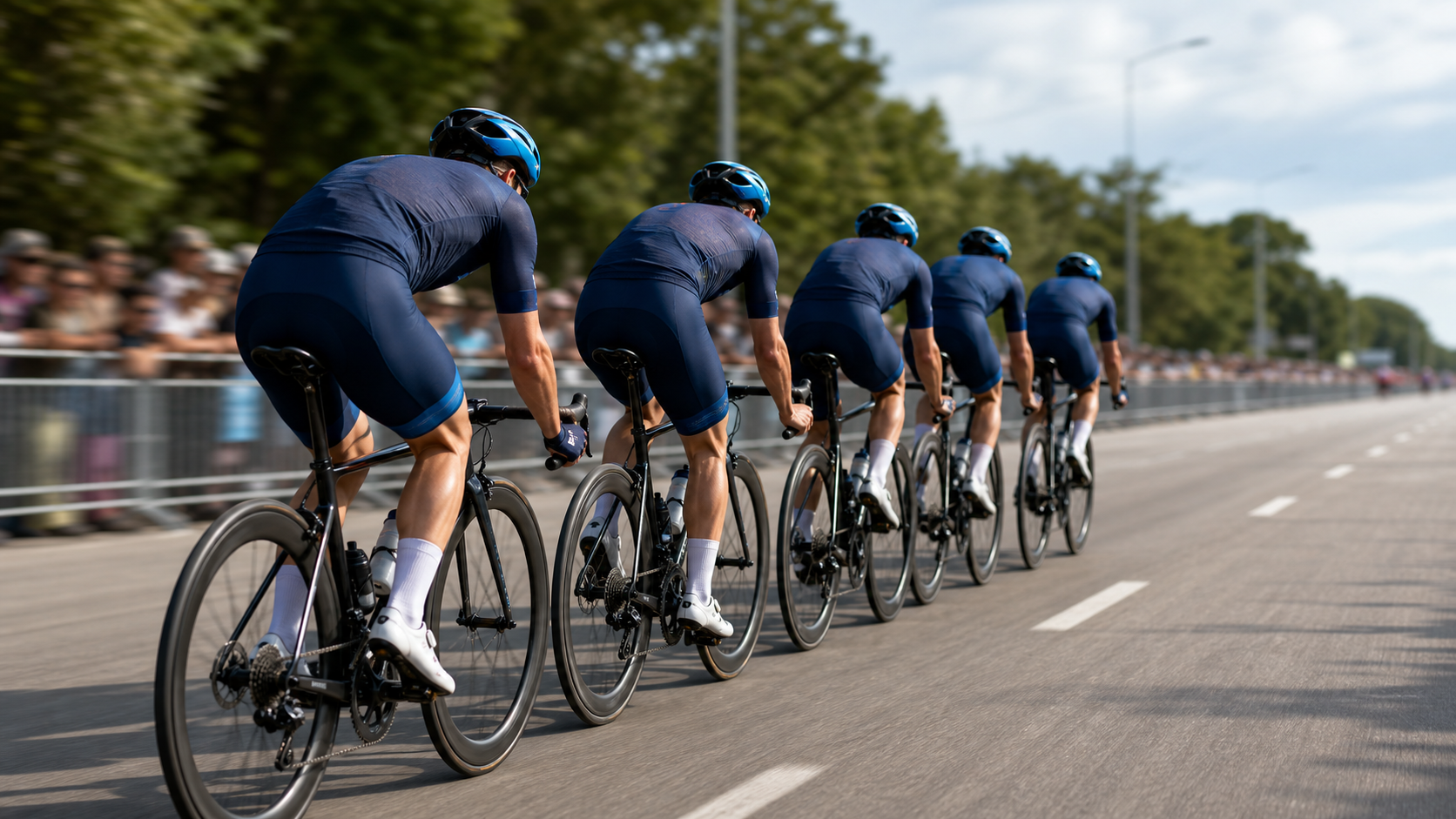
Lead-out Train Tactics: Role Assignments in a Five-Rider Lead-out Train
You think sprinting is a solo show? Wrong. 95% of Tour de France sprint victories come from a five-rider lead-out train. Every position has its own dedicated role, and none can be missing.
The Five-Rider Lead-out Train Structure
[5th Rider] → [4th Rider] → [3rd Rider] → [2nd Rider] → [Sprinter]
  Pace-Setting     Transition    Pilot        Final Engine    Finisher
     Leader
Role Responsibilities by Position
5th Rider: Pace-Setting Leader (Domestique / Engine)
- Mission: Pull the peloton to 50 km/h+ in the final 5 km, keeping rivals boxed in
- Physical demands: High FTP (350-400W), sustained output for 3-5 minutes
- Timing: Full-gas pull from 5-3 km to the finish
- Exit: Drops off around the 3 km mark, mission complete
- Typical riders: Tony Martin, Dylan van Baarle at the Tour de France
4th Rider: Transition Rider
- Mission: Take over the speed from the 5th rider, maintain the high pace, and block rivals from moving up
- Physical demands: 1-2 minutes at 500 W+
- Timing: From 3-1.5 km to the finish
- Exit: Drops off around the 1.5 km mark
3rd Rider: Lead-out Pilot
- Mission: Handles route selection—choosing inside/outside lines through corners and picking sides
- Physical demands: 1 minute at 600 W+
- Timing: From 1.5-0.5 km to the finish
- Key skills: Course familiarity, cornering technique, reading wind direction
- Typical riders: Mark Renshaw (Cavendish’s legendary pilot)
2nd Rider: Final Lead-out
- Mission: Deliver the sprinter to the “launch point” (200-250 meters from the line)
- Physical demands: 30 seconds at 800-900 W
- Timing: From 500-200 meters to the finish
- Exit: Immediately veers off line after the launch (letting the sprinter through)
- Typical riders: Michael Mørkøv (the final engine for Sam Bennett and Cavendish)
1st Rider: Sprinter
- Mission: Explode in the final 200 meters
- Physical demands: Peak Power of 1500-1900 W
- Positioning requirement: Must stay glued to the 2nd rider’s rear wheel, within 0.3 meters
Lead-out Train Power Timeline
| Distance | Rider at Front | Peloton Speed | Front Rider Power |
|---|---|---|---|
| 5 km | 5th Rider | 50 km/h | 400 W (3-5min) |
| 3 km | 4th Rider | 53 km/h | 500 W (1-2min) |
| 1.5 km | 3rd Rider | 56 km/h | 600 W (1min) |
| 500 m | 2nd Rider | 60 km/h | 800-900 W (30s) |
| 200 m | Sprinter | 70 km/h | 1500 W+ (10s) |
Key Principles of Train Operation
1. Always Stay Within 30 cm of the Rear Wheel
If the sprinter drifts more than 30 cm off the train, wind resistance instantly increases by 40%, wasting the teammates’ efforts.
2. No Lateral Wobbling
The train must ride in a straight line—any sideways movement disrupts the rhythm of the sprinter behind.
3. Timing Down to the Second
If the 2nd rider’s “final engine” blows up 5 seconds early, the sprinter is exposed to the wind; 5 seconds late, and rivals behind have already jumped.
4. Communication and Chemistry
Racing relies on earpiece communication, hand signals, and chemistry. It takes at least 3 months of practice to become a stable train.
How Can Amateur Teams Simulate This?
Amateur teams rarely have five riders, but a three-rider train works:
- 3rd rider: High FTP pulls for 3 km
- 2nd rider: Final engine pulls for 500 meters
- 1st rider: Sprints
Training focus: Practice “seamless handoffs”—the moment one rider drops off, the next fills in immediately with no gap.
Conclusion
The lead-out train is cycling’s most beautiful team art. Next time you watch a race, don’t just look at who crosses the line first—watch those 4 teammates sacrificing themselves behind—they are the true heroes.
Related Reading
- The Mechanics of a Sprint Train: The Art of Speed on Flat Finishes
- Role Division in Pro Teams: How Domestiques, Sprinters, Climbers, and Team Leaders Serve One Man
- Sprint Positioning in the Final 3 km of a Road Race: Locomotive Position and Sprint Timing
- Tour de France Tactics Explained: Team Strategy from Pace-Setting to the Final Sprint
CT 喇低賽) 武嶺牽車 才是王道 西進牽車四小時內秘訣 攝手位置 如何判斷 防抽筋小秘訣
7 年前
Zwift跨國線上追逐賽 第二站 台灣 TTR vs. 日本 JETT 第二場 (台灣追日本) | 數百位國內外公路車高手,同場較勁 | 多視角賽事直播
4 年前
FTL 與 SYB 車隊專訪 西進武嶺 實用攻略分享! 2小時 如何練?!你不知道的眉角!新手準備武嶺必看 EP1 | 實力派女車友 | 精華版 | 公路車 | CTYeh
4 年前
#公路車 #西進武嶺 配速配瓦實驗 坡度分析 四小時內攻略 建大盃 NeverStop #西進武嶺攻略
6 年前
福隆鐵人團練隨拍
8 年前
2019 夏季KOM 5小 完賽心得 準備攻略 東進武嶺 夏季登山王之路 Taiwan KOM Challenge
7 年前
西進武嶺 8000名單車友數據分析 PART1 | 從新手到高手數量/瓦數/推力比/FTP推力比/功率計使用率 大解析 | 公路車 | CTYeh
5 年前
昇陽SYB車隊 & Fuji 菁英選手們的趣味經驗分享,長知識了!市民車友必看~ 一路被拉爆後才給問 | 戀戀197 武嶺 凸台經驗分享 | 公路車 | CT Yeh
4 年前