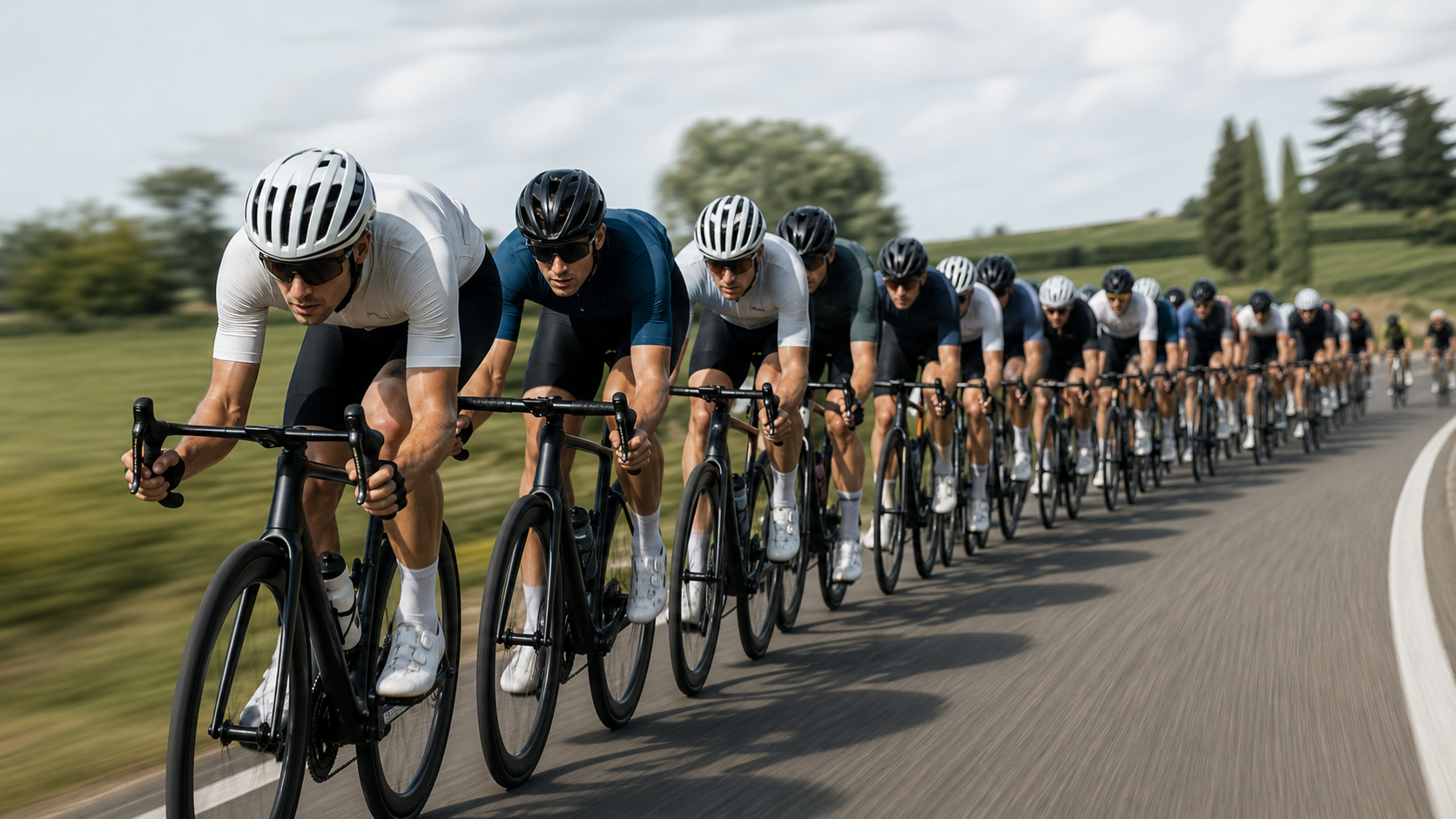
Peloton Energy Physics: How Many Watts Do You Save by Drafting?
“Drafting saves energy” is the golden rule of cycling, but do you know how much it saves? In 2018, Eindhoven University of Technology in the Netherlands used wind tunnel and CFD simulations to study a Tour de France-level peloton, and the conclusion was striking: a rider in 50th position can save up to 95% of aerodynamic drag.
The Mathematical Basis of Aerodynamic Drag
The air resistance formula: F = ½ × ρ × Cd × A × v²
Where:
- ρ: Air density (1.225 kg/m³)
- Cd: Drag coefficient
- A: Frontal area
- v: Relative wind speed
Key point: Drag is proportional to the square of speed. The aerodynamic drag at 50 km/h is 4 times that at 25 km/h.
Energy-Saving Ratios by Position in the Peloton
According to the 2018 Bert Blocken study (wind tunnel + CFD), at 50 km/h:
| Position | Drag Percentage | Energy Saved |
|---|---|---|
| 1st (leader) | 100% | 0% |
| 2nd | 71% | 29% |
| 3rd | 50% | 50% |
| 5th | 36% | 64% |
| 10th | 23% | 77% |
| 30th | 8% | 92% |
| 50th | 5% | 95% |
Striking finding: The larger the peloton, the more energy saved at the back. Riding solo requires 400 W, but the 50th rider only needs 20 W!
Why Is the 50th Rider More Efficient Than the 5th?
Intuitively, the 5th rider should already be fully in the “wind shadow” of the riders ahead. But the research shows that the peloton itself is a massive aerodynamic body:
- After the air in front of the peloton is pushed aside, side airflow forms a stable low-pressure zone at the rear
- Riders from 30th position onward are almost riding in a “vacuum”
- This is also why riders at the very back of the peloton can often chat “leisurely”
The Impact of Peloton Size
| Peloton Size | Energy Saved at 5th | Energy Saved at 30th |
|---|---|---|
| 8 riders | 50% | N/A |
| 20 riders | 60% | N/A |
| 80 riders | 64% | 88% |
| 150 riders | 65% | 92% |
The Impact of Following Distance
At 50 km/h, distance to the rider ahead:
| Distance | Energy Saved |
|---|---|
| 10 cm | 35% |
| 30 cm | 30% |
| 50 cm | 27% |
| 1 m | 20% |
| 2 m | 12% |
| 5 m | 3% |
Balancing safety and efficiency: 30-50 cm is the optimal range—too close is dangerous, too far is wasteful.
Does Drafting Still Work in Crosswinds?
Crosswind from 90 degrees:
- Drafting energy savings drop to 10-15%
- You must switch to an Echelon formation
- In an echelon, the 5th rider can save 40-50%
Drafting Techniques
1. Watch the Shoulders of the Rider Ahead
Don’t stare at the front wheel (you can’t see acceleration or deceleration); watch the rider’s shoulders to gauge their pedaling rhythm and forward-backward body movements.
2. Anticipate Accelerations
The rider ahead stands up → prepare to accelerate; the rider ahead leans forward → prepare to sprint.
3. Don’t Brake
Any braking in the peloton triggers a chain reaction. Rather than braking, ease off the pedals or drift to the side.
4. Find a Stable Rear Wheel
Choose to ride behind skilled riders (coaches, pros)—their lines and speed variations are the most predictable.
Power Data Case Study of Peloton Riding
On a 200 km flat stage of the Tour de France, the peloton averaged 45 km/h:
- Lead rider: average 380 W (5 hours)
- Rider in the middle of the peloton: average 180 W
- Rider at the back of the peloton: average 140 W
- Dropped rider: couldn’t catch back on even at 400 W solo
Conclusion
Peloton riding is a miracle of physics. Those who know how to draft can keep up with professional wheels on amateur legs. But the prerequisite is—you have to get into the peloton first.
Related Reading
- The Science of Aerodynamic Drag: A Complete Analysis of Pace-Lining Technique and Peloton Riding Efficiency
- Team Pace-Lining and Breakaway Tactics: Why Drafting Saves Energy, the Principles of Formation, and Etiquette and Safety for Amateur Group Rides
- Position Management in the Road Race Peloton: Aerodynamic Principles for Saving Energy
- Research Review: Fluid Dynamics Drag Reduction Report on Drafting Techniques in Road Cycling Pelotons—Biomechanical Quantitative Experiment Report (Part 11)
西進武嶺 8000名單車友數據分析 PART1 | 從新手到高手數量/瓦數/推力比/FTP推力比/功率計使用率 大解析 | 公路車 | CTYeh
5 年前
風櫃嘴時間 預測西進武嶺時間?13000名車友統計數據分析告訴你 !
5 年前
風櫃嘴! 現實與虛擬騎乘 會有誤差嗎? 背著iPad邊騎一趟風櫃嘴實際測試一次 | 公路車 | CT Yeh
3 年前
大家都在開箱的...單車用藍芽對講耳機真的有幫助嗎? SENA BiKom 20 長距離旅遊 & 海鷗繞圈賽 實際體驗心得 / 公路車 / CT Yeh
9 個月前
一日北高前的西濱集訓 | 跟著11小時軍團 | 300W踩不動的大逆風 | 輪車破風差幾瓦?
6 年前
ThinkRider 智騎 XXPRO 訓練台,高階機種功能 只要 1/3價格!? 實測功率對比、噪音實測 / 公路車 / CT Yeh
1 年前
2025 自行車錶排行榜 兩萬車友大數據 / Garmin Bryton 排名會大洗牌嗎? / 全新的碼表前身分析 /公路車 / CT Yeh
1 年前
鉅齒紋輪組!? ControlTech MEG-T50 EVO 碳纖維幅條輪組/ 功率對比實驗 / 公路車 / CT Yeh
2 年前