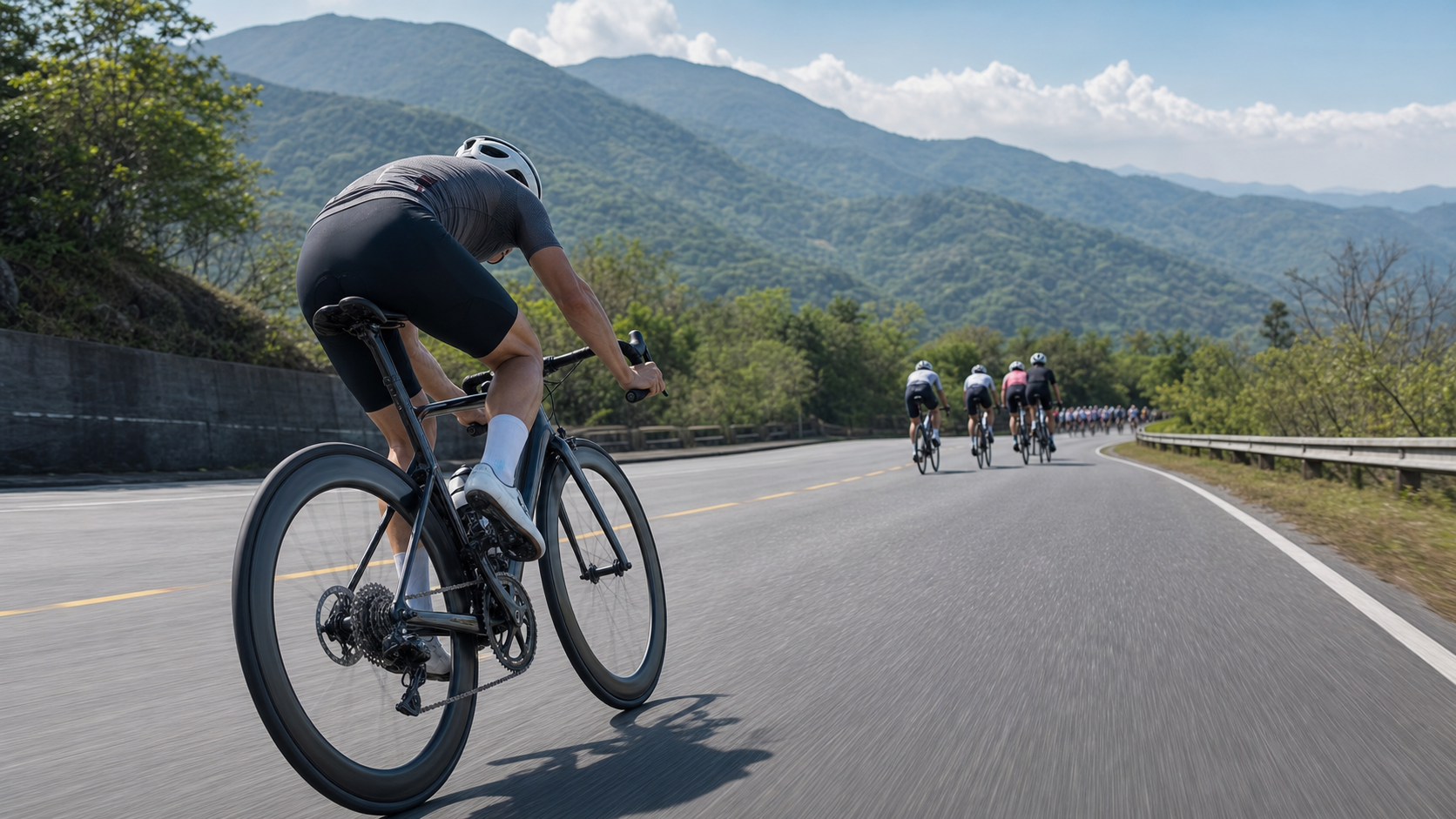
Peloton Chase Tactics: The Power Calculation for Bridging to a Breakaway
Mid-race, 5 riders up the road form a Breakaway, 30 seconds ahead. You glance at your power meter and think: Should I bridge up?
Bridging is a high-risk, high-reward decision. Get it wrong once, and you lose the whole race. This article breaks down the power demands of a bridge with math.
The Basic Physics of Bridging
You’re alone, chasing down the 5-rider Breakaway ahead.
The Breakaway’s speed up front:
- 5 riders rotating through the wind, each swapping every 30 seconds
- Average power (individual): 280 W
- Collective speed: 48 km/h
The peloton’s speed (behind you):
- Large group, riders taking turns chasing
- Average speed: 44 km/h
Your speed requirement:
- Must be at least 3-5 km/h faster than the Breakaway
- Target speed: 51-53 km/h (solo)
How Many Watts to Ride Solo at 51 km/h?
Based on aerodynamic formulas:
- Weight 70 kg, bike 7.5 kg, CdA = 0.32
- Power required on flat roads at 51 km/h: approximately 390 W
Comparison: Your FTP is 300 W, 5min Power is 380 W.
Conclusion: To bridge a 30-second gap, you need to output your 5min Power for 5 minutes.
Bridge Time Calculation
Assuming you output 400 W at a speed of 52 km/h:
- Relative speed difference: 52 - 48 = 4 km/h
- 30 seconds = 0.4 km (Breakaway’s lead distance = 0.4 km / 8 km/h = 6 minutes)
- But you’re only 4 km/h faster than the Breakaway, catching them takes 0.4 / 4 = 0.1 hours = 6 minutes
You need to hold 400 W for 6 minutes—well above FTP, approaching VO2max.
Bridge Difficulty at Different Lead Distances
Assuming your 5min Power = 380 W, FTP = 300 W:
| Lead | Chase Time | Power Required | Difficulty |
|---|---|---|---|
| 10 seconds | 2 minutes | 360 W | Moderate |
| 20 seconds | 4 minutes | 390 W | High |
| 30 seconds | 6 minutes | 400 W | Extreme |
| 60 seconds | 12 minutes | 380 W | Impossible (exceeds 5min Power duration) |
| 90 seconds | 18 minutes | 370 W | Impossible |
Reality: With a lead of 60 seconds or more, a solo bridge by an amateur rider is essentially impossible.
Best Strategies for Bridging
1. Find a teammate to bridge together
With 2 riders rotating through the wind, each individual’s power can drop to 320 W (FTP+7%), sustainable for 10 minutes, extending the bridgeable distance to 60 seconds.
2. Wait for the Breakaway to slow down
- Breakaways usually “fade,” dropping from 48 km/h to 45 km/h
- Your power requirement drops accordingly
- Timing: When the Breakaway has already been gone for 30+ km
3. Use the terrain
- Bridge on an uphill: Your explosive power is relatively amplified
- Bridge on a downhill: Your advantage disappears (the Breakaway can also save energy downhill)
4. Use the peloton’s shelter before launching
- Don’t bridge directly from the back of the peloton
- First move to the very front → the peloton “slingshots” you out
- That’s like getting 50-100 meters of distance for free
The Cost of a Failed Bridge
If you output 400 W for 4 minutes but don’t catch them:
- Accumulated fatigue: FTP drops 10-15% for the next 30 minutes
- Mental blow: feeling like you “blew up”
- The peloton may catch you → becoming the most awkward “sandwich”
In-Race Decision Flow
See a Breakaway up the road
│
├─ Lead < 15 seconds?
│  ├─ Yes → Bridge directly
│  └─ No → Keep evaluating
│
├─ Do I have a teammate?
│  ├─ Yes → Two-rider bridge (lead < 45 seconds)
│  └─ No → Keep evaluating
│
├─ Is there still a long way to go (> 50 km)?
│  ├─ Yes → Wait for terrain or timing
│  └─ No → Give up, stay with the peloton
│
└─ Is the peloton showing signs of chasing?
   ├─ Yes → Wait for the peloton to catch the Breakaway, then counter-attack
   └─ No → Seriously evaluate whether to bridge
Advanced: Decisions After Bridging
Once you’ve bridged, you should:
- Don’t immediately take a pull: Recover for 30 seconds first, get your heart rate in check
- Assess the Breakaway riders’ strength: If they’re all strong → join the rotation; if there are weaker riders → actively accelerate to drop them
- Recalculate the time/power needed to the finish
Conclusion
Bridging is a “gamble” in racing. A power meter can help you calculate the physical feasibility, but psychology, terrain, and the peloton’s reaction are what truly determine success or failure. Before a pro bridges, they run the full calculation through their head—that’s why their attacks look so “confident.”
Related Reading
西進武嶺 8000名單車友數據分析 PART1 | 從新手到高手數量/瓦數/推力比/FTP推力比/功率計使用率 大解析 | 公路車 | CTYeh
5 年前
戰略) Zwift Race 如何咬在第一集團 如何評估自己要開多少推力 (請開1.5倍速看)
7 年前
如果Pogačar騎西進武嶺可以多快?會破2嗎?各種情況深度推估探討 / 公路車 / CT Yeh
2 年前
#公路車 #西進武嶺 配速配瓦實驗 坡度分析 四小時內攻略 建大盃 NeverStop #西進武嶺攻略
6 年前
全台首發!邁金P715踏板功率計!市場價格撼動者再出招 / 功率對比實測 / FAVERO ASSIOMA 可參考! / 公路車 / CT Yeh
1 年前
西進武嶺 免費訓練分析服務 Intervals | 練不夠還是練過頭?你哪一種類型選手?AI模型告訴你! | 備戰神器 | 公路車 訓練 | CT Yeh
4 年前
西進武嶺各路段 前8000名 大數據分析 配速攻略/功率/心律/推力比/維持率/踏頻/踏瓦比/牽車率 大公開 | 建大盃 NeverStop 可參考 | 公路車 | CT Yeh
5 年前
西進武嶺 自製新版AI配速表產生器 x 賽前攻略 抱佛腳! 沒有功率計也可以產生配速表嗎?有什麼其他眉角賽前要注意的呢? | 西進武嶺 / 東進武嶺 KOM 攻略 | 公路車 | CT Yeh
4 年前