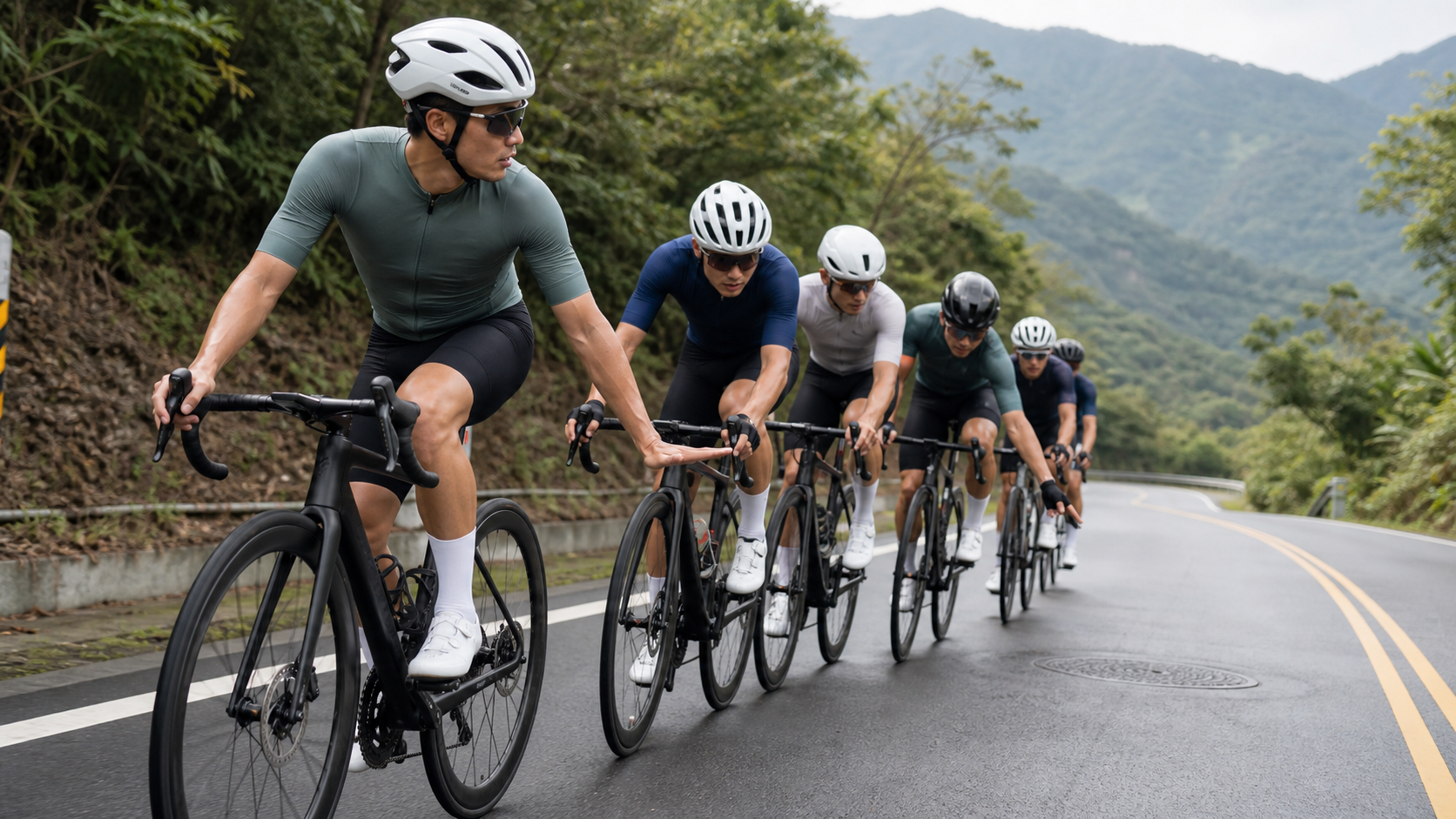
Group Riding Safety: A Complete Guide to Hand Signals, Positioning, and Braking Signals
Group riding can reach speeds of 50 km/h, and any miscommunication can cause a chain-reaction crash. Pro riders communicate through hand signals and instinct, but if amateur riders don’t understand them, the consequences can be severe. This article compiles internationally recognized hand signals and safety guidelines.
Why Do Group Rides Need Hand Signals?
- Speed is too high: At 50 km/h, your voice is easily carried away by the wind
- The formation is too tight: With a following distance of 30 cm, you only have a 0.3-second buffer to react to the rider in front’s braking
- Limited visibility: Followers only see the rear of the rider ahead, making it impossible to spot hazards up front
Core Hand Signal List
1. Pointing at the Ground: Obstacle on the Road
- Action: Point down with your right or left hand (pointing toward the obstacle)
- Meaning: Pothole, manhole cover, glass, or rocks on the road
- Follow-up: The rider behind repeats the signal to pass the message back
2. Hand Waving Behind Your Back: Water / Slippery Surface
- Action: Wave your hand back and forth behind your lower back
- Meaning: Puddle, oil slick, or freshly watered road
3. Fingertips Pointing Forward: Obstacle in the Lane Ahead
- Action: Flick your fingertips forward
- Meaning: Stopped car, pedestrian, or slow vehicle ahead
4. Open Palm Facing Backward: Slowing Down
- Action: Open your palm with all five fingers spread, back of hand facing rearward
- Meaning: “I’m slowing down, riders behind beware”
- Important: Never brake suddenly — give the signal first, then brake gradually
5. Closed Fist Backward: Full Stop
- Action: Make a fist with a bent elbow
- Meaning: Red light, police, or emergency situation requiring a stop
6. Tapping Your Hip: Asking the Rider Behind to Take Over
- Action: Tap your own hip/butt
- Meaning: “I’m tired, next rider comes up to take the wind”
7. Index Finger Circling: Caution Ahead
- Action: Circle your index finger above your head
- Meaning: Situation ahead, but not yet an emergency
8. Hand Pointing Flat to the Side: Changing Lane / Direction
- Action: Point your hand flat in the direction you’re going
- Meaning: “I’m moving over to the left/right”
Positioning Communication: Riding a Straight Line Is the Golden Rule
Golden Rules of Following
- Ride a straight line, no weaving side to side
- Any lateral movement > 10 cm should be preceded by a check behind you
- When checking behind, use your eyes, not just turn your head
Positioning Changes Within the Group
- 20 meters before a corner: The lead rider signals the direction with a hand gesture
- Over a speed bump: Signal with an upward hand motion
- Over a rumble strip: Signal with a downward point
Key Timing for Braking Signals
Braking is the most dangerous action in a group. Any braking must be preceded by a signal.
Three-Level Braking Warning
| Warning Level | Action | Corresponding Situation |
|---|---|---|
| Level 1 | Slowly rise off the saddle, stop pedaling | Changing road conditions, anticipating a need to slow |
| Level 2 | Open palm facing backward | Confirmed need to slow down |
| Level 3 | Closed fist + loud shout of “STOP” | Emergency braking |
Why Can’t You Brake Directly?
- You brake to 40 km/h, but the rider behind is still at 50 km/h
- 0.3 seconds of reaction time = 4 meters of distance
- Following distance is only 0.3 meters → collision is inevitable
Race vs. Training Differences
Training Groups (Amateur Riders)
- Hand signals should be exaggerated and obvious
- Use verbal cues when necessary (“Hole!”, “Car back!”, “Slowing!”)
- The lead rider carries heavy responsibility; new riders stay at the back
Race Groups (Professional)
- Hand signals are small and concise
- Rely mainly on instinct and earpieces
- No loud shouting (wastes energy)
Chinese vs. English Call-Out Comparison
| Chinese | English | Meaning |
|---|---|---|
| 後車! | Car back! | Vehicle behind |
| 前車! | Car up! | Vehicle ahead |
| 坑! | Hole! | Pothole on the road |
| 慢! | Slowing! | Slowing down |
| 停! | Stop! | Full stop |
| 左! | Left! | Turning left |
| 右! | Right! | Turning right |
| 過! | On your left! | Passing on the left |
Top 5 Common Causes of Crashes
- Braking without a hand signal (30%)
- Weaving side to side, unstable line (25%)
- Following too close, unable to react in time (20%)
- Road hazards not communicated (15%)
- Other (reaching for a bottle, turning head, mechanical failure) (10%)
Conclusion
Group riding is a team sport, and safety is the most important discipline. Your hand signal could save your teammate’s life, and their signal could save yours. Before your next group ride, make sure everyone is using the same set of signals — it matters more than your training plan.
Related Reading
- Group Ride Hand Signals and Communication: The Unspoken Language of Safe Group Riding
- Cycling Hand Signals and Team Communication: Basic Safety Hand Signal Guidelines for Riding in Taiwan
- Communicating with Riding Companions on Long Rides: Team Hand Signals, Pace Coordination, and Supply Division
- Skills and Coordination in Group Rides: Hand Signals, Following Distance, and Principles for Avoiding Chain-Reaction Crashes
相關影片
訂閱CT的頻道 CT 喇低賽) 單車 比賽總是沒照片? 攝影師的觀點大公開 姿勢就是力量! 請加速1.25倍收看
7 年前
[教學] Premiere 影片 手震 修正 教學 防抖 單眼 影像 GoPro 穩定 Video Stabilization
8 年前
戰略) Zwift Race 如何咬在第一集團 如何評估自己要開多少推力 (請開1.5倍速看)
7 年前
CT 喇低賽) 武嶺牽車 才是王道 西進牽車四小時內秘訣 攝手位置 如何判斷 防抽筋小秘訣
7 年前
2024 如來神掌 百人約騎挑戰!feat. 秘境單車社團 / 神人們太可怕 / 全程錄影 x 完整坡度解析 / 公路車 / CT Yeh
2 年前
富士山KOM 賽事篇 VLOG!/ 小野田出沒!/ 完整路段分析 / 武嶺要騎多快才能拿環?/ 台灣選手 第20回Mt.富士ヒルクライム 参加!/ 公路車 / CT Yeh
2 年前
[教學] Dashware 教學 如何製作有 速度 功率 心律的 騎車影片 Guages Video
8 年前
2024桃園團體自由車邀請賽!4K環台賽等級拍攝 全賽事精華!/ 集團大摔車 / 60隊菁英好手衝線 / 公路車 CT Yeh
1 年前