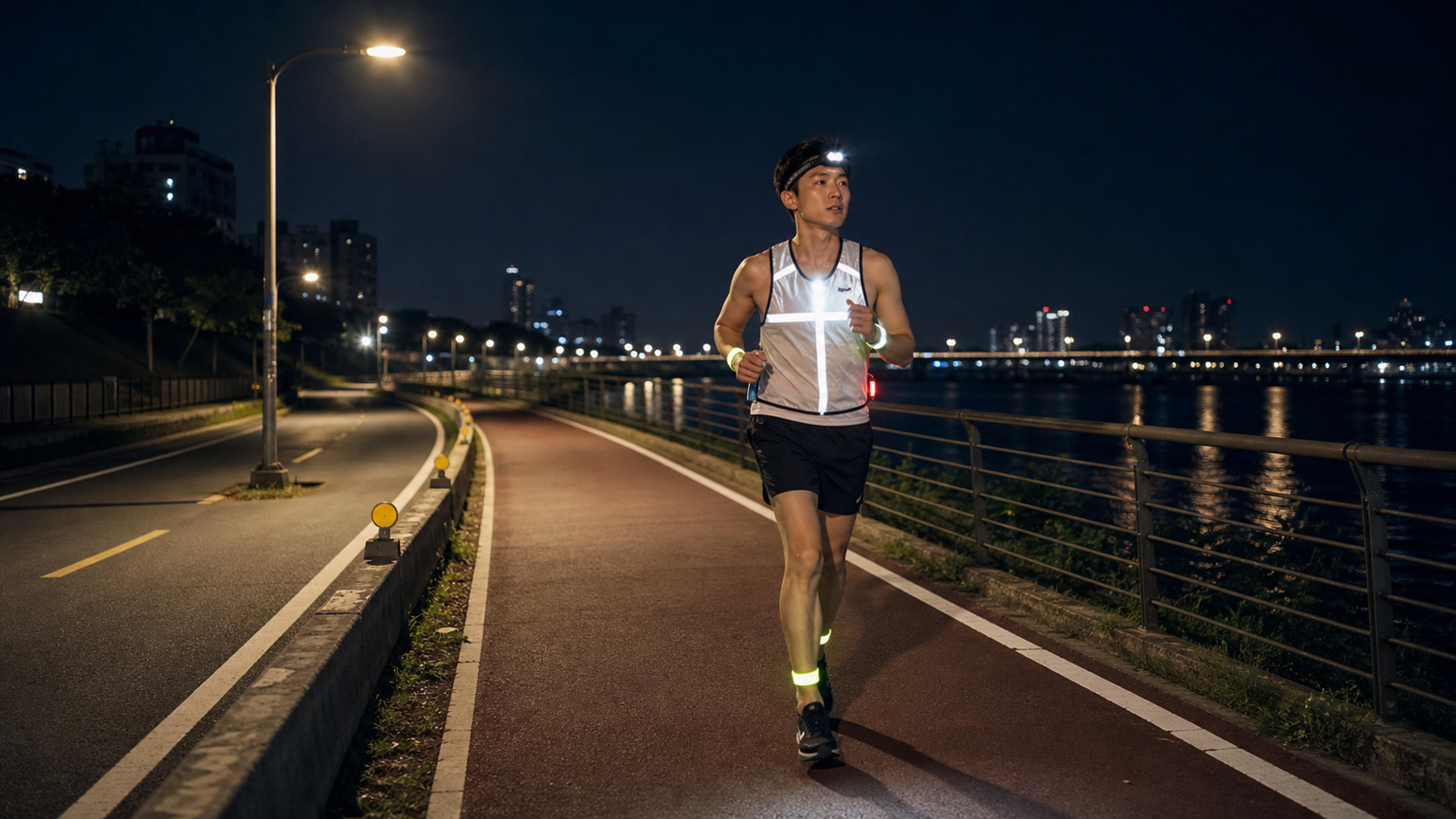
Night Running Accident Statistics
According to US NHTSA data, pedestrians/runners are 3 times more likely to be fatally struck at night than during the day. Taiwan’s Ministry of Transportation and Communications statistics show that for runner accidents occurring between 22:00-06:00, 80% of runners were not wearing reflective gear.
Nighttime risks come from three aspects:
- Poor visibility: Drivers only see you from 50m away (up to 200m during the day)
- Drowsy driving: Accident rates rise 40% after 22:00
- Drunk driving: The highest rate of drunk driving occurs between 11:00 PM and 3:00 AM
Reflective Gear: 3 Most Critical Positions
Reflectivity isn’t just about “having something”—position determines visibility.
Essential Positions
| Position | Reason | Recommended Gear |
|---|---|---|
| Ankle/Calf | Most visible running motion; lets drivers identify “this is a pedestrian” from a distance | Reflective ankle bands/reflective socks |
| Upper arm/Wrist | Arm swing creates a motion trail, highlighting it as a moving object | Reflective arm bands |
| Back | Key warning when drivers approach from behind | Reflective vest or reflective running top |
Reflectivity Grades
- EN 17353 Type AB or ANSI 107 Class 2: Compliant standards, 150m+ visibility
- Cheap reflective bands may only offer 30-50m visibility
- Black clothing with reflective strips still has 40% lower visibility than fluorescent colors
The Science of Color
- Daytime: Fluorescent yellow > Fluorescent orange > Red > White > Black
- Dusk: Fluorescent orange > Fluorescent yellow > Red > White
- Night (no lighting): Reflective material is what matters; base color is irrelevant
- Night (with streetlights): White > Fluorescent colors > Reflective
Choosing a Headlamp/Chest Light
Specification Guide
| Metric | Regular Night Running | Trail/Unlit Sections |
|---|---|---|
| Lumens | 100-200 lm | 300-500 lm |
| Battery Life | 3-4 hours | 6+ hours |
| Water Resistance | IPX4 | IPX6 or higher |
| Weight | <100g | <200g |
| Red Rear Light | Essential | Essential |
Headlamp vs. Chest Light
- Headlamp Pros: Beam direction follows your gaze; Cons: Running motion makes the field of view bounce, which can cause headaches
- Chest Light Pros: Stable beam, no bouncing, doesn’t strain neck muscles; Cons: Can’t illuminate a new direction when you turn your head
- Recommendation: Use a headlamp on trails, a chest light on roads
4 Key Principles for Route Selection
1. Lighting Continuity
Ideal route: streetlight spacing under 50m for the entire route. How to test: Walk the route once during the day and note the distance between each streetlight.
2. Avoid Dangerous Intersections
Priority order:
- Riverside trails (no vehicles) ★★★★★
- School tracks (enclosed space) ★★★★★
- Park running tracks ★★★★
- Residential alleyways (slow traffic) ★★★
- Main road sidewalks ★★
- Suburban industrial roads (no sidewalks) ★
- Mountain roads ★ (highly not recommended at night)
3. Avoid Out-and-Back Routes
Choose loop routes for night running to avoid running the same stretch twice. Reasons:
- Repeated routes are easier for fatigued drivers to overlook
- Loop routes spread out the risk
- Mentally, you avoid the fear of retracing the same path
4. Distribution of Help Points
Every 1-2 km, there should be:
- A 24-hour convenience store
- A taxi stand
- A gathering point (near night markets, clubs)
Personal Safety Gear Checklist
Essential
- [ ] Reflective vest (EN 17353 Type AB)
- [ ] Headlamp or chest light (with red rear light)
- [ ] Phone (in a waterproof pouch)
- [ ] Health insurance card or a copy of your ID
- [ ] Emergency contact note (in your pocket)
- [ ] Whistle (for help in an attack or accident)
Recommended
- [ ] Sports smartwatch (with GPS + fall detection + LiveTrack)
- [ ] Pepper spray (where legal)
- [ ] Personal alarm (high-decibel safety alarm)
- [ ] Non-slip running shoes (easy to step on slippery surfaces at night)
Smartwatch Safety Features (Must Enable)
- LiveTrack/Share My Location: Family can see your location in real time
- Fall Detection: Available on Garmin, Apple Watch, and Fitbit
- Emergency Contact: Long-press a specific button to auto-dial
Choosing Your Night Running Time
| Time Slot | Risk | Recommendation |
|---|---|---|
| 19:00-20:00 | Low (post-dinner crowd peak) | Recommended |
| 20:00-21:30 | Medium (fewer people but still heavy traffic) | Main routes |
| 21:30-23:00 | Medium-high (rising driver fatigue) | Riverside, parks |
| 23:00-05:00 | Extremely high (drunk driving peak) | Outdoor running not recommended |
| 05:00-06:00 | Low (dawn light increasing) | Recommended |
The Math of Running with Others
Risk of running alone at night = X
- 2 people = X × 0.4
- 3-5 people = X × 0.15
- 5+ people = X × 0.05
If you can’t find company on weekdays, join a running group’s regular night sessions. Thursday 19:30 at the riverside and Saturday 20:00 at the track are common Taipei running group time slots.
The romance of night running comes from seeing the city’s other side, but the prerequisite for that romance is getting home alive. Treat reflectors, headlamps, and routes like your running shoes—not accessories, but essentials.
Related Reading
- Night Running Lighting Systems: A Complete Buying Guide from Headlamp Lumens to Reflective Gear
- The Complete Guide to Night Running Safety Gear: Reflective Accessories, Headlamp Selection, and Visibility Enhancement Strategies
- The Complete Guide to Night Running Safety Gear: The Essential Reflective Gear Checklist for Taiwan’s Night Runners
- Trail Running Night Safety: Complete Rules from Headlamps to Routes
雷達尾燈 雷不雷? 邁金L508 智慧雷達尾燈 情境考驗實測 | 同場加映 2千元等級的專業車錶 C406 Pro | 公路車 | CT Yeh
3 年前
單車 一日北高 ( 雙城 ) 肥宅雙人瘋狂行 紀錄片 REACTO
10 年前
一日北高前的高裝檢 | 北高 360 | 挑戰11小時的裝備 | 一日雙塔 | 補給
6 年前
iPhone 12 Pro 夜間騎車動態錄影 效果屌打 GoPro Hero 9 | 公路車 團練
5 年前
CT 喇低賽) 單車 比賽總是沒照片? 攝影師的觀點大公開 姿勢就是力量! 請加速1.25倍收看
7 年前
再快都跟的上!? 單車跟隨攝影機之王 HOVERAir X1 PROMAX 全面實測 / 唯一!8K畫質&自行車專用模式和跟蹤信標&前後避障 / DJI Neo 可參考/ 公路車 / CT Yeh
1 年前
摔車後補裝備: 好市多新款單車安全帽& Specialized Romin 北高整路屁股都不痛的坐墊 | 一千元居然有MIPS | CT Yeh | 公路車
4 年前
一日北高/長距離團騎 常見問題補充篇 / 組團或跟團的眉角 / 壯車友容易被瘦車友慢性拉爆 / 原來屁股痛可能是這個原因...? / 風場配速法 / 公路車 / CT Yeh
2 年前