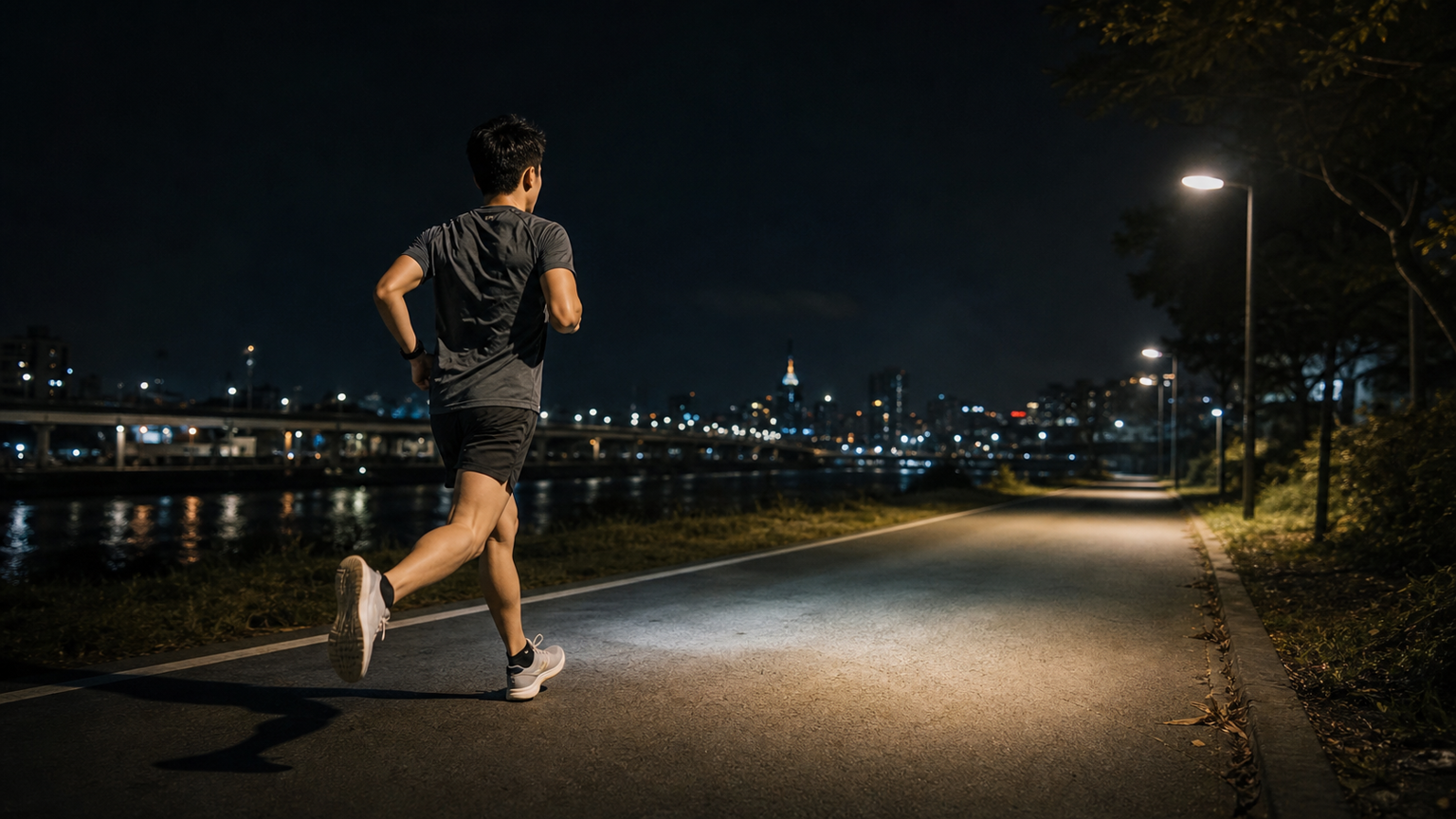
5 Reasons Night Running “Feels Faster”
1. Compressed Visual Field Illusion
The nighttime visual field narrows from 180° during the day to 60-90° (limited by headlamp/streetlight range). With fewer reference points, the sense of speed is amplified. The same 5:00/km feels normal during the day but feels like 4:30 at night.
2. Amplified Wind Noise
Ambient noise drops at night (65 dB during the day → 45 dB at night), making the sound of wind rushing past your ears relatively louder, increasing the subjective sense of speed.
3. Enhanced Peripheral Vision
At night, rod cells dominate vision and are 5 times more sensitive to motion detection than during the day. The sensation of roadside objects rapidly sweeping past your field of view makes you think you’re running fast.
4. Psychological Excitement
Night running often comes with:
- Adrenaline from releasing work stress
- Attention from pedestrians (sense of accomplishment)
- Music rhythm driving you on
All of these push up your RPE (rate of perceived exertion), causing you to misjudge intensity.
5. Higher Core Body Temperature
Physiological mechanisms (detailed later) cause nighttime training heart rate to be 5-10 bpm higher than during the day, making the perceived physical burden greater than the actual effort.
Why Actual Pace Is Actually Slower
The Influence of Circadian Rhythm
Human physical performance follows a natural rhythm:
| Time Period | Core Body Temperature | VO2 Max | Pace Performance |
|---|---|---|---|
| 04:00-06:00 | Lowest | Lowest | -3% |
| 06:00-09:00 | Slightly Low | Moderate | -1% |
| 14:00-18:00 | Highest | Highest | Baseline |
| 18:00-21:00 | Medium-High | High | -1% |
| 21:00-24:00 | Moderate | Moderate | -2% |
| 00:00-04:00 | Slightly Low | Low | -4% |
After 21:00, night running pace capability is 1-2% lower than in the afternoon, meaning a 10 km run is about 30-60 seconds slower.
Digestive System Interference
There’s usually a 2-3 hour gap between dinner and a night run, and food residue may still be in the stomach, causing:
- Blood flow being diverted to the digestive system
- Heart rate 5-8 bpm higher than running on an empty stomach
- Increased likelihood of abdominal pain or side stitches
Cumulative Fatigue
After 8 hours of daytime work, the nervous system is already fatigued:
- Reaction time slows by 10-15%
- Movement coordination declines
- Running economy decreases by 3-5%
Real Data: Night Run vs. Morning Run
Comparing the same runner’s 10 km training sessions:
| Metric | Morning Run 06:30 | Afternoon 16:00 | Night Run 21:00 |
|---|---|---|---|
| Average Pace | 5:08/km | 5:00/km | 5:12/km |
| Average Heart Rate | 156 bpm | 152 bpm | 161 bpm |
| RPE (Perceived Exertion) | 6/10 | 5/10 | 7/10 |
| Cadence | 178 | 182 | 175 |
| Stride Length | 1.15m | 1.18m | 1.13m |
Night running has a heart rate 9 bpm higher and pace 12 seconds slower, yet feels the most exhausting.
Pace Adjustment Recommendations
Training Pace Adjustments
Using the daytime afternoon as baseline:
- Morning 06:00-08:00: subtract 5 sec/km
- Late Morning 09:00-11:00: baseline
- Afternoon 14:00-18:00: baseline
- Dusk 18:00-20:00: subtract 3 sec/km
- Night 20:00-22:00: subtract 8 sec/km
- Late Night after 22:00: subtract 15 sec/km
Use Heart Rate Instead of Pace
For night runs, it’s recommended to:
- Focus on heart rate zones instead of pace
- For E-pace runs: keep heart rate below the Z2 upper limit
- Avoid high-intensity workouts like T, I, R (not suited to your circadian rhythm)
Night Run Training Plan Suggestions
What kind of training suits night running?
Suitable:
- E-pace recovery runs (30-60 minutes)
- Easy long runs (< 90 minutes)
- Active recovery runs
- Running form drills and cadence practice
Not Suitable:
- T-pace lactate threshold runs
- 400m/800m speed intervals
- Repeated hill runs
- Race pace testing
Don’t Be Fooled by Your Pace Watch
At night, your eyes, ears, and heart are all deceiving you—your pace watch is the only source of truth. Common mistakes:
- Feels fast → run faster → blow up at 5 km
- Watch shows slow → speed up → DOMS (delayed onset muscle soreness) explodes the next day
- Using night run pace as a race goal → overestimating yourself by 3-5%
3 Tips for Night Runners
- Accept that night running is “tiring”: Your body isn’t a machine; circadian rhythms are real
- Do main workouts during the day, treat night runs as supplements: Use daytime for weekend long runs, and weekday night runs for aerobic maintenance
- Use RPE rather than pace to plan training: If it feels right, that’s what matters; numbers are secondary
The purpose of night running has never been a PR—it’s about preserving a space for exercise for office workers. Once you understand the pace illusion, you can run longer and safer at night.
Related Reading
- Night Segment Pacing in Trail Races: A Lonely Battle Under the Headlamp, the Dual Challenge of Pacing and Psychology
- Pace Differences Between Running in Rain and Sunshine: Analysis of 5 Variables That Slow You Down by 20 sec/km
- GPS Watch Pace Errors in Road Running: Why Your Pace Isn’t Accurate
- Night Running and Sleep: The Impact of Running After 21:00 on Falling Asleep
2016/4/20 - 中社路 夜騎 半年甩肉14KG 後測
10 年前
#公路車 #Fitting 靠人工智慧APP 幫你調整單車
6 年前
CT 喇低賽) 單車 比賽總是沒照片? 攝影師的觀點大公開 姿勢就是力量! 請加速1.25倍收看
7 年前
iPhone 12 Pro 夜間騎車動態錄影 效果屌打 GoPro Hero 9 | 公路車 團練
5 年前
Live) 備戰2019彰化經典百K 賽前攻略 (已完賽請看新影片
7 年前
iPhone 13 Pro 電影級 VLOG 實拍測試!優缺點 原理分析! 夜間效果對決 GoPro10!蘋果沒有說的超強錄影體驗!? | CT Yeh
4 年前
一日北高 11小時 賽後心得分享篇 | TWB北高360 | 一日雙城 | 單車 | 公路車
6 年前
東進武嶺 西進武嶺 AI 配速 上線囉 公路車
5 年前