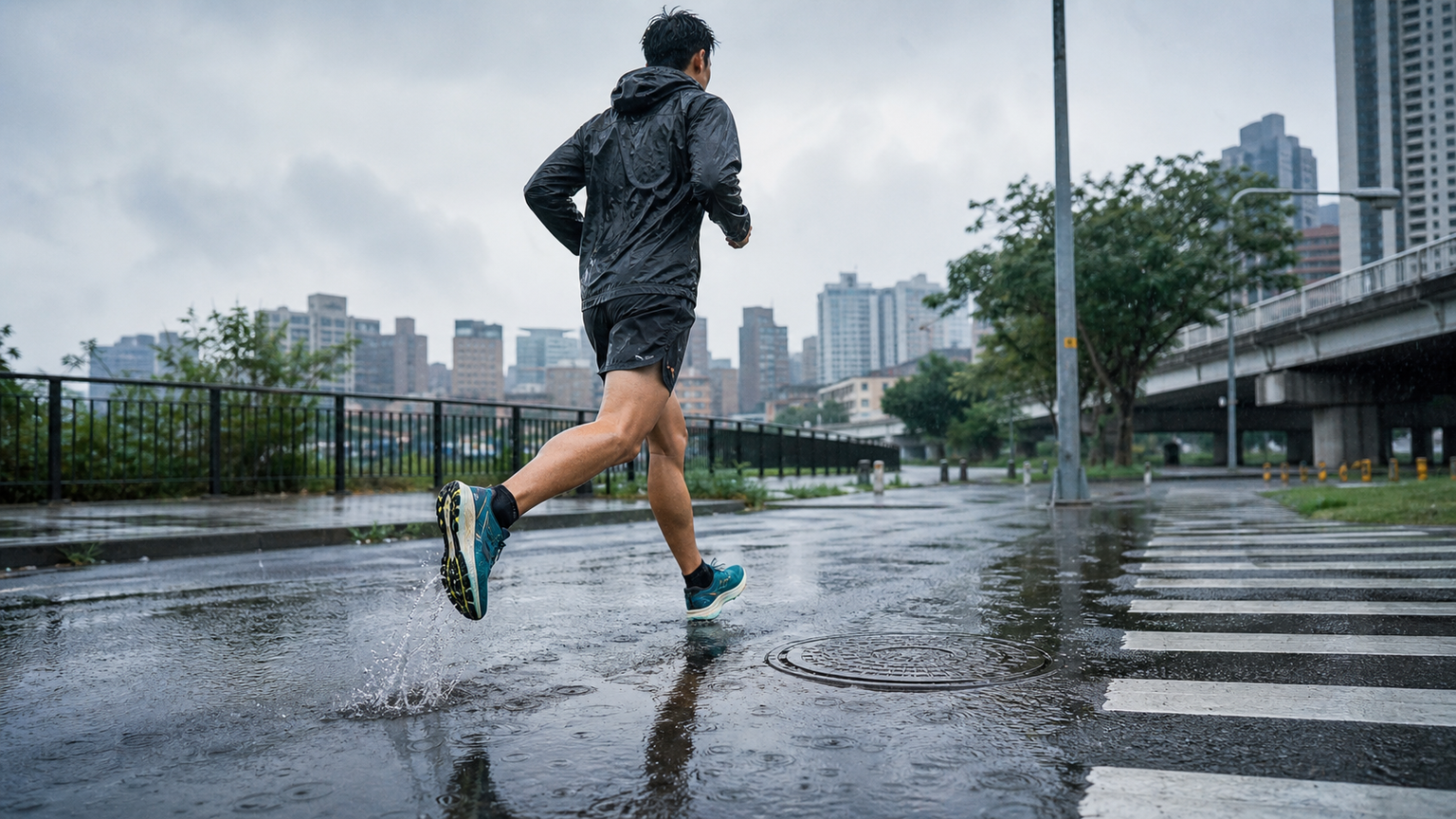
The 3 Physical Variables of Rainy-Day Running
1. Reduced Ground Friction
Friction coefficients change depending on the surface and how wet it is:
| Surface Type | Dry μ | Slightly Wet μ | Soaked μ | Risk |
|---|---|---|---|---|
| Asphalt | 0.8 | 0.6 | 0.5 | Medium |
| Concrete | 0.9 | 0.5 | 0.3 | High |
| Tile | 0.7 | 0.3 | 0.2 | Very High |
| Wooden Boardwalk | 0.8 | 0.4 | 0.2 | Very High |
| Steel Manhole Cover | 0.6 | 0.2 | 0.1 | Very High |
| Painted Crosswalk | 0.7 | 0.3 | 0.15 | Very High |
Bottom line: The most dangerous surface in the rain isn’t asphalt — it’s tile, manhole covers, crosswalk paint, and wooden boardwalks.
2. Accelerated Heat Loss
How fast your body loses core heat in the rain:
- Dry conditions, 15°C: heat loss of 1°C/hour
- Light rain, 15°C: heat loss of 2°C/hour
- Heavy rain, 15°C: heat loss of 3-4°C/hour
- Heavy rain + wind (10 m/s): heat loss of 5-6°C/hour
Once core temperature drops below 36°C, you enter the hypothermia risk zone, and your pace will noticeably slow down.
3. Reduced Visibility
Visible distance in the rain:
- Drizzle: visibility 200m+ (minor impact)
- Moderate rain: visibility 100-200m
- Heavy rain: visibility 50-100m
- Downpour: visibility < 50m (running not recommended)
Choosing Running Shoes
Rainy-Day Essential: High-Drainage Running Shoes
Key criteria:
- Upper: Breathable mesh is better than dense synthetic leather (letting water drain out matters more than blocking it)
- Midsole: EVA absorbs less water; supercritical foam materials drain faster
- Outsole tread: Deeper than 4mm, multi-directional grooves, diamond or hexagonal traction patterns
- Insole: Removable, quick-drying insoles
Recommended Types
| Shoe Type | Suitable Scenario | Examples |
|---|---|---|
| Trail running shoes | Trails, dirt roads in the rain | Salomon, Hoka Speedgoat |
| Road training shoes (with slip-resistant outsole) | Urban rain running | Asics GT-2000, Brooks Adrenaline |
| Racing shoes | Rain-day races | Nike Vaporfly water-resistant version, Saucony Endorphin |
Shoes to Avoid
- Pure white-soled running shoes (poor traction)
- Carbon-plated racing shoes (most models get slippery in the rain)
- Old shoes with more than 800 km on them
- Pure trail running spikes (they slip on paved roads)
Choosing Clothing
The 3-Layer Rainy-Day System
Base layer (next-to-skin, moisture-wicking):
- Material: polyester, polypropylene
- Avoid: pure cotton (poor insulation once wet, causes chafing)
- Length: covers below the waist
Mid layer (insulating, can be skipped in summer):
- Material: thin wool, brushed fleece wicking shirts
- Thickness: 100-150 g/m²
- Not needed for summer rain
Outer layer (waterproof, breathable):
- Material: Gore-Tex, eVent, or a brand’s proprietary waterproofing tech
- Breathability: RET < 13 (lower is more breathable)
- Zippers: waterproof zippers (YKK AquaGuard)
- Ventilation: underarm and back zip vents
Layering by Temperature in the Rain
| Temperature | Base Layer | Mid Layer | Outer Layer |
|---|---|---|---|
| > 25°C | Moisture-wicking short sleeve | — | None (or a light sun cap) |
| 20-25°C | Moisture-wicking short sleeve | — | Lightweight windbreaker/rain jacket (< 100g) |
| 15-20°C | Moisture-wicking long sleeve | — | Rain jacket + waterproof cap |
| 10-15°C | Moisture-wicking long sleeve | Thin fleece | Waterproof jacket + waterproof cap + gloves |
| < 10°C | Thick insulating long sleeve | Medium fleece | Waterproof jacket + insulated cap + waterproof gloves |
Small Items Easily Overlooked
- Waterproof cap: keeps rain out of your eyes and improves visibility
- Water-resistant running socks: wool blends (e.g. 80% Merino wool)
- Waterproof gloves: protects fingers on cold rainy runs
- Calf sleeves: protects calves and guards against small stones
- Hooded rain jacket: adjustable fit around the head
Pace Adjustments
Pace Adjustment by Rainfall Level
The following is based on a 5:00/km marathon-pace baseline:
| Rainfall | Pace Adjustment | Heart Rate Change | Risk Level |
|---|---|---|---|
| Drizzle | +0 sec/km | No change | Low |
| Light rain (< 5mm/hr) | +5 sec/km | +2 bpm | Low |
| Moderate rain (5-15mm/hr) | +15 sec/km | +5 bpm | Medium |
| Heavy rain (15-30mm/hr) | +25 sec/km | +8 bpm | High |
| Downpour (> 30mm/hr) | Running not recommended | — | Very High |
Fine-Tuning Your Running Form
In the rain you should:
- Shorten stride by 5-10%: reduces slipping
- Increase cadence slightly by 3-5 bpm: compensates for the shorter stride
- Lower your center of gravity slightly: bend the knees a bit more
- Land mid-foot: avoid heel-striking first (it’s more prone to slipping)
- Avoid sharp turns: start slowing down 20m before any bend
Route Selection
Preferred Rainy-Day Routes
- School PU track (good drainage, stable surface) ★★★★★
- Indoor treadmill ★★★★★
- Riverside asphalt path (avoid boardwalk sections) ★★★★
- Park trails ★★★
- Regular sidewalks ★★ (avoid tiled sections)
Routes to Avoid in the Rain
- Mountain trails (mudslides, falling rocks, poor visibility)
- Wooden boardwalks (extremely slippery)
- Sections with heavy tiling
- Long unsheltered bridges (wind and rain combine)
- City alleys with many manhole covers
4 Techniques for Rainy-Day Training
1. Before the Run
- Check the weather app for rainfall amount and trend
- Bring your phone and an emergency contact card
- Tell your family your route and expected return time
- Pack a compact rain jacket in a waist pack
2. During the Run
- If your shoes get wet, don’t stop to take them off — keep running
- If your body temperature drops sharply, find shelter immediately or speed up to get home
- If there’s lightning, stop immediately and find indoor shelter
- If you fall, check for a sprain before continuing
3. After the Run
- Change into dry clothes within 30 minutes (to avoid catching a cold)
- Stuff running shoes with newspaper and place them in a shaded, ventilated area (don’t use a clothes dryer — it damages the adhesive)
- Wash apparel in cold water and avoid the dryer (it breaks down the waterproof coating)
- Drink something warm or have hot soup to help restore core temperature
4. Gear Maintenance
- Reapply DWR waterproofing spray to your rain jacket every 5 washes
- Wipe down running shoes and apply shoe polish (for leather surfaces) every couple of weeks
- Check your watch’s water-resistance rating (5 ATM or higher is suitable for rain running)
When You Should Skip the Run
Do not run under the following conditions:
- Thunderstorms (even if the lightning seems distant)
- Downpours (rainfall > 30mm/hr)
- An approaching typhoon
- Standing water on the road deeper than 5 cm
- Visibility < 50m
- Feels-like temperature < 5°C
- Icy surfaces (even if they look dry)
Conclusion: Rainy-Day Training Is an Advanced Skill
Rainy-day training isn’t a “badge of toughness” — it’s preparation for races that might have rain. If your target race could realistically see rain (such as the New Taipei Marathon, Tokyo Marathon, or Taichung Marathon), rainy-day training is a necessary skill.
But if it’s just everyday training, switching to an indoor treadmill when it pours is completely fine. Smart runners know when to push through and when to back off.
Related Reading
- The Complete Guide to Running in Rain and Cold Weather: Gear, Safety, and Training Adjustments
- The Pace Difference Between Rainy and Sunny Runs: 5 Variables Behind That 20 sec/km Slowdown
- Weather Strategy for Road Races: Adjusting for Rain, Heat, and Strong Wind
- Triathlon Rain-Gear Checklist: Race-Day Rain Preparation and Backup Gear
下雨天就是要改車 #ceramicspeed #bike
1 年前
雨戰! 西進武嶺員工旅遊 加料 各路段大數據分析 | 同事端出5公斤的公路車來挑戰!? EP1
4 年前
一日北高前的高裝檢 | 北高 360 | 挑戰11小時的裝備 | 一日雙塔 | 補給
6 年前
#公路車 #Fitting 靠人工智慧APP 幫你調整單車
6 年前
Zwift 元宇宙單車世界 如何與全世界同步騎車運動
6 年前
用了AirTag 單車就不怕被偷?盲點大測試 結果… |公路車|CT Yeh
5 年前
3D 列印車褲墊 / 舒適改善? / 無痕 x 分區壓縮 / ATK & Decider系列 / JE22黑科技 / #公路車 #CTYEH
11 個月前
微雨戰! 2022桃園市長盃錦標賽 無敵交管 沒來玩太可惜了! 羅馬公路太可怕 差點成佛! 公路車 | CT Yeh
4 年前