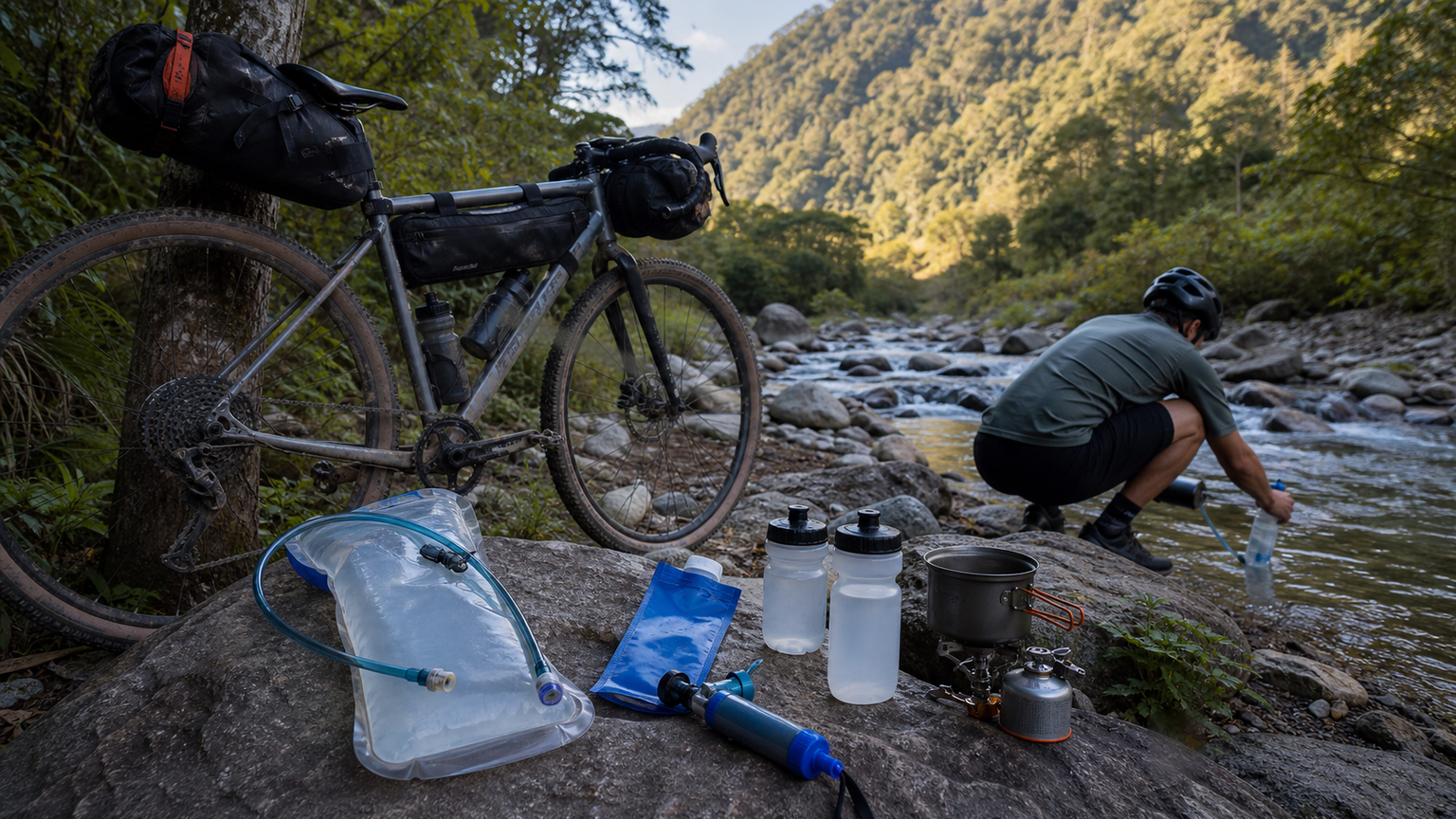
The Numerical Reality of Water
Bikepacking requires 4-6 liters of water per day (3-4L for riding + 1-2L for cooking), but 5L of water weighs 5 kg—equivalent to a full lightweight tent and sleeping bag combined. Water management is the most critical logistics issue in bikepacking.
Water Sources and Treatment Requirements
| Water Source | Treatment | Risk |
|---|---|---|
| Tap water / convenience store | Drink directly | Low |
| Public drinking fountains | Drink directly | Low |
| Mountain springs / waterfalls | Filter or boil | Medium |
| Streams | Filter + chemical treatment | Medium-high |
| Ponds / puddles | Filter + boil + chemical | High |
| Rainwater | Drink directly or filter | Low |
Choosing a Water Filter
Hollow Fiber Filters (Most Mainstream)
Removes 99.9999% of bacteria and 99.9% of protozoa, but cannot remove viruses (viruses are rare in Taiwan’s wild water sources).
- Sawyer Mini: 60g, NT$1000, handles 38,000L
- Sawyer Squeeze: 85g, NT$1500, faster flow rate
- Katadyn BeFree: 60g, NT$1500, fastest filtration speed
Chemical Treatment (Backup)
- Chlorine dioxide tablets: 1 tablet treats 1L of water, 30 minutes
- Iodine tablets: 1 tablet treats 1L of water, 30 minutes, not for pregnant women
- Weight: 10 tablets ≈ 5g
UV Pens (Not Recommended for Bikepacking)
Require clear water, drain batteries, and are fragile—unsuitable for off-road environments.
Boiling (Most Reliable but Fuel-Intensive)
Boiling at 100°C for 1 minute kills all pathogens, but requires 5-10 minutes of fuel burn time.
Recommended Combo: Sawyer Mini + chlorine dioxide tablets (backup) = 65g total weight, covers most scenarios.
Water Container Systems
Primary Water (For Riding)
Bottle Cages:
- 750ml standard bottles × 2
- 1.5L capacity, easily accessible while riding
Hydration Packs:
- 1.5-3L bladder + drinking tube
- Drink without stopping while riding
- Drawbacks: high center of gravity, stuffy heat
Recommendation: Bottle cages (for riding) + fork bag water bladder (for reserve)
Reserve Water (For Camping and Long Stretches)
Soft Bottles:
- Platypus 2L Softbottle: 32g
- Collapses flat when empty
- Hang from a tree for gravity filtration while camping
Dromedary Bags:
- MSR Dromedary 4L: 170g
- Durable, can double as a pillow
- Suitable for long stretches without resupply
The Camelbak (Backpack Bladder) Debate
The bikepacking community is split on Camelbaks:
Supporters say:
- Drink anytime while riding (no need to stop)
- Stable center of gravity (not on the bike)
- Large capacity (2-3L)
Opponents say:
- Weight on the back accumulates fatigue
- Stuffy and hot in summer
- Increases injury risk in a crash
Compromise: Use bottle cages for short rides (< 50 km), and a small 1.5L Camelbak (like the Camelbak Chase Vest 8L) for long rides.
Water Planning Formula
Calculate your daily water needs before departure:
Riding consumption: At 15-20 km/h, drink 500-800ml per hour
Cooking consumption: Breakfast 300ml + dinner 800ml = 1.1L
Emergency reserve: 500ml
Example: 6 hours of riding = 3-5L + 1.1L cooking + 0.5L reserve = 4.6-6.6L total requirement
Carry Amount Between Resupply Points
Carry amount based on distance between resupply points:
| Resupply Interval | Summer Carry | Winter Carry |
|---|---|---|
| <30 km | 1L | 0.7L |
| 30-60 km | 1.5-2L | 1L |
| 60-100 km | 3-4L | 2L |
| 100+ km | 5L+ | 3L+ |
Rule of thumb: Better to carry 0.5L extra than to run short.
Hydration Timing and Amounts
Avoid the mistake of “drinking only when thirsty”:
- 30 minutes before departure: 500ml pre-hydration
- Every 15-20 minutes while riding: 150-200ml
- At resupply points: top up at least 1L
- Within 1 hour after setting up camp: 1L
- Before bed: 300ml
Electrolyte Supplementation
Summer bikepacking requires electrolyte supplementation—hyponatremia is more dangerous than dehydration.
DIY sports drink mix:
- Glucose powder 50g
- Salt 1g (about 400mg sodium)
- A splash of lemon juice
- Add to 1L of water
Recommended commercial options:
- Tailwind Endurance Fuel (200 kcal + 310mg sodium/packet)
- Nuun (electrolyte tablets, sugar-free)
Emergency Scenarios
No Water Source Found
- Follow the stream downstream to a confluence (more stable flow)
- Knock on doors at homes or farmhouses for help (Taiwan’s mountain communities are hospitable)
- Collect rainwater (place bottle opening upward on the bike rack)
- Cut bamboo to collect water from bamboo nodes (in high-mountain bamboo forests)
Punctured Water Bladder
Backup options:
- Emergency repair with Tenacious Tape
- Use a spare plastic bag as a temporary water container
- Grab a PET bottle at the next resupply point (most reliable)
Assessing Spring Water Drinkability
Most mountain springs in Taiwan are drinkable, but filtering is still recommended:
- High confidence: High altitude (>2000m), visible source, fast flow, clear
- Medium confidence: Mid-elevation forest roads, moss growth present
- Low confidence: Low elevation near farmland, livestock activity, stagnant water
No matter how high the confidence, filtering never hurts—a filter adds only 60g but can save you from a trip-ruining bout of diarrhea.
Related Reading
- Hiking Water Bladders, Bottles, and Filters: Building a Complete Water System
- Trail Running Packs and Bladders: 6 Key Principles for Choosing the Right Gear
- Road Running Hydration Pack Buying Guide: Capacity Planning and Harness System Comparison for Ultra-Trail
- Running Pack Buying Guide: Capacity and Stability Assessment for Trail Running Hydration Packs
洗單車神器 吹水機! 實際洗車用用看 暴力洗鍊條大法 | 公路車 | CT Yeh
4 年前
單車 一日北高 ( 雙城 ) 肥宅雙人瘋狂行 紀錄片 REACTO
10 年前
半日 小台灣 極限單車路線挑戰實錄
7 年前
西拉雅五庫單車挑戰 / 曾文水庫 & 南168 二寮 / 500元報名費居然這麼超值/ 公路車 / CT Yeh
10 個月前
多到選擇障礙... 換個單車把帶想一個小時 / BTP / 編織&軟木特有材質超吸睛! / 公路車 / CT Yeh
1 年前
自助洗車場 洗單車 50元有找 清鍊條大法 居然還有小小兵
7 年前
單車 重低音 藍芽喇叭 音質實測 SoundBot SB525 Real Sound Test
8 年前
雨戰! 西進武嶺員工旅遊 加料 各路段大數據分析 | 同事端出5公斤的公路車來挑戰!? EP1
4 年前