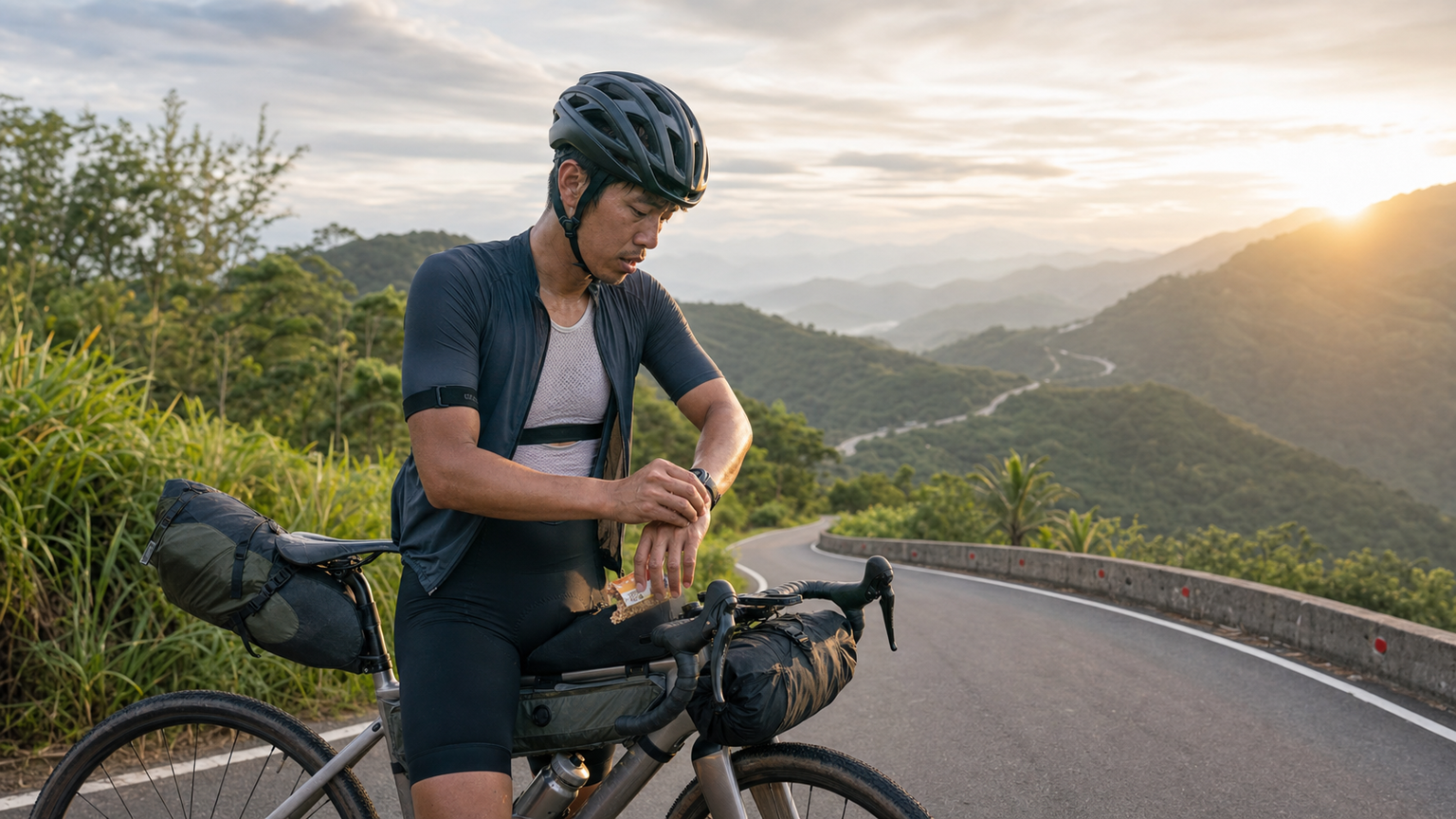
The Fatigue Curve of Multi-Day Riding
Bikepacking isn’t a single-day 100K—it’s 60-120K for 5-10 consecutive days. The fatigue accumulation curve is completely different:
- Day 1: Excitement dominates, energy at 100%
- Day 2: Muscle soreness begins, energy at 85%
- Day 3: The toughest day, full-body stiffness, mental fatigue, energy at 70%
- Days 4-5: Body adaptation period, energy at 75%
- Day 6 onward: Steady state, energy at 70%
Day three is the “muscle adaptation trough” of Bikepacking, where many beginners give up.
The Key to Pacing: Heart Rate Zones
Bikepacking isn’t a race; pacing should target “sustainability over multiple days.”
The Five Heart Rate Zones
| Zone | Heart Rate (% of Max) | Application | Duration |
|---|---|---|---|
| Z1 Recovery | 50-60% | Warm-up, gentle descents | Several hours |
| Z2 Aerobic | 60-70% | Bikepacking mainstay | 6-8 hours/day |
| Z3 Tempo | 70-80% | Short climbs | 1-2 hours |
| Z4 Threshold | 80-90% | Pushing hard | 20-40 minutes |
| Z5 Maximum | 90-100% | Emergencies | < 5 minutes |
The Golden Rule of Bikepacking: 80% of the time in Z2, 15% in Z3, 5% in Z4 or below.
Estimating Maximum Heart Rate
- Formula: 220 - age
- Example: 35 years old = 185 bpm
- Z2 = 111-130 bpm
The Key to Pacing: Energy Systems
The body’s energy sources shift with intensity:
| Intensity | Primary Fuel | Duration |
|---|---|---|
| Z1-Z2 | Fat (80%) + Carbohydrates (20%) | Tens of hours |
| Z3 | Fat 50% + Carbohydrates 50% | Several hours |
| Z4 | Carbohydrates (80%) + Fat 20% | 1 hour |
| Z5 | Carbohydrates + Phosphocreatine | A few minutes |
Bikepacking should rely heavily on fat metabolism (Z2 zone), which is why eating high-fat foods matters.
Managing the Daily Rhythm
Before Departure, 7:00
- Eat breakfast within 1 hour of waking
- 10 minutes of dynamic warm-up (squats, hip circles)
- Hydrate with 500ml
Warm-up Segment, 7:00-9:00
- Ride easy in Z1-Z2
- Don’t tackle big climbs
- Drink 200ml every 30 minutes
Golden Segment, 9:00-12:00
- Best energy of the day; schedule main climbs here
- Maintain Z2; short climbs can go into Z3
- Fuel with 200-300 kcal per hour
Lunch, 12:00-13:00
- Full 1-hour rest
- Consume 800-1200 kcal
- Take off shoes, elevate legs, stretch
Afternoon Segment, 13:00-16:00
- Energy enters the second half
- Maintain Z2; avoid Z3 and above
- Guard against heatstroke (summer) and hypothermia (winter)
Arrival and Camp Setup, 16:00-17:00
- Stopping early is wiser than pushing through
- Reserve time for setting up camp and cooking
Fatigue Monitoring Indicators
1. Morning Heart Rate & HRV
If you have a sports watch (Garmin, Whoop, Polar), observe HRV changes:
- Down 10-20%: Moderate fatigue, normal
- Down > 20%: Excessive fatigue, consider reducing load
- Down > 30%: Rest is mandatory
2. Rating of Perceived Exertion (RPE)
Rate 1-10 at the end of each day:
- 1-3: Easy
- 4-6: Moderate (Bikepacking target)
- 7-8: Tired but manageable
- 9-10: Exhausted (reduce load tomorrow)
3. Appetite and Sleep
- Decreased appetite: overtraining
- Difficulty falling asleep: elevated residual heart rate (daytime intensity too high)
- Waking up at night: stress or insufficient fueling
Multi-Day Recovery Strategies
Active Recovery
- 15 minutes of stretching after each day
- Focus: quadriceps, glutes, iliopsoas, shoulders and neck
- Foot soaking (if possible): promotes blood circulation
Protein Intake
- Within 1 hour after riding: 20-30g protein
- Carry protein powder (30g per packet)
- Add to oatmeal, coffee, or soup
Sleep
- Multi-day riding requires 8-9 hours of sleep
- Tent sleep quality is poor; go to bed 1 hour earlier than at home
- Earplugs and an eye mask can significantly improve quality
Sore Spots and How to Address Them
Buttocks and Perineum
- Cause: Saddle pressure
- Response: Lift off the saddle every 30 minutes, adjust saddle angle, apply petroleum jelly to prevent chafing
Wrists, Shoulders, and Neck
- Cause: Monotonous handlebar position
- Response: Alternate hand positions on drop bars, roll shoulders and neck, shake out hands every hour
Knees
- Cause: Gearing too heavy, incorrect saddle height
- Response: Shift to easier gears (cadence 80-90 rpm), check saddle height (leg should have a slight bend with heel on the pedal)
Achilles Tendon
- Cause: Incorrect foot position on the pedal
- Response: Align the ball of the foot with the pedal axle, stretch calves regularly
The Iron Rule of Fueling
Consume 200-400 kcal per hour, broken down as:
- Hour 1: Can be under 200 kcal (warm-up segment)
- Hours 2-5: Steady 300-400 kcal
- Hour 6 onward: Can drop to 200-300 (lunch is being digested)
Forbidden: Waiting until you’re hungry to eat → blood sugar crash, energy cliff-drops.
Managing Mental Fatigue
Beyond physical fatigue, mental fatigue is equally deadly:
Set Small Daily Goals
- Don’t just think about “the 100K finish line”
- Break it down into “the next 10K,” “the next resupply point,” “the next viewpoint”
Music and Podcasts
- Use a single earbud (stay aware of your surroundings)
- Listen to upbeat music on climbs
- Listen to calming music or turn it off on descents
Planning Rest Days
If planning a Bikepacking trip of 7+ days, make day 4 a full rest day:
- Don’t ride, or only ride 30K for sightseeing
- Eat more and sleep more
- Organize gear, wash clothes
- Mental reset
Conclusion: Bikepacking Is a Marathon, Not a Sprint
The winner of a multi-day ride isn’t the fastest at the start, but the one who can still hold the pace on day 7.
Pacing mantra: “Always feel like you could go a little faster”—hold onto that feeling, and you’ll finish the whole journey.
Related Reading
- Multi-Day Race Climbing Strategy: Managing Fatigue Across Three Consecutive Days of Climbing
- Managing Cumulative Fatigue on Consecutive Multi-Day Rides: Taiwan Round-the-Island or Stage Race Strategies
- Energy Allocation and Recovery Techniques for Multi-Day Races
- Energy Management for Rides Over 10 Hours: Fatigue Curve and Pacing Adjustment Strategies
一日北高/長距離團騎 常見問題補充篇 / 組團或跟團的眉角 / 壯車友容易被瘦車友慢性拉爆 / 原來屁股痛可能是這個原因...? / 風場配速法 / 公路車 / CT Yeh
2 年前
一日北高常見問題大集合 | 攻略 | 路線 | 訓練 | 補給 | 自行車 單車 | 一日雙城 | 雙塔 | TWB北高360 | 屁股痛
6 年前
單車 一日北高 ( 雙城 ) 肥宅雙人瘋狂行 紀錄片 REACTO
10 年前
一日北高 11小時 賽後心得分享篇 | TWB北高360 | 一日雙城 | 單車 | 公路車
6 年前
2019 夏季KOM 5小 完賽心得 準備攻略 東進武嶺 夏季登山王之路 Taiwan KOM Challenge
7 年前
西進武嶺 免費訓練分析服務 Intervals | 練不夠還是練過頭?你哪一種類型選手?AI模型告訴你! | 備戰神器 | 公路車 訓練 | CT Yeh
4 年前
一日北高前的高裝檢 | 北高 360 | 挑戰11小時的裝備 | 一日雙塔 | 補給
6 年前
靠單車減肥35公斤 心得分享與整理
7 年前