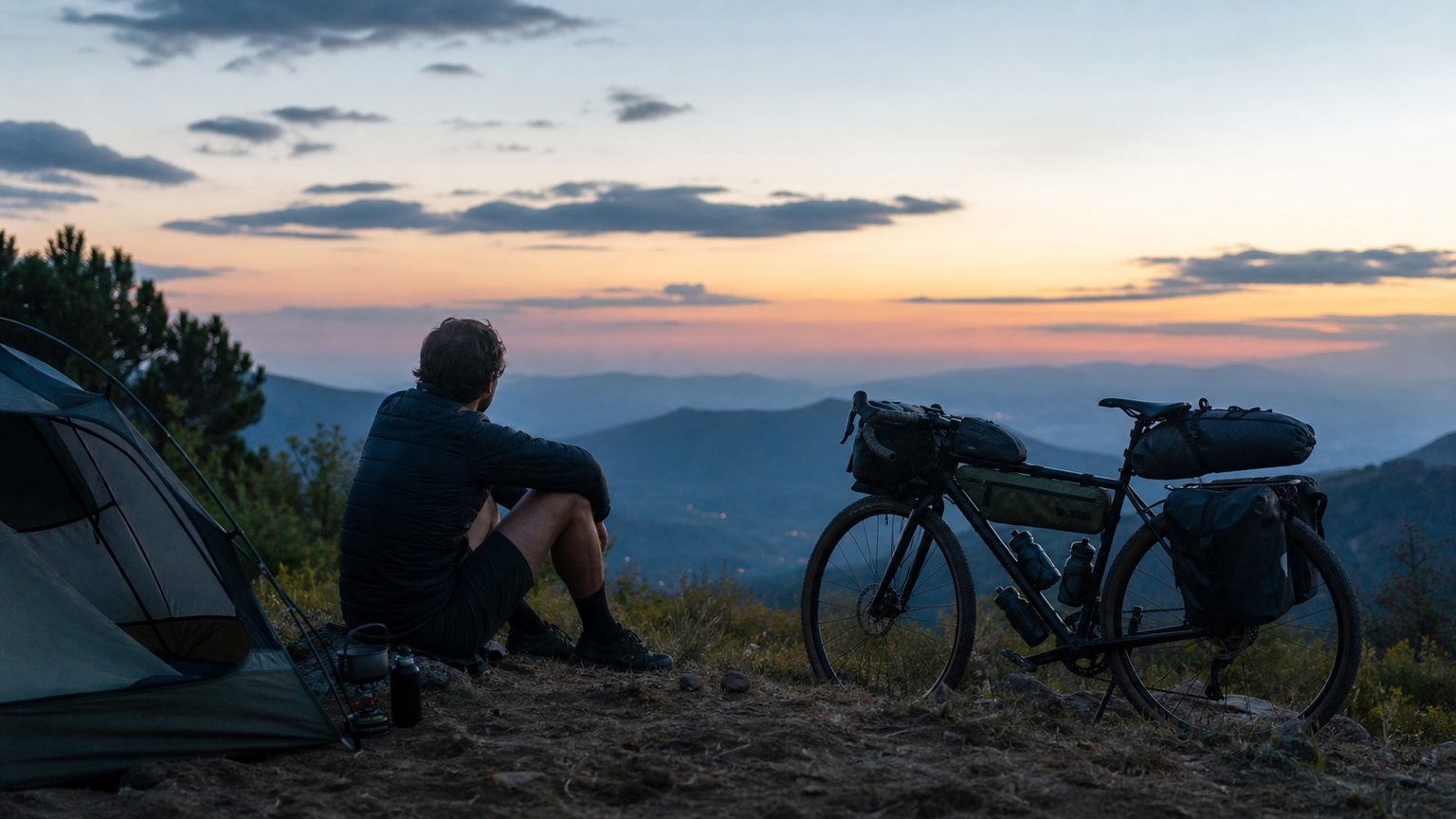
The Mental Challenge of Bikepacking
Many people assume Bikepacking is a test of physical endurance, but in reality, mental strength is what determines success or failure. Riding solo for 5-10 consecutive days brings these mental challenges:
- Loneliness when setting up camp at night
- The temptation to quit on day three
- Low mood from consecutive overcast and rainy days
- Anxiety from failed resupplies
- Self-doubt as physical performance declines
Your body can handle 200K, but your mind might break down at 100K.
Mental Preparation Before Departure
1. Expectation Management
Don’t romanticize Bikepacking. Most beginners set off with the romantic vision of “escaping daily life and connecting with nature,” but the reality is:
- 80% of the time is muscle soreness and sweat
- 15% is eating and sleeping at resupply points
- Only 5% is genuine “scenery and awe”
The right mindset: “I’m going to experience an uncomfortable but meaningful journey, and along the way there may be 5% of beautiful moments.”
2. Accept Uncertainty
Uncertainty is the essence of Bikepacking:
- Weather can change suddenly
- Resupply points may be closed
- Your body can get injured
- Gear can fail
Mental tool: List 10 “worst-case scenarios” and write down a response plan for each. Fear comes from the unknown, and planning can eliminate fear.
3. Set Adjustable Goals
Avoid rigid goals like “I must complete 800K.” Instead, use a three-tier goal system:
- Goal A (Best case): Complete 800K
- Goal B (Reasonable): Complete 600K + a week of rest
- Goal C (Fallback): Return home safely
Reaching Goal B is a success, and reaching Goal C is not a failure.
Five Mental Tools for the Journey
Tool 1: Chunking
The human brain cannot process abstract large numbers like “800K,” but it can easily handle “the next 10K.”
In practice:
- Don’t look at total mileage; only look at the next resupply point
- Break the entire journey into “daily segments”
- Break each day into “morning + lunch + afternoon + camp setup”
Psychological principle: Completing small goals releases dopamine, sustaining motivation.
Tool 2: Body Scan
When your mood drops, check your body from head to toe:
- Head: Any headache? (Dehydration)
- Neck and shoulders: Any stiffness? (Same position too long)
- Wrists: Any numbness? (Change hand positions)
- Core: Any fatigue? (Shorten the next segment)
- Thighs: Any soreness? (Shift to an easier gear)
- Knees: Any pain? (Check the saddle)
- Ankles: Any aching or numbness? (Check the cleats)
Addressing problems immediately is far better than pushing through until you break down.
Tool 3: Gratitude Practice
Before the end of each day, write down 3 small things from that day that you’re “grateful for.”
Examples:
- “The rain stopped for an hour this afternoon, letting me finish the last 20K comfortably”
- “The shop owner at the resupply point gave me a free cup of hot coffee”
- “The starry sky tonight was beautiful”
Psychological principle: Gratitude practice can reverse negative thought loops. Research shows that 21 consecutive days can improve mental resilience.
Tool 4: Why List
Before departure, write down 10 reasons “why you’re doing Bikepacking” and keep them in your wallet or phone notes.
Examples:
- “I want to prove to myself that I can complete a challenge”
- “I want to temporarily escape work stress”
- “I want to see the remote corners of Taiwan”
- “I want to test my limits”
When the urge to quit hits on day three, take it out and read it again.
Tool 5: External Connection
Loneliness is the most common mental challenge in Bikepacking. How to cope:
- Call family for 5-10 minutes each evening
- Post one photo on IG/FB daily (text optional)
- Join Bikepacking communities and let people follow your journey
- Exchange stories with other riders (resupply points are social hubs)
The Nature of Loneliness
Loneliness in solo Bikepacking comes in two layers:
Surface Loneliness (Easy to Handle)
- Missing family and friends
- Missing familiar food
- Missing a warm bed
Coping: Make calls, send messages, plan activities for after you return home
Deep Loneliness (Requires Reflection)
- “Why am I doing this?”
- “What meaning does this have?”
- “No one knows I’m here—do I matter?”
Coping: This isn’t a bad thing. The “forced solitude” that Bikepacking provides is a rare opportunity in modern life. Write these questions down and reflect on them slowly after you return home.
The Temptation to Quit (The Day-Three Phenomenon)
90% of Bikepacking abandonments happen on day three. Reasons:
- The body hasn’t adapted yet, and soreness peaks
- The psychological novelty has worn off
- The “pull back home” is strongest
- You’ve already completed 1/3 and feel like “that’s enough”
Coping strategies:
The 24-Hour Rule
If you want to quit, hold on for 24 hours before deciding. In most cases, day four brings noticeable improvement.
Distinguish “Real Quitting” from “False Quitting”
- Real quitting: Injury, hypothermia, severe weather
- False quitting: Fatigue, homesickness, boredom
False quitting should not end the journey; real quitting requires immediate withdrawal.
Modify Instead of Cancel
If you can’t complete the full route, consider:
- Shortening the route (Goal B)
- Skipping a section (take a train to the next stop)
- Switching to a stationary 2-3 day stay and exploring
Any option is better than “just going home.”
Anxiety Over Failed Resupplies
Convenience stores in Taiwanese towns may close unexpectedly. When a resupply fails:
- Take a deep breath: Don’t let panic drive your decisions
- Inventory existing resources: Remaining food, water, distance to the next resupply
- Calculate the worst-case scenario: If you get no supplies before the next resupply point, how long can you last?
- Take action: Shorten the day’s mileage, ask locals for help, modify the route
Mental tool: “I’m not the first person to face this situation, and I have the resources to handle it.”
Post-Completion Highs and Lows
The Moment of Completion (Psychological High)
- A huge sense of accomplishment
- Deep gratitude
- Confidence in the future
The Low 1-2 Weeks Later
Many Bikepacking finishers experience “post-return depression”:
- Daily life feels dull
- Can’t find the next goal
- Loss of passion for work
Coping:
- Accept that this is a normal reaction
- Plan the next small goal (it doesn’t have to be another Bikepacking trip right away)
- Write down your experience and share it with others
Conclusion: The Mind Is the Real Journey
After Bikepacking, most people discover:
Physical soreness fades within 2 weeks, but the mental transformation lasts for years.
You’ll return to daily life carrying the belief that “I can do hard things”—which is more precious than any photo or souvenir.
The ultimate mental tool: “No matter what happens, this journey will shape me.”
Related Reading
- The Mental Challenge of Long-Distance Riding: Psychological Preparation Strategies for a 200km One-Day Ride
- Mental Strategies for Long-Distance Riding: Systematic Development of Milestone Setting and a Sense of Completion
- The Mental Hurdles of Long-Distance Riding: Coping Strategies for the 100km Wall
- The Loneliness of Running Training: Mental Maintenance Techniques for Solo Long Runs
單車 一日北高 ( 雙城 ) 肥宅雙人瘋狂行 紀錄片 REACTO
10 年前
一日北高前的高裝檢 | 北高 360 | 挑戰11小時的裝備 | 一日雙塔 | 補給
6 年前
一日北高常見問題大集合 | 攻略 | 路線 | 訓練 | 補給 | 自行車 單車 | 一日雙城 | 雙塔 | TWB北高360 | 屁股痛
6 年前
靠單車減肥35公斤 心得分享與整理
7 年前
一日北高/長距離團騎 常見問題補充篇 / 組團或跟團的眉角 / 壯車友容易被瘦車友慢性拉爆 / 原來屁股痛可能是這個原因...? / 風場配速法 / 公路車 / CT Yeh
2 年前
#公路車 #Fitting 靠人工智慧APP 幫你調整單車
6 年前
單車賞雪 裝備準備及注意事項分享 | 公路車
5 年前
2019 夏季KOM 5小 完賽心得 準備攻略 東進武嶺 夏季登山王之路 Taiwan KOM Challenge
7 年前