Triathlon Race Belt Selection Guide: Integrated Configuration for Bib Numbers, Gel Carrying, and Hydration
Why Do You Need a Dedicated Race Belt?
Triathlon race rules require the bib number to be clearly visible during the run leg, but it is typically not worn during the swim and bike legs (bikes use frame number stickers). Traditional safety pins leave large holes in your Trisuit, and re-pinning during T2 transition wastes precious time. A Race Belt solves two problems: it clips on in one second during T1/T2 transitions, and you can rotate the bib number from your back to your front during the run as needed.
Three Key Buying Considerations
1. Elastic Band Width and Material
| Width | Best For | Drawbacks |
|---|---|---|
| 20mm (narrow) | Sprint, Olympic distances | Small carrying capacity, prone to twisting |
| 25mm (standard) | 70.3 Half Ironman | Balanced choice |
| 32-38mm (wide) | IRONMAN Full Distance | Heavier, more noticeable on the body |
A wider band generally means more gel loops and elastic capacity, but also more friction against your body while running. For the elastic band, we recommend TPU + Nylon blend, which resists sweat and salt corrosion better than pure rubber, with a lifespan of 2-3 years.
2. Gel Carrying Structure
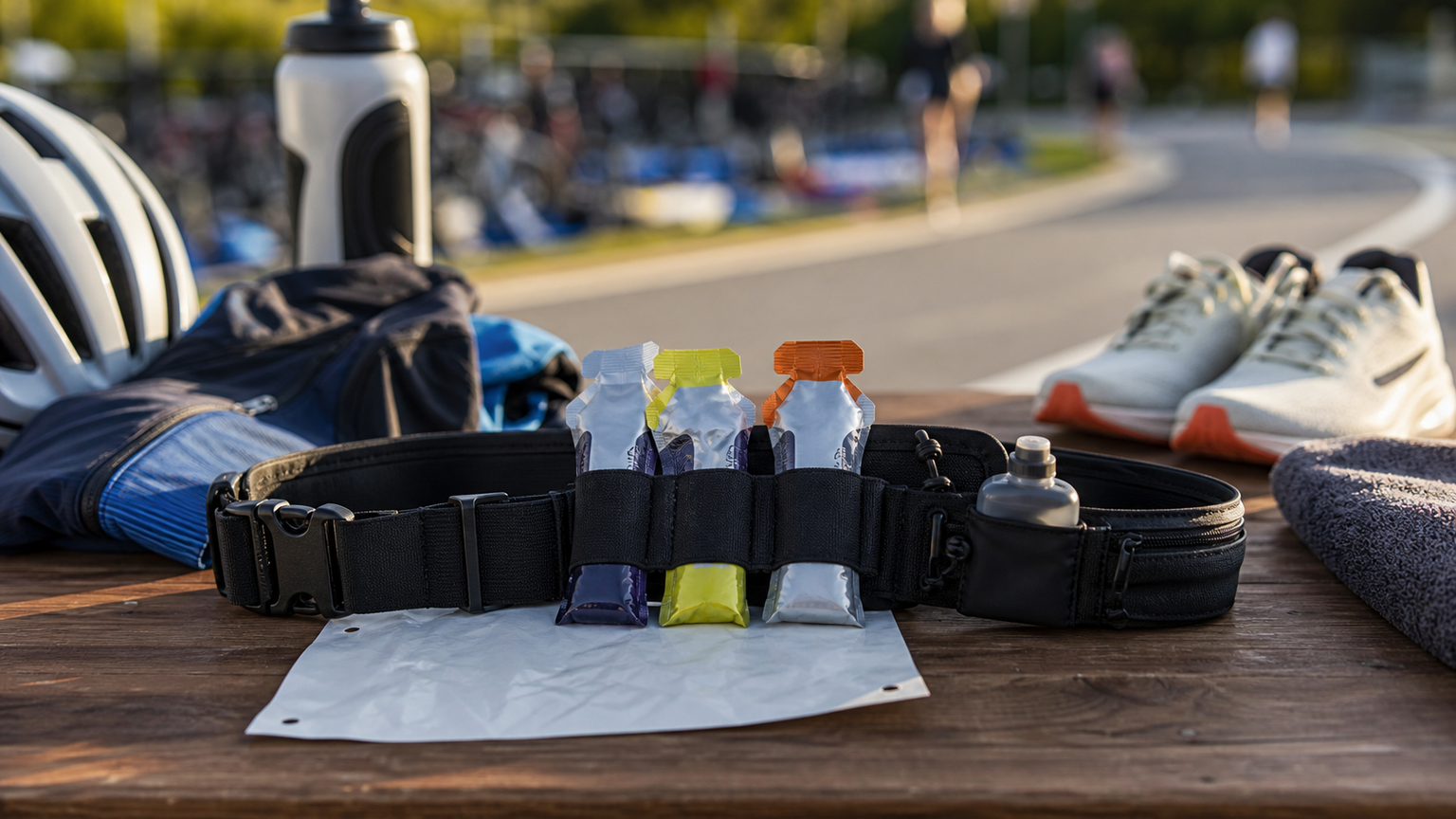
- Elastic loop type: 5-8 rubber loops hold gels in place; tear open the top of the gel and consume directly—fastest option
- Pocket type: A small stitched pocket for salt tablets, cash, or timing chip, but gels are harder to access quickly
- Magnetic clip type: Premium option; gels are secured with magnetic clips, no bouncing while running, but pricier
A 70.3 distance typically requires 4-6 gels, while IRONMAN Full Distance calls for 6-8 (with the rest covered by aid stations).
3. Number Toggle
Three common types: plastic clip is cheapest but breaks easily, silicone snap button feels best, and metal hook is most durable but can rust. We recommend practicing clipping it three times at home before race day to ensure you can do it one-handed within 5 seconds.
Advanced Setup Tips
- Pre-cut gel method: Before the race, use scissors to make a 5mm slit at the top of each gel (without cutting all the way through). During the run, tear it open with your teeth in one motion, saving 3-5 seconds
- Ice pack pouch: Attach a small cold pack (with ice) to the back of the race belt to slow gel melting and leaking during hot-weather races
- Separate salt tablets: Keep salt tablets in a separate small pouch (not with the gels) to prevent gel leakage from melting and clumping the tablets
Price Ranges and Brand Positioning (Anonymous Examples)
| Tier | Price | Features |
|---|---|---|
| Entry | NT$ 350-600 | Basic elastic band + 4 gel loops |
| Mid-range | NT$ 800-1,400 | 8 gel loops, sweat-resistant TPU, adjustable buckle |
| Premium | NT$ 1,800-3,000 | Modular gel pouches, magnetic clips, race-grade shock padding |
Pre-Race Testing Checklist
- [ ] Run 10K to confirm it stays in place and doesn’t chafe your waist
- [ ] Test balance with fully loaded gels (doesn’t tilt to one side)
- [ ] Simulate the T2 flow in transition area; confirm one-handed clipping time < 8 seconds
- [ ] Confirm gel loops don’t drop gels when jumping
The Race Belt is one of the few triathlon gear items that “saves big time for little money,” yet many athletes just grab any cheap one without thought. Choosing the right spec for your race strategy can save 30-60 seconds of fueling time across the entire event.
Related Reading
- The Complete Triathlon Fuel Belt Setup Guide: From Energy Gel Configuration to Race-Day Strategy
- Race Number Belt and Bib Clip Buying Guide: The Most Overlooked Gear in Transition
- Three Key Features of Triathlon Running Shoes: Elastic Laces, Sockless Wear, and Drainage Hole Design Details
- Road Running Fuel Belt Design and Capacity: How to Choose the Right Race Gear
3D 列印車褲墊 / 舒適改善? / 無痕 x 分區壓縮 / ATK & Decider系列 / JE22黑科技 / #公路車 #CTYEH
11 個月前
多到選擇障礙... 換個單車把帶想一個小時 / BTP / 編織&軟木特有材質超吸睛! / 公路車 / CT Yeh
1 年前
一日北高前的高裝檢 | 北高 360 | 挑戰11小時的裝備 | 一日雙塔 | 補給
6 年前
#公路車 #Fitting 靠人工智慧APP 幫你調整單車
6 年前
來都來了!改好改滿 / CS大導輪 + BB 可以省幾瓦? / 同場加映 TIME XPRO卡踏 / #公路車 #ceramicspeed / CT Yeh
1 年前
大家都在開箱的...單車用藍芽對講耳機真的有幫助嗎? SENA BiKom 20 長距離旅遊 & 海鷗繞圈賽 實際體驗心得 / 公路車 / CT Yeh
9 個月前
西進武嶺 免費訓練分析服務 Intervals | 練不夠還是練過頭?你哪一種類型選手?AI模型告訴你! | 備戰神器 | 公路車 訓練 | CT Yeh
4 年前
Lun HYPER 第三代 D45碳幅條輪組 功率對比實測 / 鈦合金行星齒輪,中高階的製造水準 / 公路車 / CT Yeh
1 年前