How the Two Heart Rate Sensors Work
Optical Heart Rate (PPG, Photoplethysmography)
The LEDs on the back of the watch emit green light (some models add red light and infrared) to detect changes in light absorption by hemoglobin in the blood vessels, calculating the heart rate.
Advantages: No chest strap needed, unobtrusive, can monitor all day
Disadvantages: Relies on skin contact quality, movement during exercise creates false signals, tattoos and darker skin tones reduce accuracy
Chest Strap Heart Rate (ECG, Electrocardiogram)
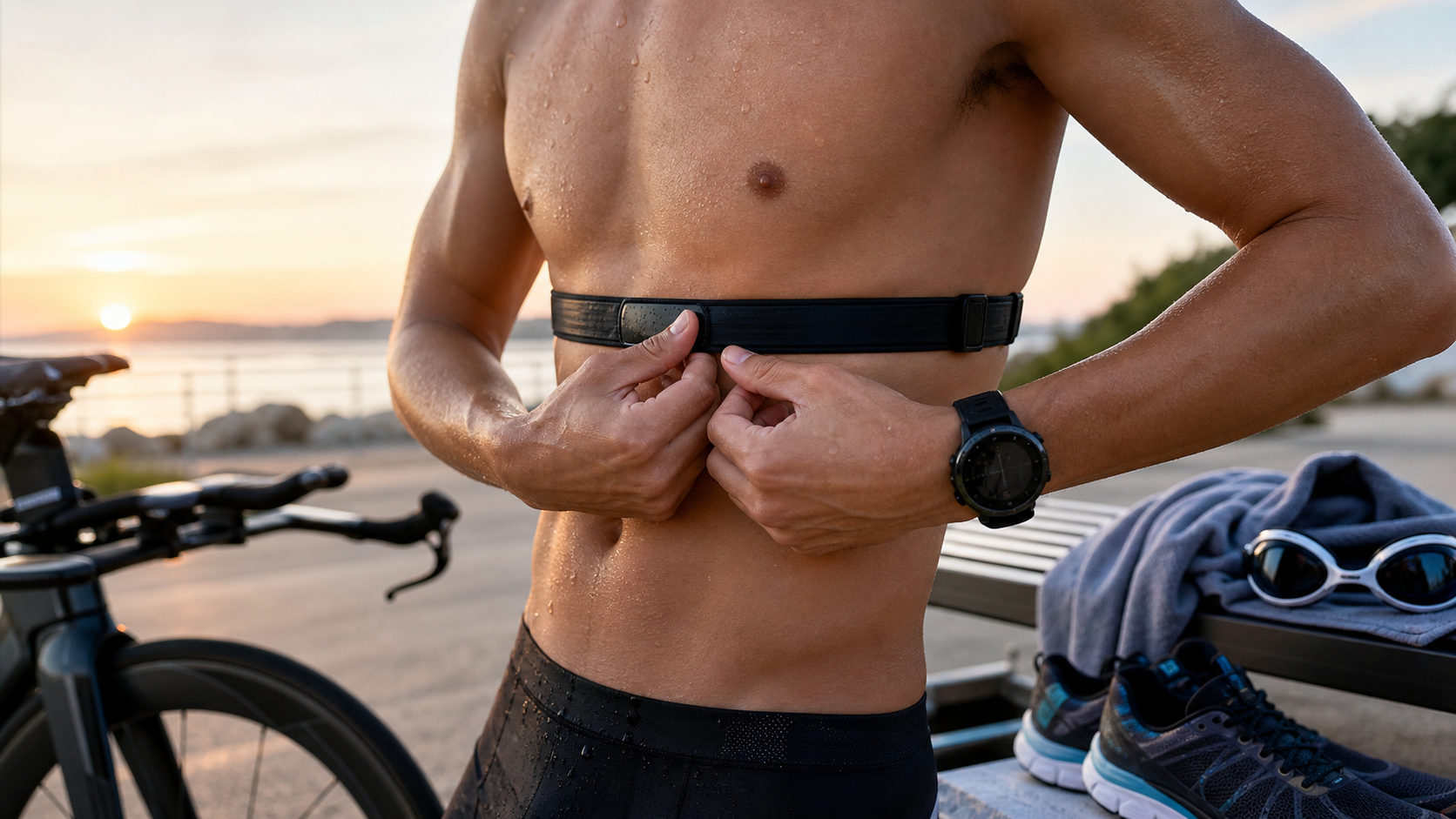
Two electrodes on the chest strap detect the electrical signals emitted by the heart, directly reading the ECG signal to calculate HR and HRV.
Advantages: Medical-grade accuracy, zero latency, RR Interval analysis possible
Disadvantages: Must be worn, requires sweat or gel for conductivity, skin friction can cause discomfort
Signal Challenges in Triathlon
| Discipline | Main Optical Heart Rate Issues | Main Chest Strap Issues |
|---|---|---|
| Swimming | Water flow interferes with the optical signal (almost unusable) | In-water signals require short-range Bluetooth transmission (some models can’t do this) |
| Cycling | Wrist angle changes cause the watch to loosen | Signal stabilizes after sweating (no problem) |
| Running | Stride frequency resonance causes “cadence false heart rate” | Chest movement may cause poor contact |
The “Cadence False Heart Rate” Phenomenon
Running cadence is typically 160-180 SPM, which is close to the exercise heart rate of 140-180 BPM. Optical sensors can sometimes mistake cadence for heart rate readings, causing the heart rate graph to show an abnormally flat horizontal line.
How to tell: During the early stages of a run, heart rate should gradually rise (120 → 150). If it starts at 165 and stays at 165 the entire time, it is almost certainly a false signal.
The Selection Logic for Triathletes
Scenario 1: Daily Training + All-Day Health Monitoring
Recommendation: Optical heart rate as the primary. For low-intensity activities like daily walking, indoor cycling, and treadmill running, optical errors have minimal impact, and convenience is what matters most.
Scenario 2: Threshold Training, Interval Training
Recommendation: Chest strap as the primary. For threshold zone training (heart rate 165-175), an error of 5 BPM can shift you out of the zone, so a highly accurate chest strap is essential.
Scenario 3: Open Water Swimming
Recommendation: Chest strap or upper arm strap. Optical heart rate is almost completely ineffective in water. Newer “upper arm optical straps” (such as OH1, Coros HR Monitor) worn on the biceps offer accuracy close to a chest strap with comfortable wear.
Scenario 4: IRONMAN Races
Recommendation: Chest strap + watch optical as backup. Races last 10+ hours, and the chest strap may chafe the skin or shift out of place. Dual sensors allow automatic switching when the primary signal fails.
Advanced: HRV (Heart Rate Variability) Needs
If you want to do:
- Training load quantification (TSB, CTL, ATL)
- Recovery status assessment (daily HRV)
- Overtraining monitoring
You must use a chest strap. Optical heart rate cannot accurately read the RR Interval (millisecond-level differences between heartbeats), making HRV data completely unreliable.
Buying Guide (Anonymous Examples)
Chest Strap Tiers
| Tier | Price Range | Features |
|---|---|---|
| Entry | NT$ 1,500-2,500 | Basic HR, Bluetooth transmission |
| Mid-Range | NT$ 3,000-4,500 | HR + HRV + running dynamics (stride length, vertical oscillation) |
| High-End | NT$ 5,000-7,000 | Medical-grade + built-in memory (offline recording for swimming) + multi-connection |
Upper Arm Straps
| Tier | Price Range | Features |
|---|---|---|
| Entry | NT$ 2,500-3,500 | Dual-band Bluetooth + ANT+, swim-capable |
| High-End | NT$ 4,500-6,000 | Multiple LEDs + temperature sensing + extended battery life |
Wearing Tips
Chest Strap
- Wear it 2cm below the nipple line, not too tight (standard: two fingers should fit underneath)
- Wet the contact points with water or gel (sweat will do this automatically)
- Men can apply a small piece of tape to protect the nipples from friction injuries
- Wash it once a week before race season (to avoid bacteria increasing the risk of skin irritation)
Watch Optical
- Wear it 2-3cm above the wrist bone protrusion (not directly on the bone)
- Tightness: the strap should be just tight enough not to slide, but not tight enough to leave red marks
- In cold weather, blood vessels constrict, so you may need to tighten it slightly more
- Over time, sweat residue builds up on the strap, so wash it once a week
Conclusion
There is no “best” heart rate sensor, only “the right tool for the right scenario”. Use optical for daily monitoring, a chest strap for key training sessions, and an upper arm strap for open water—this is the standard setup for triathletes. Mistaking optical heart rate for a chest strap could mean building your entire training plan on incorrect data.
Related Reading
- Running Heart Rate Strap vs. Optical Heart Rate: Comparison of Measurement Accuracy and Wearing Comfort
- Running Heart Rate Strap vs. Optical Heart Rate: Choosing Between Accuracy and Use Case
- Heart Rate Strap vs. Optical Wrist Heart Rate Monitor: Which Is More Accurate for Running Training?
- Road Running Heart Rate Strap vs. Optical Heart Rate Watch: Accuracy Differences and Best Use Case Analysis
西進武嶺 免費訓練分析服務 Intervals | 練不夠還是練過頭?你哪一種類型選手?AI模型告訴你! | 備戰神器 | 公路車 訓練 | CT Yeh
4 年前
Apple Watch 3 值得 買嗎!? 實測 單車車錶 遙控相機 Zwift 心律連線 Apple Pay 全聯買菜 GoPro 遙控
8 年前
#公路車 #Vo2Max #最大攝氧量 測驗 體驗 | 心肺測試
6 年前
全台首發神車錶! iGPSPORT iGS630 兩趟一日北高的續航! 超強導航、功率訓練、超人性APP! Garmin & Bryton 有對手了嗎? | 公路車 |CT Yeh
3 年前
2026 車錶排行榜!誰是最多車友正在使用?練家子最愛哪款?🏆 (2萬名車友數據) / 公路車 / CT Yeh
5 個月前
首發 Garmin Edge 850 車錶 深入開箱!? / 公路車 / CT Yeh
10 個月前
Garmin Edge 1050 旗艦車錶 全台首測!/ 環法冠軍指定 / 對比Edge 1040改進哪些? / 公路車 / CT Yeh
2 年前
[教學] Premiere 影片 手震 修正 教學 防抖 單眼 影像 GoPro 穩定 Video Stabilization
8 年前