Triathlon Cycling Shoes' Quick On/Off Design: The Trade-off Between a Single Velcro Strap vs. the Boa System
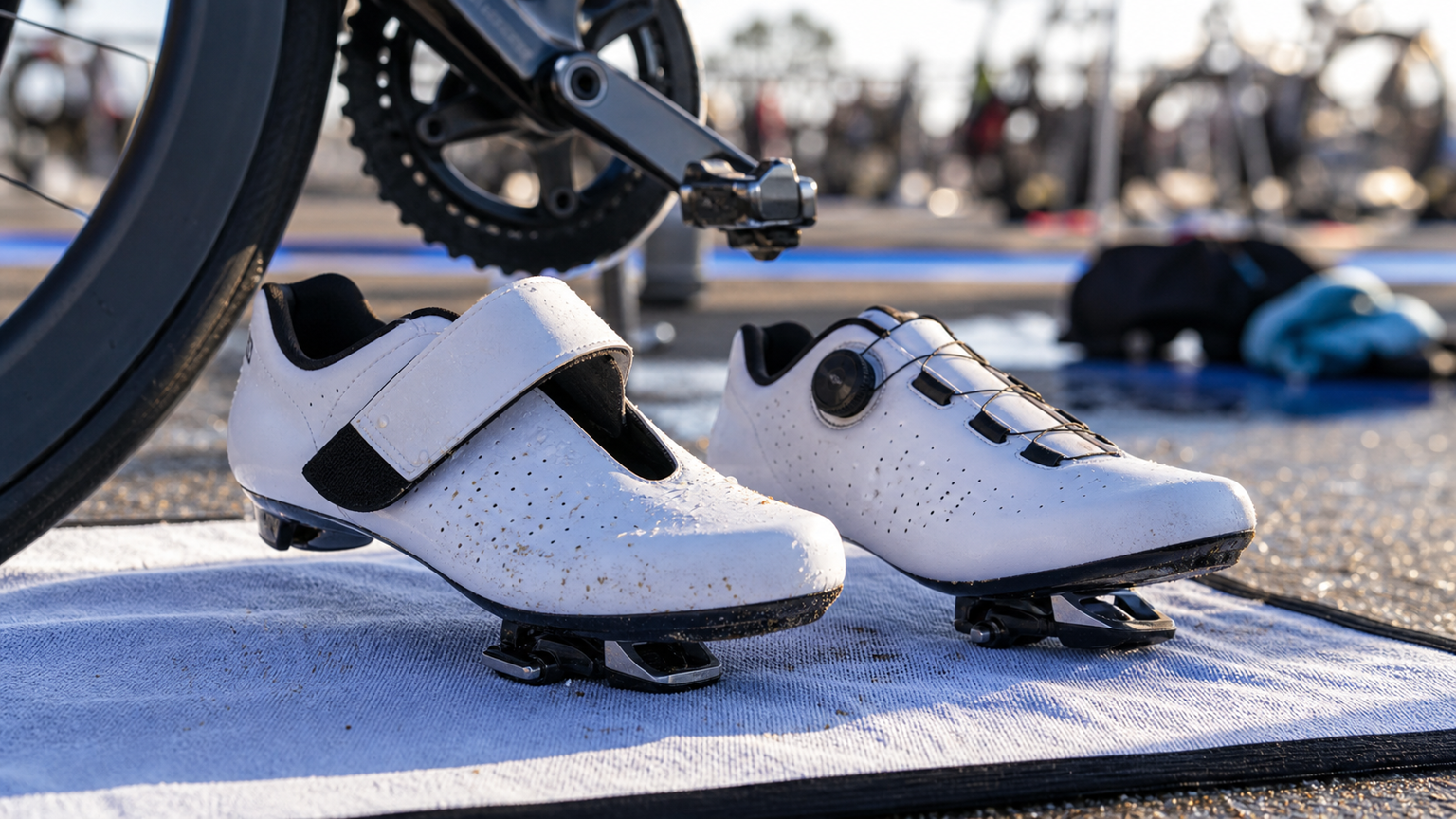
Core Requirements of Triathlon Cycling Shoes
Compared to road cycling shoes, triathlon cycling shoes have three unique requirements:
- Quick On/Off: T1 transition time is measured in seconds; the closure system must be minimal
- Worn Barefoot: Usually worn without socks (to save T1 time); the interior needs drainage and abrasion resistance
- Large Opening: Running into the transition area with wet feet, soles wet and sandy, must be easy to enter
These three requirements push triathlon cycling shoe design onto a completely different path from road cycling shoes.
Closure System Showdown
1. Single Velcro Strap
The most classic triathlon cycling shoe design. A single wide Velcro strap across the top of the shoe.
Advantages:
- Unfastening at T2 takes only 1 second
- No complex mechanisms, extremely low failure rate
- Lightest weight (< 250g/pair)
Disadvantages:
- Lower fit precision (Velcro position is fixed)
- May shift out of place during sprints
- Prone to wear and loosening over long rides
2. Double Velcro Straps
Some mid-range models use two Velcro straps, front and rear, securing the midfoot and ankle respectively.
Advantages:
- Better fit than a single strap
- Still can be put on and taken off within 3 seconds
Disadvantages:
- Two straps to fasten at T1, slightly slower
- Feels slightly heavier
3. Boa Dial System
One or two Boa dials paired with steel wire; rotation allows fine-tuned tension adjustment.
Advantages:
- Best fit
- Adjustable during the ride (tighten or loosen)
- High-end models offer zone-specific adjustment
Disadvantages:
- Unfastening at T2 requires many turns (unless equipped with a quick-release button)
- Heavier weight
- A broken wire renders the shoe completely useless
- 50-100% higher price
4. Hybrid System (Boa + Velcro)
A compromise on high-end triathlon cycling shoes: a Boa dial at the ankle for precise fit, and Velcro at the front for quick adjustment.
Triathlon T1 Workflow
The “Pre-Mounted Shoe” Method
Advanced triathletes attach their cycling shoes to the pedals before the race, then run out of T1 barefoot, and slip their feet into the shoes after mounting the bike.
Key steps:
- Before the race, secure the shoes horizontally on the pedals with rubber bands (to prevent the toe from dragging on the ground when the pedals rotate)
- After mounting the bike, pedal 3-5 revolutions with feet on top of the shoes to build up speed
- Slip each foot into its shoe one at a time
- After accelerating to cruising speed, fasten the Velcro straps
This technique only works with single Velcro strap shoes. It is nearly impossible to execute with the Boa system.
The “Pre-Prepared Shoe” Method
A simpler approach: in the transition area, open the cycling shoes, sprinkle talcum powder inside, and fully open the closures. Slip the foot in, push it all the way, and fasten. The talcum powder absorbs residual moisture and helps prevent blisters.
Last Width
Triathlon cycling shoes typically feature a “European-style wider” design, because:
- Worn barefoot, the foot is slightly wider than when wearing socks
- Later in the ride, feet swell due to heat expansion
- Accommodates a wider range of foot shapes
Brand width differences across manufacturers (anonymized description):
| Brand Type | Width Tendency | Suitable Foot Shape |
|---|---|---|
| Italian A | Narrower | Long, slim European feet |
| American B | Standard | Most people |
| American C | Wider | Asian flat feet |
| Japanese D | Specialized wide last | Wide feet |
Drainage and Ventilation Design
Triathlon-specific cycling shoes typically feature:
- Sole drainage holes (2-4 small holes to let water from the swim exit drain out)
- Mesh upper (large mesh panels at the front for heat dissipation)
- Hydrophobic lining (prevents bacteria growth from prolonged moisture)
Sole Material and Stiffness
The stiffness index of triathlon cycling shoe soles is typically:
| Level | Stiffness Index | Sole Material |
|---|---|---|
| Entry | 6-8 / 14 | Fiberglass-reinforced nylon |
| Mid-range | 9-11 / 14 | Partial carbon fiber |
| High-end | 12-14 / 14 | Full carbon fiber |
Triathletes do not necessarily need maximum stiffness (an IRONMAN ride lasts 5-6 hours; overly stiff soles can compress the feet). Mid-range stiffness + high-level fit is usually the best combination.
Pedal Compatibility
Most triathlon cycling shoes use a 3-bolt (Look / SPD-SL) cleat pattern, with a few offering 2-bolt (SPD MTB) options. Recommendations:
- Pure triathlon + TT bike: 3-bolt Look system, larger pedal platform
- Multi-purpose (shared between road bike and triathlon bike): depends on your existing pedals
- Heavy trainer use: consider 2-bolt (easier to walk in)
Price Ranges (Anonymized Examples)
| Level | Price | Features |
|---|---|---|
| Entry | NT$ 3,500-5,500 | Single Velcro strap, fiberglass sole |
| Mid-range | NT$ 6,500-9,500 | Double Velcro straps, partial carbon fiber |
| High-end | NT$ 11,000-16,000 | Boa + Velcro hybrid, full carbon sole |
| Top-tier | NT$ 18,000-25,000 | Custom heat-moldable, premium carbon sole |
Conclusion
For your first pair of triathlon cycling shoes, we recommend a mid-range single Velcro strap model:
- The best tool for practicing the pre-mounted shoe technique
- Lowest failure rate
- No regrets converting it to trainer use after the season ends
Once you start counting every second of T1 and your riding position is stable enough for aero testing, then consider upgrading to a hybrid system. For 95% of amateur triathletes, a single Velcro strap is the best solution.
Related Reading
- Triathlon-Specific Cycling Shoe Buying Guide: The Speed Secret of Single-Strap Design
- Three Key Features of Triathlon Running Shoes: Elastic Laces, Sockless Wear, and Drainage Hole Design Details
- Trisuit Selection Guide: The Trade-off Between Aero Performance and Comfort
- Complete Cycling Shoe Buying Guide: Sole Stiffness, Boa System, and Wide Last Selection
多到選擇障礙... 換個單車把帶想一個小時 / BTP / 編織&軟木特有材質超吸睛! / 公路車 / CT Yeh
1 年前
Nepest NOVA 碳條輪組:輕量、空力、舒適一次滿足!/ 公路車 / CT Yeh
7 個月前
3D 列印車褲墊 / 舒適改善? / 無痕 x 分區壓縮 / ATK & Decider系列 / JE22黑科技 / #公路車 #CTYEH
11 個月前
碟煞公路車 銑面器 !? 原來銑完差這麼多! 降低蹭碟機率! | TIME 公路車 保養小記錄 | CT Yeh
3 年前
單車 一日北高 ( 雙城 ) 肥宅雙人瘋狂行 紀錄片 REACTO
10 年前
Unaas X50 全碳纖幅條輪 數據實測對比PK | Lun Hyper 的高階版 | 板輪爬坡也可以很厲害? ! 武嶺2小時大師一起親測! CP值超高 | 公路車 | CT Yeh
4 年前
#公路車 #Fitting 靠人工智慧APP 幫你調整單車
6 年前
再一組! 全碳幅條 碟煞/無內胎輪組 開箱! 到底好騎嗎? UNAAS X40 | 公路車 | CT Yeh
4 年前